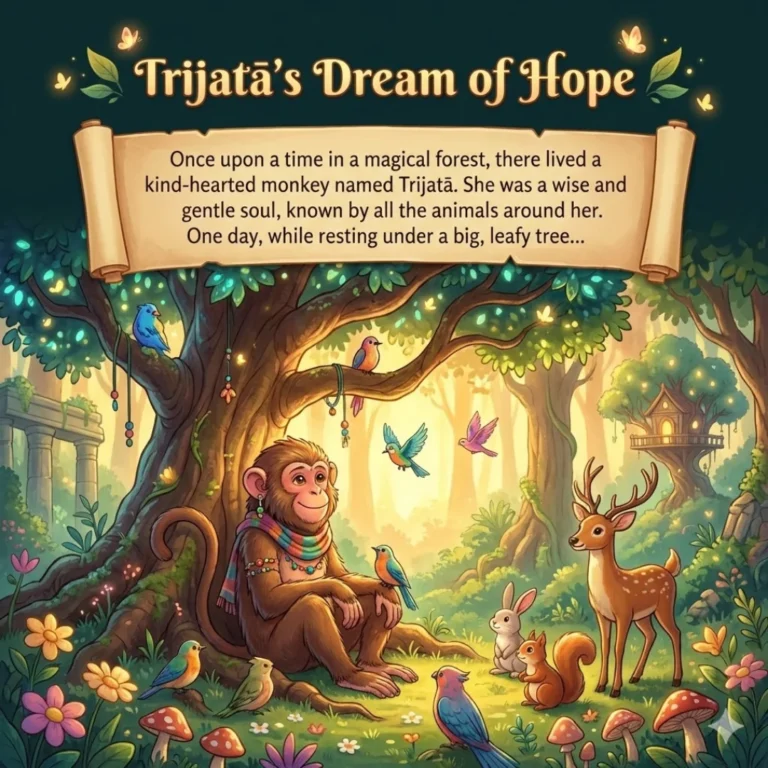
Share this engaging bedtime story with kids ages 6-12 to teach valuable life lessons.
THE ASHOKA GROVE PRISON
In the magnificent island kingdom of Lanka, far across the southern ocean, stood a beautiful garden known as Ashoka Vatika—the Grove of Ashoka trees. Under normal circumstances, this garden would have been a place of peace and serenity, with its fragrant flowers, singing birds, and ancient trees providing shade. But during the time of our story, this beautiful grove had become a prison for one of the most virtuous women who ever lived.
Sita, the beloved wife of Prince Rama and daughter of King Janaka, sat beneath one of the Ashoka trees, her heart heavy with sorrow and her eyes red from weeping. She had been cruelly abducted by Ravana, the ten-headed demon king of Lanka, who desired to make her his queen. Despite being surrounded by luxury in Ravana’s golden city, Sita felt only emptiness and loneliness.
Ravana had assigned a group of fearsome rakshasis—female demons of terrible appearance—to guard Sita day and night. Their orders were clear: convince Sita to forget Rama and accept Ravana as her husband, using any means necessary. Most of these rakshasis were cruel and enjoyed tormenting the captive princess. They threatened her, mocked her devotion to Rama, and tried to break her spirit with harsh words and terrifying displays of their demonic powers.
“Your husband has forgotten you!” they would hiss at her. “He cannot even cross the ocean to reach Lanka! Our lord Ravana is the conqueror of the three worlds! Accept him and live as a queen, or perish in misery!”
But Sita, whose very name meant “furrow”—for she had been born from the earth itself—remained as steadfast as the earth. She held tight to the memory of Rama, her faith unshakeable despite being surrounded by enemies and separated from everything she loved.
“I will never betray my husband,” she would respond quietly but firmly. “Rama embodies dharma itself. He will come for me, and righteousness will prevail over evil. Of this, I have no doubt.”
THE COMPASSIONATE GUARDIAN
Among all the rakshasis assigned to guard Sita, one was different. Her name was Trijata, which meant “three matted locks,” and she was much older than the others—aged and experienced in the ways of the world. Unlike her cruel companions, Trijata looked upon Sita not with hatred or cruelty, but with a grandmother’s compassion and wisdom.
Trijata was the daughter of Vibhishana, Ravana’s younger brother who secretly harbored doubts about his brother’s actions. Perhaps she had inherited his sense of righteousness. Perhaps living long enough to see many rises and falls of kingdoms had taught her wisdom. Or perhaps there was simply something in Sita’s pure character and gentle nature that awakened the dormant goodness in Trijata’s heart.
Whatever the reason, Trijata found herself drawn to protect this captive princess rather than torment her. When the other rakshasis became too cruel in their taunts, Trijata would intervene. When they threatened violence, she would step between them and Sita. When Sita wept in despair, Trijata would offer what comfort she could.
“Peace, sisters,” Trijata would say to the other rakshasis. “This is no ordinary woman. Can you not sense the divine light that surrounds her? There is something greater at work here than we understand. Be careful not to bring doom upon ourselves through cruelty to one who may be under the protection of the gods.”
The other rakshasis would laugh at her warnings, but something in Trijata’s ancient eyes made even the fiercest among them pause before going too far.
THE NIGHT OF VISIONS
One night, as Sita sat sleepless beneath her Ashoka tree, tortured by worry and separation from her beloved Rama, the rakshasis guarding her fell into deep sleep. Even in the demon world, exhaustion eventually claims its due.
Trijata, too, closed her ancient eyes and drifted into slumber. But this was no ordinary sleep. As she slept, a vision came to her—powerful, vivid, and undeniably prophetic. It was a dream sent by the gods themselves, revealing truths that would soon unfold in the waking world.
In her dream, Trijata witnessed scenes of extraordinary significance:
She saw Rama, the prince of Ayodhya, no longer dressed in the simple bark cloth of an exile, but radiant in royal garments of pure white that shone like the moon. Beside him stood his devoted brother Lakshmana, equally resplendent. The two brothers were not walking on earth, but riding upon Airavata, the magnificent white elephant that was the vehicle of Indra, king of the gods. This was a clear sign: Rama was no mere mortal prince, but divinity incarnate.
Then the vision shifted, and Trijata saw Sita herself, transformed from the weeping captive she currently was. In the dream, Sita wore garments of the purest white, symbolizing her unstained virtue despite all her trials. She stood atop a great white mountain rising from the midst of the ocean, shining like the moon itself. This mountain represented her unshakeable dharma, standing firm in the ocean of adversity.
As Trijata watched in awe, she saw Rama and Sita reunite. The sight was magnificent beyond words—like the sun and moon coming together, like light merging with its source. The joy and radiance of their reunion illuminated the entire vision.
But the dream did not end with these beautiful images. It also showed the terrible fate awaiting those who had chosen the path of adharma.
Trijata saw the mighty city of Lanka, proud capital of Ravana’s empire, with its golden palaces and impregnable walls. But in her dream, Lanka was transformed: its magnificent gateways and proud arches were shattered and broken. The city was ablaze with flames that consumed everything. She saw it falling, crumbling, sinking into the very ocean that had protected it for so long.
And Ravana himself—the terror of the three worlds, the conqueror of gods, the king of demons—appeared in the vision in a state of ultimate humiliation. Trijata saw him with his head shaved, his body smeared with oil, wearing red garments, and being dragged away toward his doom by a woman dressed in black. His ten heads, once crowned with jeweled diadems, were bowed in defeat. His twenty arms, which had wielded divine weapons and defeated countless foes, hung powerless.
The dream also showed Ravana’s brother Kumbhakarna, the giant who slept for six months at a time, drinking liquor frantically, trying to drown the knowledge of his approaching death. His sons and generals, all the mighty rakshasa warriors of Lanka, were shown fleeing in terror, their power broken, their pride shattered.
Then, in a vision of cosmic significance, Trijata saw Rama ascending a magnificent celestial chariot drawn by divine swans, with Sita by his side and Lakshmana attending them. They flew northward, toward Ayodhya, where crowds of joyous people awaited their return, singing and dancing, lighting countless lamps to welcome their righteous king home.
THE AWAKENING AND THE WARNING
Trijata woke with a start, her ancient heart pounding. The images from her dream were so vivid, so real, that they seemed more true than the waking world around her. She knew with absolute certainty that these were not mere fantasies of sleep, but visions of events that would surely come to pass.
Looking around, she saw the other rakshasis beginning to stir as dawn approached. She saw Sita, still sitting beneath her tree, her face pale with sorrow but her spirit unbroken. And Trijata knew that she had been given this dream for a purpose—she must speak, she must warn her sister rakshasis before it was too late.
“Wake! Wake, all of you!” Trijata called out urgently. “I have had a dream, a vision of great importance! Listen to me, and listen well, for your very lives may depend upon heeding my words!”
The other rakshasis stirred irritably, annoyed at being disturbed. “What is it, old woman? What nonsense troubles your sleep?”
“No nonsense, but truth!” Trijata insisted, her voice carrying the weight of her years and her certainty. “I have seen what is to come. The gods themselves have revealed it to me in a vision!”
Now fully awake, the rakshasis gathered around Trijata, curious despite themselves. Even Sita raised her tear-stained face to listen.
THE PROPHETIC DECLARATION
Trijata took a deep breath and began to recount her dream in detail, describing each vision exactly as she had seen it. As she spoke, her voice grew stronger, filled with prophetic power.
“I have seen Rama, whom you mock as a mere mortal prince, riding the celestial elephant Airavata! He is no ordinary man, but the Supreme Lord himself descended to Earth! I have seen him adorned in white, shining with divine radiance, victorious and glorious!
“I have seen our captive princess Sita—she whom you torment with your cruel words—standing upon a white mountain above the ocean, clothed in pure white, reunited with her beloved husband. She is dharma personified, and like a mountain, her virtue cannot be shaken!
“And I have seen the fate of this city and its king! Lanka, our proud golden city, shall burn and fall into the sea! Its gates shall be shattered, its walls broken! All its glory shall turn to ashes!
“I have seen our lord Ravana brought low, humiliated beyond measure, dragged away to his doom! His great power shall avail him nothing! All who follow him in this unjust path shall perish alongside him!”
The other rakshasis gasped and murmured among themselves. Some were angry at these words, calling them treason. But others felt a chill of fear, for there was something undeniably powerful in Trijata’s delivery, something that rang with truth.
Trijata turned to face them directly, her ancient eyes blazing with urgency. “Sisters, hear me! We stand at a crossroads! The path of our king leads only to destruction! But we need not follow him to our doom!
“Look at this woman we are guarding!” She gestured toward Sita. “Can you not see her true nature? She is not our enemy, but our salvation! She is divine—an avatar of the goddess Lakshmi herself! By tormenting her, we bring curses upon our own heads!
“I beg you, cease your cruel treatment of her! Apologize for the harsh words you have spoken! Take refuge in her compassion! When Rama comes—and he will come, as surely as the sun rises—those who have shown kindness to Sita will be protected. But those who have tormented her will face terrible retribution!”
THE IMPACT ON SITA
While the rakshasis argued among themselves about whether to believe Trijata’s dream, Sita listened with growing wonder and hope. After months of captivity, surrounded by cruelty and despair, these words fell upon her heart like cooling rain upon parched earth.
Tears flowed down Sita’s face, but these were different from the tears of sorrow she had shed before. These were tears of relief, of renewed faith, of hope reborn.
“Can it be true?” Sita whispered, her voice barely audible. “Will Rama truly come? Will I see him again?”
Trijata moved closer to Sita and took the young woman’s hands in her own aged ones. “Dear child, it is absolutely true. I stake my life upon it. I have lived long and seen much, and I know a true vision when it is given. Your suffering is nearly at an end. Hold fast to your faith just a little longer. Rama is coming, and with him comes your deliverance and the restoration of dharma.”
Sita looked into Trijata’s eyes and saw nothing but sincere compassion and certainty. For the first time since her abduction, she felt a weight lift from her heart. She was not forgotten. She was not abandoned. Rama would come, righteousness would prevail, and her faith would be vindicated.
“Thank you,” Sita said softly to Trijata. “You have been like a mother to me in this terrible place. Your kindness has been a lamp in my darkness. When Rama comes and I am restored to him, I will ensure that you are protected and honored. You have my solemn promise.”
Trijata bowed her head, honored by these words from one she now recognized as divine. “I ask for no reward, princess. To serve dharma is its own reward. But I accept your promise with gratitude.”
THE DIVISION AMONG THE RAKSHASIS
The rakshasis were now divided. Some, frightened by Trijata’s prophetic dream and perhaps feeling the first stirrings of conscience, began to treat Sita with more respect. They stopped their cruel taunts and threatening gestures. A few even apologized for their previous harsh treatment, begging Sita’s forgiveness.
These wiser rakshasis realized what Trijata had seen: they were on the wrong side of a cosmic battle between dharma and adharma. Ravana might be their king, but his cause was unjust, and no amount of power could ultimately prevail against righteousness.
But others remained loyal to Ravana, mocking Trijata’s dream as the fantasy of an old woman. They continued their cruel treatment of Sita, though perhaps with a bit less certainty than before. Deep in their hearts, even they felt a whisper of doubt, for there had been something undeniably powerful in Trijata’s words.
THE DREAM COMES TRUE
In the days and weeks that followed Trijata’s prophetic dream, events unfolded exactly as she had foreseen. Hanuman, the mighty son of the wind god, discovered Sita’s location and brought her Rama’s ring as a token, filling her with joy and renewing her hope. He set fire to part of Lanka as a warning of what was to come.
Rama and his vanara army built a miraculous bridge across the ocean and marched to Lanka. The great war began, exactly as Trijata had predicted. One by one, Ravana’s mighty generals and even his own sons fell in battle.
Finally, Rama faced Ravana himself in single combat. The battle raged for days, but ultimately, Rama’s arrow—blessed by the gods and propelled by the force of dharma itself—struck Ravana in the heart, and the demon king fell, just as Trijata had seen in her vision.
Lanka, once so proud and seemingly invincible, lay in ruins. The golden city that had defied gods and demons alike had fallen, its glory turned to ashes. And Sita, her virtue proven and her faith vindicated, was reunited with Rama in a moment of joy that echoed across the three worlds.
THE PROTECTION OF THE RIGHTEOUS
When Rama’s forces entered Lanka victorious, there was fear among many of the rakshasa civilians, wondering what revenge the victors might take. But Rama, true to his nature as the embodiment of dharma, decreed that only those who had fought against him in battle were his enemies. Civilians and those who had shown compassion were to be protected.
True to her word, Sita ensured that Trijata was particularly honored. When the other rakshasis who had tormented Sita faced judgment, those who had heeded Trijata’s warning and changed their behavior were spared. But those who had persisted in cruelty faced consequences for their actions.
Trijata, the compassionate rakshasi who had dared to see truth even when it meant defying her own king, was honored and blessed by both Rama and Sita. Her father Vibhishana, who had also chosen the side of dharma despite being Ravana’s brother, was crowned the new king of Lanka, and Trijata lived to see her island kingdom transformed from a place of cruelty and fear into a land of righteousness and prosperity.
THE ETERNAL LESSON
The story of Trijata’s dream teaches us several profound truths that echo through time:
First, that dharma reveals itself to those who have the courage to see it, regardless of their birth or circumstances. Trijata was born a rakshasi, raised in Ravana’s kingdom, and assigned to be a jailer. Yet her inner goodness allowed her to recognize truth when it was shown to her, and she had the courage to speak that truth even when it was unpopular.
Second, that compassion and kindness matter more than power or position. While the mighty Ravana fell despite all his strength and magic, the gentle Trijata prospered because she chose to treat others with compassion.
Third, that it is never too late to choose the right path. Many of the rakshasis who initially tormented Sita changed their ways after hearing Trijata’s warning. By choosing compassion over cruelty, they saved themselves from the destruction that befell those who persisted in evil.
Fourth, that hope is never lost when dharma is on our side. Even in her darkest hour, imprisoned in a foreign land, surrounded by enemies, separated from everything she loved, Sita’s faith was rewarded. Trijata’s dream came at the exact moment when hope was most needed, showing that the universe itself supports those who remain true to righteousness.
Finally, that one voice speaking truth can change the course of events. Trijata was just one old rakshasi among many, but by having the courage to share her prophetic dream, she saved lives, gave hope to the despairing, and played a crucial role in the victory of dharma over adharma.
And so, children, when you find yourself in darkness, remember Sita beneath the Ashoka tree, and remember Trijata who brought her a message of hope. When you face difficult choices between going along with the crowd and standing up for what is right, remember that Trijata chose compassion over cruelty, truth over loyalty to evil, and dharma over the commands of an unjust king.
Hope is never lost. Goodness exists even in unexpected places. And when we have the courage to speak truth and show compassion, we become part of the eternal victory of righteousness over evil.
Moral Lessons
- Hope and truth reveal themselves even in the darkest circumstances. By choosing compassion over cruelty and having the courage to speak truth, we can change destinies and become instruments of righteousness, regardless of our origins or circumstances.
Test Your Understanding
1. Who was Trijata, and why was she different from the other rakshasis guarding Sita?
Frequently Asked Questions
What is the moral lesson of Trijatá’s Dream of Hope?
What age is this story appropriate for?
How long does it take to read Trijatá’s Dream of Hope?
What culture does this story come from?
Can I use this story for teaching?
Frequently Asked Questions
Who is Trijatá and what is her dream of hope about?
Trijatá is a compassionate rakshasi (female demon) in the Ramayana who, unlike other demons guarding Sita, shows kindness to the captive princess. Her prophetic dream reveals that Rama will rescue Sita and defeat Ravana, bringing hope during Sita’s darkest moments in captivity.
Is this bedtime story for kids appropriate for my 6-12 year old?
Yes, this story is specifically adapted for children ages 6-12. While based on the epic Ramayana, it focuses on themes of hope, kindness, and compassion rather than violence, making it perfect as an educational bedtime story that teaches valuable life lessons.
What moral lesson does Trijatá’s story teach children?
This story teaches children about the power of compassion and standing up for what’s right, even when it’s difficult. Trijatá shows that kindness can emerge even in dark situations, and that hope and goodness will ultimately triumph over evil and despair.
📚 Recommended Books
Handpicked for readers like you
As an Amazon Associate, we earn from qualifying purchases. These recommendations are personalized based on this story's themes and your reading history.
Is this story based on real Hindu mythology or is it made up?
This is an authentic story from the Ramayana, one of India’s greatest epic texts. Trijatá is a real character from Hindu mythology who played an important role in supporting Sita during her captivity, making this both educational and culturally significant.
What happens in the Ashoka Grove where Sita is being held?
The Ashoka Grove (Ashoka Vatika) in Lanka serves as Sita’s beautiful but lonely prison. While other rakshasis torment her and try to make her forget Rama, Trijatá provides comfort and shares her hopeful dream about Sita’s eventual rescue and reunion.