

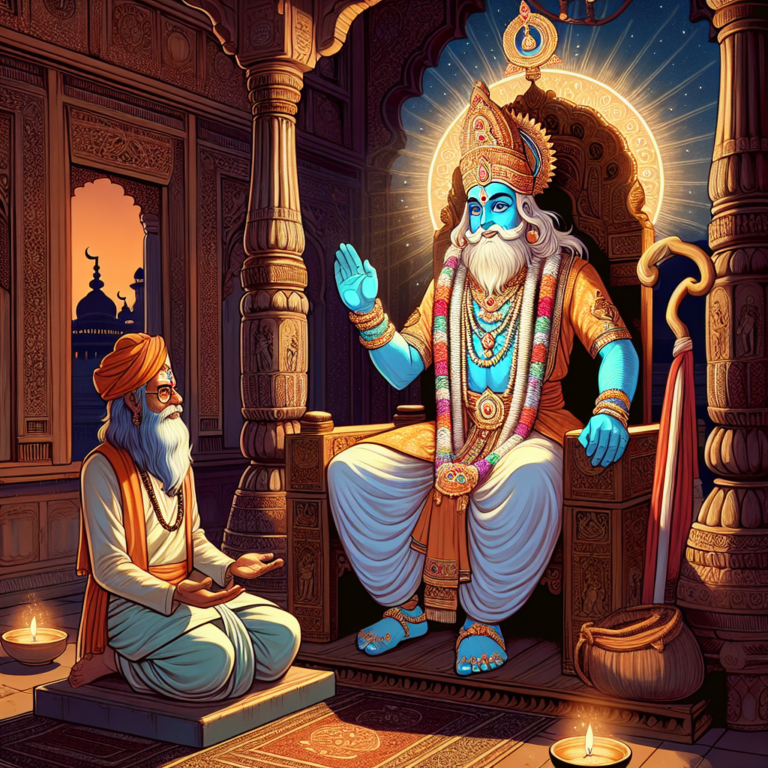
Share this engaging bedtime story with kids ages 6-12 to teach valuable life lessons.
THE KING WHO EMBODIED TRUTH
In ancient Bharat (India), during the age when dharma still guided the hearts of rulers, there lived a king whose name became synonymous with truth itself. His name was Harishchandra, king of the Ikshvaku dynasty and ruler of Ayodhya, the same golden city that would later be ruled by Lord Rama.
King Harishchandra was not the most powerful king, nor the wealthiest, nor did he possess divine weapons or supernatural powers. What made him extraordinary was something far rarer and more valuable: he had never, in his entire life, spoken a lie. Not even once.
This was not simply because he was careful with his words, but because truth was the very foundation of his being. His subjects adored him, his kingdom prospered, and his name was honored throughout the world. He lived with his beloved wife Shaibya (also called Taramati or Chandramati in some texts) and their young son Rohitashva in perfect happiness and righteousness.
But the gods, who watch all beings from the heavens, wondered: “Has this king’s virtue ever truly been tested? It is easy to be truthful when life is comfortable. But what would happen if keeping his word cost him everything? Would he still value truth above all else?”
THE DIVINE DREAM AND THE SACRED PROMISE
One night, King Harishchandra had an extraordinary dream. In this dream, he saw himself performing magnificent acts of charity—giving away his entire kingdom, his wealth, even his family—all to uphold dharma. When he woke, he felt deeply moved by the dream and mentioned it in his court.
At that very moment, the great sage Vishwamitra arrived at the palace. Now, Vishwamitra’s relationship with truth and kings had a complex history—he himself had transformed from a king into a Brahmarishi through immense spiritual effort, and he understood both worldly power and spiritual authority.
“Great king,” Vishwamitra said, “I have heard of your reputation as one who never breaks his word. I have come to ask something of you.”
Harishchandra, following the ancient tradition of royal hospitality, immediately replied, “Revered sage, my kingdom and everything in it is at your disposal. Whatever you ask, I shall grant.”
“Do you truly mean that?” Vishwamitra asked, his eyes penetrating deep into the king’s soul.
“I do,” Harishchandra replied without hesitation. “A king’s word is his dharma. I will not fail in this.”
“Then I ask for dakshina (a gift or fee) for performing a Rajasuya yajna on your behalf,” Vishwamitra said.
“Certainly!” Harishchandra agreed. “Name the amount, and it shall be yours.”
And thus, unknowingly, King Harishchandra had set in motion a chain of events that would test him beyond anything he could have imagined. For this was not merely about money—this was a divine test of satya (truth) itself, orchestrated by the gods through Sage Vishwamitra.
THE FIRST SACRIFICE: THE KINGDOM
Vishwamitra began by asking for gold. Harishchandra emptied his treasuries. The sage asked for more. The king gave more. Then Vishwamitra demanded jewels, Elephants, horses, and weapons. All were given.
Finally, Vishwamitra said, “I ask for your entire kingdom—the land, the palaces, the forests, the villages, the animals, the people—everything must be given as dakshina for the yajna.”
The courtiers gasped. The ministers protested. “Your Majesty, this is unreasonable! No sage has the right to ask for an entire kingdom as a fee! This violates all precedent!”
But Harishchandra raised his hand for silence. “I have given my word. A king who breaks his promise is not worthy of being called a king. The kingdom is yours, revered sage.”
And so, in an extraordinary ceremony, King Harishchandra formally gifted his entire kingdom to Vishwamitra. He removed his crown, took off his royal robes, and dressed himself, his wife, and his young son in simple bark cloth, like forest ascetics.
As they prepared to leave the palace they had called home, Harishchandra’s wife Shaibya asked quietly, “Where will we go, my lord?”
“We will go wherever fate takes us,” Harishchandra replied with dignity. “We have lost our kingdom, but we have not lost our integrity.”
But Vishwamitra was not finished with his test.
THE HUMILIATION AT THE CITY GATES
As the royal family prepared to leave Ayodhya, Vishwamitra appeared before them at the city gates.
“King Harishchandra—or rather, former king—you have given me your kingdom as dakshina, but you have not yet paid the actual fee for performing the Rajasuya yajna ceremony. That dakshina is separate and must still be paid.”
Harishchandra was stunned. “But revered sage, I have given you everything! I have nothing left!”
“That is not my concern,” Vishwamitra replied coldly. “You made a promise to pay dakshina. You must fulfill it. I give you one month to arrange the payment. If you fail, your promise will be broken, and your reputation as a truthful man will be destroyed.”
“But how can I pay when I have nothing?”
“That is for you to determine,” Vishwamitra said. “You have one month.”
And so Harishchandra, his wife, and his young son had to leave Ayodhya not as a king voluntarily entering forest exile, but as a debtor fleeing a debt he had no means to pay. As they crossed the borders of his former kingdom, guards stopped them.
“You must pay a toll to leave this kingdom,” the guards said, not recognizing their former king in his simple clothes.
“But we have nothing,” Harishchandra explained.
“Then you cannot pass.”
It was Shaibya who solved this crisis. “Take my jewelry,” she said, removing the modest ornaments she still wore. “These should suffice as toll tax.”
With heavy hearts, they crossed the border and headed toward the great city of Varanasi (Kashi), hoping to find some means to earn the money needed to pay Vishwamitra.
THE SECOND SACRIFICE: THE FAMILY
Weeks passed as Harishchandra desperately sought work in Varanasi. But who would hire a man with no skills except governance? He had been a king, not a laborer or craftsman. Time was running out, and the deadline to pay Vishwamitra approached.
Vishwamitra appeared again, surrounded by his disciples, and demanded his payment before the entire marketplace.
Harishchandra fell at his feet. “Revered sage, I have tried everything, but I cannot earn enough money in the time given. Please, grant me more time!”
“I have been generous enough,” Vishwamitra replied harshly. “You made a promise. If you cannot pay, then you are a liar, and your reputation is false. Perhaps you should sell your family to raise the money.”
The crowd gasped at this cruelty. Harishchandra’s face went pale. Sell his own wife and child? It was unthinkable!
But before he could respond, Shaibya stepped forward. “If this is what must be done to preserve my husband’s word and honor, then let it be done. I offer myself for sale.”
“No!” Harishchandra cried. “I cannot do this!”
“You must,” Shaibya said firmly, tears streaming down her face. “What is the worth of my freedom compared to your lifetime of truth? What kind of wife would I be if I allowed you to break your word and destroy everything you have stood for? Our son and I will endure whatever comes, but you must keep your promise.”
A wealthy Brahmin in the crowd needed servants for his household. He agreed to purchase Shaibya and young Rohitashva. The money was counted out and handed to Harishchandra, who then gave it all to Vishwamitra.
“It is still not enough,” Vishwamitra said coldly. “You are still in debt to me.”
As Shaibya and Rohitashva were led away by their new master, the mother and son looked back at Harishchandra. Their eyes conveyed everything words could not: love, sorrow, faith, and desperate hope that somehow, this nightmare would end.
Harishchandra watched his family disappear into the crowd, his heart breaking. But he had not yet cried or complained. A king—even a fallen king—must maintain his dignity.
THE THIRD SACRIFICE: THE SELF
Now Harishchandra had nothing at all. No kingdom, no family, no money, no possessions. He owned only the simple bark cloth he wore. And still, Vishwamitra said the debt was not paid.
“What more can I give?” Harishchandra asked. “I have nothing left!”


“You have yourself,” Vishwamitra replied. “You can sell yourself as a slave. Surely your freedom has some value?”
So Harishchandra stood in the slave market, offering himself for sale. Many passed by, finding nothing special about this thin, sad-looking man. Finally, a buyer approached—a Chandala named Veerabahu.
Chandalas were considered the lowest caste in ancient Indian society, responsible for cremating the dead and maintaining the cremation grounds. For a member of the Kshatriya royal class to become the slave of a Chandala was the ultimate degradation, a reversal so complete that many would prefer death.
But Harishchandra did not hesitate. “I offer myself as your slave,” he said to Veerabahu.
“What can you do?” the Chandala asked.
“I can learn whatever you need me to do,” Harishchandra replied.
Veerabahu paid the price, and Harishchandra handed the money to Vishwamitra. Even this was not quite enough, but Vishwamitra finally accepted it as final payment.
“Your debt is paid,” Vishwamitra declared. “You have kept your word.” And with that, he departed, leaving Harishchandra as the slave of a Chandala, assigned to work at the cremation ghats (funeral grounds) of Varanasi.
THE DARKNESS BEFORE THE DAWN
For months, Harishchandra performed the most degrading work imaginable for a former king. He collected fees from those who brought bodies to be cremated. He gathered wood for the funeral pyres. He tended the fires. He lived in a small hut near the cremation grounds, surrounded by death and sorrow every day.
He had no idea what had become of his wife and son. Were they alive? Were they suffering? Were they safe? The not knowing was perhaps worse than any physical hardship.
Meanwhile, Shaibya and Rohitashva served in the Brahmin’s household. The work was hard, and the separation from Harishchandra was agonizing, but they bore it with courage, believing that somehow their faithfulness would be rewarded.
THE TRAGIC REUNION
One terrible night, tragedy struck. Young Rohitashva was playing in the forest when he was bitten by a venomous snake. The poison acted quickly, and despite Shaibya’s desperate prayers and attempts to save him, the boy died in her arms.
Shaibya’s grief was immeasurable. Her son, her precious child, the last joy in her hard life—gone. But she had to arrange for his cremation. With no money of her own and her master refusing to pay for it, she wrapped Rohitashva’s small body in whatever cloth she could find and carried him through the darkness to the cremation ghats.
There, a figure emerged from the shadows—the keeper of the cremation ground, who would demand payment before allowing the cremation.
“You must pay the fee before you can cremate the body,” the figure said.
Shaibya looked up, and her heart nearly stopped. Even in the dim firelight, even after months of separation and hardship, she recognized him.
“Harishchandra?” she whispered.
He stepped closer, peering at the woman before him. “Shaibya? Is it really you?”
They embraced, and for a moment, all the months of separation, all the suffering, all the degradation fell away. But then Harishchandra saw the small body in her arms.
“Is that…?” he could barely form the words.
“Our son,” Shaibya said, tears flowing freely. “He was bitten by a snake. He is gone.”
They held each other and wept—this king and queen, now reduced to slave and servant, holding the body of their dead child in a cremation ground. It was the lowest point imaginable, a darkness so complete that no light seemed possible.
But even in this moment, when his heart was shattered, Harishchandra could not forget his duty.
“I must collect the fee,” he said, his voice breaking. “My master requires it. If I do not collect the fee, I will be breaking the terms of my service, breaking my word.”
“But I have nothing to give,” Shaibya said. “My master would not provide money for the cremation.”
“Then…” Harishchandra could barely speak, “then I cannot allow the cremation. I am bound by my word to my master. I cannot break it, even for this.”
Shaibya looked at him, and in that moment, she understood the depths of her husband’s commitment to truth. Even now, with their son dead in her arms, even now in the darkest hour, he would not break his word.
“Then take this,” she said, removing the last piece of cloth she had used to cover their son. “Take this as payment.”
But this left Rohitashva’s body partially exposed, and it left Shaibya herself with insufficient clothing to maintain her modesty. The cloth would have to be torn to serve both purposes.
It was too much. Even Harishchandra’s iron will, his lifetime commitment to truth, reached its breaking point. He looked up at the dark sky and cried out: “Is there no one who sees this? Is there no justice? I have given everything—my kingdom, my wealth, my family, my freedom, my dignity! I have kept every promise, told no lie, broken no word! And now my son is dead, and I am asked to choose between my duty and the last shred of human decency! Is there no end to this test?!”
THE DIVINE REVELATION
At that moment, the dark sky blazed with light. The gods themselves appeared, led by Lord Brahma, the creator. Sage Vishwamitra stood among them, but now his harsh expression had transformed into one of deep respect and compassion.
“Enough!” Brahma declared. “Harishchandra, you have passed the greatest test ever given to any mortal. Your commitment to truth has surpassed even the gods’ expectations!”
Vishwamitra stepped forward. “Great king—and you are a great king indeed—I was not cruel for cruelty’s sake. The gods asked me to test whether your reputation for truthfulness was mere appearance or reality. We had to know: would you remain committed to truth even when it cost you everything?”
Lord Indra, king of the gods, appeared with young Rohitashva alive and healthy in his arms. “Your son lives! This was all a divine test, and you have passed it beyond all measure!”
Tears of joy streamed down Shaibya’s face as she took her living son in her arms. Rohitashva hugged both his parents, and the family reunited at last.
Brahma spoke with great solemnity: “King Harishchandra, in all the history of creation, no being has shown such absolute dedication to truth. Not even the gods themselves have been tested so severely. You have earned a place in heaven immediately, without having to wait for the cycle of rebirth. You have transcended the human condition through your adherence to satya.”
“Your kingdom is restored,” Vishwamitra added. “Your wealth, your status, everything—returned manifold. But more than that, your name will live forever as the symbol of truth itself. When people speak of honesty and keeping one’s word, they will say ‘as truthful as Harishchandra.’ You have become immortal not in body, but in the moral imagination of humanity.”
THE RETURN AND THE LEGACY
Harishchandra, Shaibya, and Rohitashva returned to Ayodhya in a celestial vehicle, accompanied by gods and sages. The people rejoiced to see their beloved king restored. The kingdom prospered even more than before, for now everyone knew that it was ruled by a man whose word was absolutely trustworthy.
Harishchandra ruled for many more years, and his governance became legendary. In his kingdom, contracts needed no written form—people’s word was sufficient. Disputes were rare, because everyone strove to emulate their king’s integrity. Justice was swift and fair, because the king could not be influenced by bribes or intimidation.
When his earthly duties were finally complete, Harishchandra, along with Shaibya and Rohitashva, ascended to heaven in their living bodies—a privilege granted to only the most exceptional souls. They did not have to experience death or rebirth but were granted immediate union with the divine, a reward for their steadfast truth.
THE ETERNAL MESSAGE
The story of King Harishchandra resonates through the ages because it addresses a question every person faces: What is the worth of our word? What price are we willing to pay to maintain our integrity?
In modern times, we may be tempted to think: “This is extreme. Surely some compromise is acceptable. Surely white lies are permissible. Surely circumstances can excuse us from our promises.”
But Harishchandra’s story suggests otherwise. It teaches that truth is not conditional. Integrity is not situational. Our word should mean something absolute, not negotiable based on convenience or cost.
This does not mean we should make foolish promises, as Harishchandra perhaps did by agreeing to pay an unspecified dakshina. But once a promise is made, once we have given our word, the story suggests that keeping it should take precedence over comfort, wealth, status, and even personal relationships.
The story also teaches about dharma—righteous duty. Even at his lowest point, working as a slave at a cremation ground, Harishchandra continued to do his assigned work with integrity. Our circumstances do not excuse us from doing our duty honorably.
And finally, the story teaches that truth and integrity are ultimately rewarded. This may not happen immediately. We may suffer, as Harishchandra suffered. We may lose much, as he lost everything. But the story promises that the universe itself honors truth, and that divine justice, though it may seem absent, is always watching.
Moral Lessons
- Truth and integrity are worth any sacrifice. When we give our word, we must keep it, regardless of the cost. Our reputation for honesty and our moral character are more valuable than wealth, status, or comfort. In the end, steadfast commitment to truth brings its own reward, both in this life and beyond.
Test Your Understanding
1. What made King Harishchandra extraordinary among all kings?
Frequently Asked Questions
What is the moral lesson of King Harishchandra’s Noble Quest for Truth and Duty?
What age is this story appropriate for?
How long does it take to read King Harishchandra’s Noble Quest for Truth and Duty?
What culture does this story come from?
Can I use this story for teaching?
Frequently Asked Questions
Who was King Harishchandra and why is he famous?
King Harishchandra was a legendary ruler of Ayodhya from the Ikshvaku dynasty in ancient India. He is famous for never speaking a single lie his entire life. His unwavering commitment to truth and duty, even when tested by tremendous hardship, made his name synonymous with honesty and righteousness across generations.
What is the main lesson in the story of King Harishchandra?
The story of King Harishchandra teaches children that truth and duty are worth upholding even when it comes at great personal cost. It shows that real virtue is not just about being good when life is easy, but staying honest and honorable even during the most difficult and painful trials.
Is the King Harishchandra story suitable for young kids?
Yes, the King Harishchandra story is recommended for children ages 6 to 12. It is written as an engaging bedtime story that introduces important moral values like honesty, integrity, and responsibility in a way that is accessible and meaningful for young readers.
📚 Recommended Books
Handpicked for readers like you
As an Amazon Associate, we earn from qualifying purchases. These recommendations are personalized based on this story's themes and your reading history.
What does dharma mean in the context of King Harishchandra’s story?
In King Harishchandra’s story, dharma refers to righteous duty and moral law that guided rulers in ancient India. For Harishchandra, dharma meant always telling the truth and fulfilling his word no matter the consequences. It was the guiding principle of both his personal life and his reign as king.
How was King Harishchandra’s truth and virtue tested by the gods?
The gods questioned whether Harishchandra’s virtue was genuine, since he had lived a comfortable and prosperous life. They wondered if he could still uphold truth when keeping his word came at enormous personal sacrifice. The story explores this divine test, putting his commitment to truth and duty under extreme pressure.
