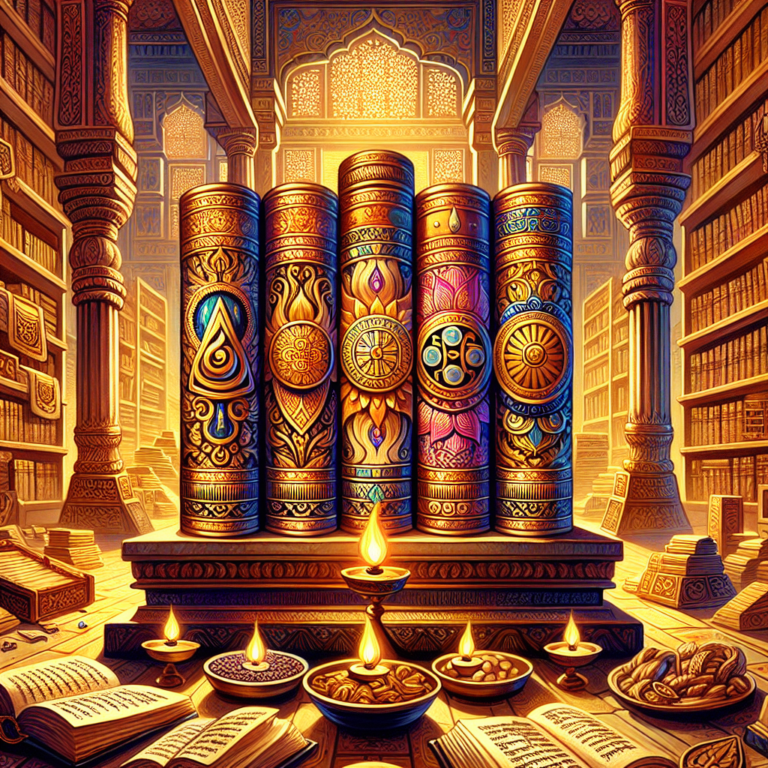
‘The Enchanted Library of Timeless Treasures’ is an educational moral story perfect for bedtime reading with children ages 6-12.
Chapter One: The Door in the Banyan Tree
Twelve-year-old Arjun pressed his back against the massive trunk of the ancient banyan tree, trying to catch his breath. The summer heat of his village in Rajasthan had driven him to seek shelter in the tree’s cool shade, but what he found was something far more extraordinary.
“That’s strange,” he murmured, running his fingers along the bark. There was a seam in the wood – a perfect rectangle, like a door.
Arjun had climbed this tree a hundred times. He had never seen this before.
His heart pounding, he pressed against the wooden door. It swung inward silently, revealing not the hollow darkness of a tree trunk, but a soft golden light.
Arjun hesitated for only a moment. Then, as curious children have done since the beginning of time, he stepped through.
Chapter Two: The Library Beyond Time
He found himself standing in a vast circular chamber that seemed to stretch upward forever. The walls were lined with books – thousands upon thousands of them – each one bound in leather that shimmered with colors Arjun had no names for. Floating platforms drifted gently through the air, carrying more books from one level to another.
In the center of the chamber, a figure sat at a great stone desk. She appeared to be a woman made of starlight, her form shifting between solid and translucent, with eyes that held the depth of galaxies.
“Welcome, young seeker,” she said, her voice like wind chimes. “I am Vidya, the guardian of the Vedic Library. I have been waiting for you.”
“Waiting for me?” Arjun stammered. “But I just found this place by accident!”
Vidya smiled. “There are no accidents in the universe, only connections we don’t yet understand. You have questions – I can feel them burning inside you. Questions about purpose, about right and wrong, about why the world is the way it is.”
Arjun swallowed hard. It was true. His father had passed away six months ago, and since then, Arjun had struggled to make sense of anything.
“This library,” Vidya continued, “contains the wisdom/” title=”More stories about wisdom”>wisdom of the Vedas – the oldest knowledge in the world, collected over thousands of years by sages who asked the very same questions you carry in your heart.”
She rose and extended her hand. “Shall I show you?”
Chapter Three: The Book of Creation – Rig Veda
Vidya led Arjun to a section where the books glowed with a deep amber light.
“This is where we keep the Rig Veda,” she explained, pulling out a massive volume that somehow weighed nothing at all. “The oldest of the four Vedas, containing over a thousand hymns composed by the ancient Rishis.”
She opened the book, and the pages came alive. Arjun found himself standing on a vast plain, watching as a bearded sage sat in meditation beneath an open sky.
“Who is that?” Arjun whispered.
“That is Rishi Vishvamitra, composing a hymn to Surya, the sun god. Watch.”
The sage opened his eyes and began to chant. The words were in an ancient language Arjun didn’t know, yet somehow he understood them:
“From the darkness, lead us to light. From ignorance, lead us to knowledge. From death, lead us to immortality.”
The sky above the sage burst into brilliant color as the sun rose, its rays reaching down like golden fingers to touch the earth.
“The Rig Veda teaches us to see the divine in nature,” Vidya explained as the vision faded. “The ancient sages didn’t just worship the sun and fire and wind – they understood that these forces were expressions of a greater power that connects all things. They called this power Brahman.”
“But why does it matter?” Arjun asked, his voice cracking. “My father… he was a good person. He prayed, he helped others. And still…”
Vidya placed a gentle hand on his shoulder. “Come. There is another book you need to see.”
Chapter Four: The Book of Action – Yajur Veda
They moved to another section where books pulsed with a steady silver rhythm, like heartbeats.
“The Yajur Veda,” Vidya said, selecting a volume. “The book of sacred actions. But the wisdom here isn’t just about rituals – it’s about something far more important.”
The book opened, and Arjun found himself in a village not unlike his own. A young man was building a house, laying each brick with careful attention.
“This young man has just lost his own father,” Vidya narrated. “Watch what he does.”
As the man worked, neighbors began to gather. An elderly woman brought him water. A young boy held the measuring rope. A farmer offered timber from his own store. Without a word, the whole village came together.
“The Yajur Veda teaches that our actions are our offerings,” Vidya said. “When we work with dedication and pure intentions, we participate in the great sacrifice that keeps the universe in balance. This is karma – not punishment or reward, but the simple truth that our actions ripple outward, affecting everything around us.”
“So my father’s kindness… it still exists somewhere?”
“It exists everywhere,” Vidya said. “In the people he helped, who help others. In the lessons he taught you, which you will teach to others. Karma is not lost. It transforms.”
Chapter Five: The Book of Music – Sama Veda
A sweet melody drifted through the library, and Arjun turned toward its source. Vidya smiled.
“Ah, the Sama Veda calls to you. It would – you have a musical soul.”
They entered a chamber filled with floating instruments – veenas, flutes, drums, and others Arjun had never seen. The books here seemed to hum rather than glow.
“The Sama Veda took the hymns of the Rig Veda and set them to music,” Vidya explained. “The sages understood that some truths cannot be spoken – they must be sung, felt, experienced.”
She touched a book, and suddenly Arjun was surrounded by sound. It wasn’t just music – it was emotion made audible. He felt joy and sorrow, hope and longing, all woven together in a tapestry of notes.
And then he heard it – a melody that reminded him of his father. The way he used to hum while cooking breakfast. The songs he sang during long car rides.
Tears streamed down Arjun’s face, but they weren’t sad tears. They were the tears that come when something broken begins to heal.
“Music connects us across time,” Vidya said softly. “The songs your father sang live in your memory. When you remember them, when you sing them yourself, he is with you.”
Chapter Six: The Book of Healing – Atharva Veda
Finally, Vidya led Arjun to a warm section of the library where the books radiated a comforting green light.
“The Atharva Veda,” she said. “The practical wisdom. Remedies for illness, prayers for protection, guidance for everyday life. But most importantly, wisdom for healing the spirit.”
She opened a book and read aloud:
“May we see with eyes that seek understanding. May we hear with ears that welcome truth. May we speak with tongues that bring peace. May we live with hearts that embrace all beings as family.”
“Your father’s death has wounded you,” Vidya continued. “This is natural. Grief is love with nowhere to go. But the Atharva Veda teaches that healing comes not from forgetting, but from transforming our pain into purpose.”
“How do I do that?” Arjun asked.
“By living well. By being kind. By asking questions and seeking truth. By remembering that you are not alone – you are part of a great chain of seekers that stretches back thousands of years and forward into eternity.”
Chapter Seven: The Way Home
Arjun stood once more at the center of the library, his heart fuller than when he arrived.
“Will I be able to come back?” he asked.
Vidya smiled. “This library exists in many places – in books, in teachers, in moments of quiet reflection. Whenever you seek wisdom with a sincere heart, you will find your way here.”
She pressed something into his hand – a small brass lamp.
“Light this when you feel lost. It will remind you of what you learned today: that you are part of something vast and ancient and beautiful. That your actions matter. That music carries the soul. And that even death cannot break the bonds of love.”
Arjun stepped back through the door in the banyan tree, emerging into the Rajasthan afternoon. The heat was the same, but somehow it felt gentler now.
That evening, he lit the small lamp and sat with his mother, who had been grieving in her own way.
“Tell me a story about Papa,” he said.
And as she spoke, Arjun understood at last: the Vedas weren’t just old books in an ancient language. They were a way of seeing the world – with wonder, with purpose, with the understanding that we are all threads in an infinite tapestry of light.
Moral Lessons
- Ancient wisdom teaches us that we are all connected – to nature, to each other, and to those who came before us. When we face loss and difficulty, we can find healing not by forgetting, but by transforming our pain into purpose and carrying forward the love we’ve received.
Test Your Understanding
1What is the Rig Veda?
Frequently Asked Questions
What is the moral lesson of The Enchanted Library of Timeless Treasures?
What age is this story appropriate for?
How long does it take to read The Enchanted Library of Timeless Treasures?
What culture does this story come from?
Can I use this story for teaching?
Frequently Asked Questions
What is The Enchanted Library of Timeless Treasures about?
The Enchanted Library of Timeless Treasures is an educational moral story about a 12-year-old boy named Arjun from Rajasthan who discovers a magical hidden door inside an ancient banyan tree. It leads him to a vast enchanted library filled with thousands of shimmering books and mysterious wonders beyond imagination.
What age group is The Enchanted Library of Timeless Treasures suitable for?
This story is ideal for children aged 6 to 12 years old. It works especially well as a bedtime story, blending adventure and fantasy with educational and moral lessons. Parents can read it aloud to younger children, while kids aged 9 and up may enjoy reading it independently.
Does this story teach any moral lessons or values to kids?
Yes, the story is designed as an educational moral tale. While the full lessons unfold through the chapters, themes of curiosity, courage, and the value of knowledge are woven throughout. It encourages children to embrace reading and learning through an exciting, relatable adventure.
📚 Recommended Books
Handpicked for readers like you
As an Amazon Associate, we earn from qualifying purchases. These recommendations are personalized based on this story's themes and your reading history.
Where is the story of the enchanted library set?
The story begins in a village in Rajasthan, India, where the young protagonist Arjun seeks shade under an ancient banyan tree during summer heat. The setting then shifts to a magical, timeless library hidden inside the tree — a vast circular chamber filled with thousands of glowing, shimmering books.
Is this a good bedtime story for children who love fantasy and adventure?
Absolutely. This story is a perfect bedtime read for children who enjoy fantasy, magic, and adventure. It features a relatable young hero, a richly imagined magical world, and a sense of wonder that captures children’s imaginations while also delivering meaningful moral and educational value.