A queen is wronged in the most public way possible—and asks one question that none of the gathered wise men can answer with integrity.
In the great hall of the Kuru court, a dice game was being played that would change history.
The Pandava prince Yudhishthira had lost everything at dice—his kingdom, his brothers, himself. And now, in a moment of madness, he had wagered Draupadi, his queen.
He lost that too.
The victorious Kauravas ordered that Draupadi be brought to the hall—in public, in disgrace. She was dragged in by her hair.
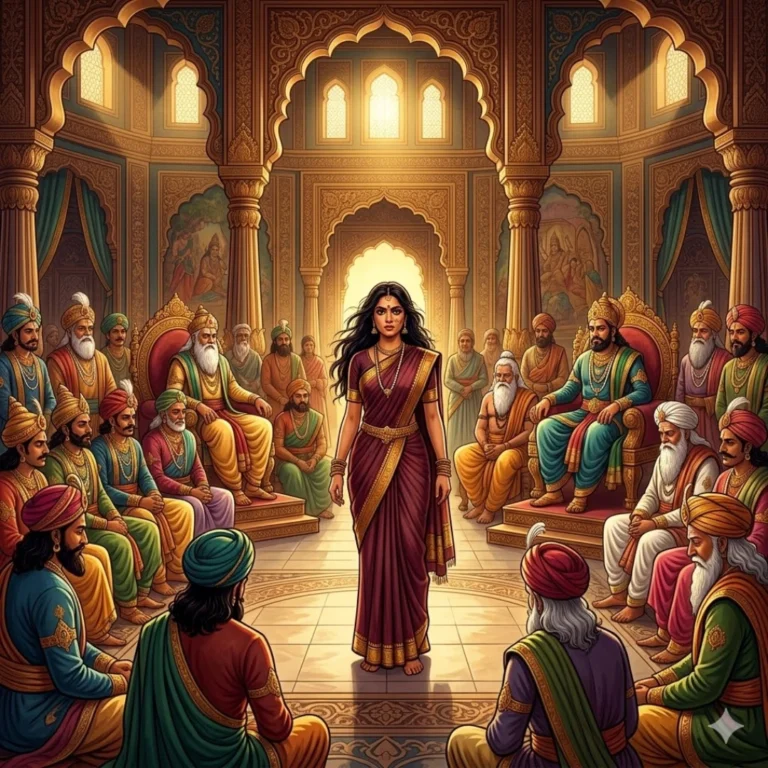
The hall was full of the wisest men in the kingdom. Kings, elders, veterans, scholars. The man who dragged her in sneered at the assembled court.
Draupadi looked at the hall. She looked at the faces.
Then she spoke.
“I have one question,” she said. Her voice was calm. “Before a man can wager another, he must himself be free. A man who has already lost himself at dice is no longer a free man. Therefore—can a man who is not free wager another?”
The hall was silent.
The wisest men stared at the floor. The kings examined their own rings. The scholars consulted their memories and found—nothing applicable.
No one answered.
Because if they said Yes—Yudhishthira had the right to wager her—they were saying a slave could sell a free woman. If they said No—then the wager was invalid and she was free.
They could not answer without revealing what they stood for.
That silence was her answer. She had not been saved by armies or gods—though later she would call on Krishna. In that moment, she had been saved by one precise, honest question that no dishonest system could answer.
Truth, when asked directly, has a way of silencing the room.
Moral of the Story
Integrity means asking the honest question, even in the middle of your greatest difficulty. Truth, stated clearly, exposes what dishonesty cannot survive.
Learn These Words
- integrity
- the quality of being honest and having strong moral principles
- wager
- to bet; to risk something on an outcome
- invalid
- not legally or officially acceptable
- disgrace
- loss of respect as a result of shameful behaviour
- applicable
- relevant to a particular situation
Test Your Understanding
1What did Yudhishthira wager and lose?
2What was Draupadi’s question?
3Why could the wise men not answer?
4How was Draupadi’s question powerful?
5What lesson does this story teach?
Frequently Asked Questions
What is Draupadi’s question in the Mahabharata dice game?
Draupadi asked whether a man who has already lost himself at dice—and is therefore no longer free—has the legal right to wager another person. This logical challenge stunned the entire Kuru court because answering either yes or no would expose a fundamental moral contradiction, and none of the assembled wise men could respond with integrity.
Why couldn’t anyone in the Kuru court answer Draupadi’s question?
The question created an impossible dilemma. Saying yes—that Yudhishthira could wager her—meant a slave had property rights, undermining the concept of slavery itself. Saying no meant the entire wager was invalid and Draupadi was still free. Either answer would unravel the Kauravas’ victory, so every elder, king, and scholar chose silence instead.
Who wagered Draupadi in the dice game and why?
Yudhishthira, the eldest Pandava prince, wagered Draupadi during a rigged dice game against the Kauravas. He had already lost his kingdom, his brothers, and even himself before staking his queen. This act of desperation set the stage for one of the Mahabharata’s most dramatic and morally significant confrontations.
📚 Recommended Books
Handpicked for readers like you
As an Amazon Associate, we earn from qualifying purchases. These recommendations are personalized based on this story's themes and your reading history.
What lesson does the story of Draupadi’s question teach?
The story illustrates the power of moral courage and clear thinking in the face of injustice. Draupadi, despite being humiliated publicly, used reason and logic rather than pleading. It also exposes how silence from powerful bystanders enables wrongdoing—a timeless lesson about the responsibility of those who witness injustice to speak up.
Is Draupadi’s question from the Mahabharata relevant today?
Absolutely. Draupadi’s question highlights themes still relevant today: standing up against public humiliation, challenging unjust systems with logic, and holding powerful bystanders accountable for their silence. It resonates in modern conversations about justice, consent, and the moral obligation of witnesses to speak against wrongdoing rather than look away.