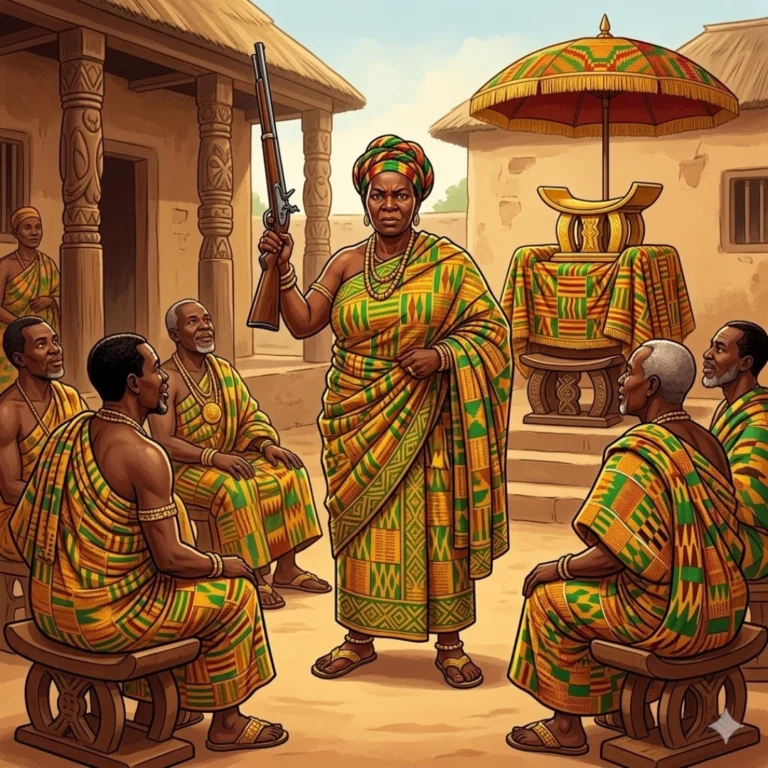
When the British demand the sacred Golden Stool and the chiefs hesitate, a grandmother stands up and inspires her people to fight for what is sacred.
In 1900, in the kingdom of Ashanti in what is now Ghana, a British governor made a demand that struck the chiefs silent with shock.
“Bring me the Golden Stool,” he said. “I will sit on it.”
The Golden Stool was not a piece of furniture. It was the sunsum—the soul—of the Ashanti people. It had descended from the sky, the legend said, and as long as it existed, so did the nation. No one sat on the Golden Stool. Not even the Ashanti king.
The chiefs went into assembly. They were afraid. The British had great guns. The British had already exiled the Asantehene, the king. If they refused, what would happen?
The assembly went on in frightened whispers. Then a voice rang out—clear and furious.
It belonged to Yaa Asantewaa, the Queen Mother of Edweso, a grandmother.
“I see that some of you fear to fight for our king and our stool,” she said. “If you, the men of Ashanti, will not go forward, then we women will. I shall call upon my fellow women. We will fight the white men. We will fight until the last of us falls in the battlefield.”
She stood. She picked up a rifle.
The chiefs looked at each other. Then they stood too.
The war was long. The Ashanti were eventually defeated by the larger British forces, and Yaa Asantewaa was exiled. She died in exile, far from home.
But the British never got the Golden Stool.
It was hidden. It survived. And to this day, in the Republic of Ghana, the Golden Stool exists—and no one sits on it.
Yaa Asantewaa died far from home. But what she fought to protect is still there, still unbroken.
Some victories happen after you are gone. The courage that makes them possible is not diminished by that.
Moral of the Story
Courage is not the absence of fear—it is speaking and acting when others are silent, because some things are worth defending regardless of the cost.
Learn These Words
- sunsum
- an Akan word meaning soul or spirit
- exile
- being forced to live away from your home country or region
- assembly
- a group of people gathered together, especially to make decisions
- sacred
- deserving respect because it is connected to something holy or deeply important
- diminished
- made smaller or less important
Test Your Understanding
1What did the British governor demand?
2Why was the Golden Stool so important?
3What did Yaa Asantewaa do when the chiefs hesitated?
4What happened to the Golden Stool?
5What lesson does this story teach?
Frequently Asked Questions
Who was Yaa Asantewaa and why is she famous?
Yaa Asantewaa was the Queen Mother of Edweso in the Ashanti Kingdom, in what is now Ghana. She is famous for rallying her people to resist British colonial demands in 1900. When the male chiefs hesitated to defy the British, this grandmother stood up and declared that the women of Ashanti would fight to protect their sacred Golden Stool and their sovereignty.
What was the Golden Stool and why was it so important to the Ashanti people?
The Golden Stool was the spiritual soul—called the sunsum—of the Ashanti nation. According to legend, it descended from the sky, and as long as it existed, so did the Ashanti people. It was so sacred that no one was allowed to sit on it, not even the Ashanti king. It represented the unity, identity, and spiritual power of the entire nation.
Why did the British governor want the Golden Stool?
In 1900, the British governor demanded that the Ashanti chiefs bring him the Golden Stool so he could sit on it. This was an act of colonial dominance meant to assert British authority over the Ashanti people. The British had already exiled the Asantehene, the Ashanti king, and seizing the sacred stool would symbolically crush the nation’s remaining sovereignty and identity.
📚 Recommended Books
Handpicked for readers like you
As an Amazon Associate, we earn from qualifying purchases. These recommendations are personalized based on this story's themes and your reading history.
Is the story of Yaa Asantewaa and the Golden Stool true?
Yes, Yaa Asantewaa was a real historical figure. In 1900 she led the War of the Golden Stool, also known as the Yaa Asantewaa War, against British colonial forces in present-day Ghana. While certain details are passed down through oral tradition, the core events—the British demand, the chiefs’ assembly, and her courageous stand—are documented in historical records.
What lesson does the story of Yaa Asantewaa teach children?
The story teaches children about courage, cultural pride, and standing up for what is sacred even when others are afraid. Yaa Asantewaa showed that leadership can come from anyone—regardless of age or gender. Her example reminds young readers that protecting one’s identity and heritage is worth fighting for, and that one brave voice can inspire an entire community to act.