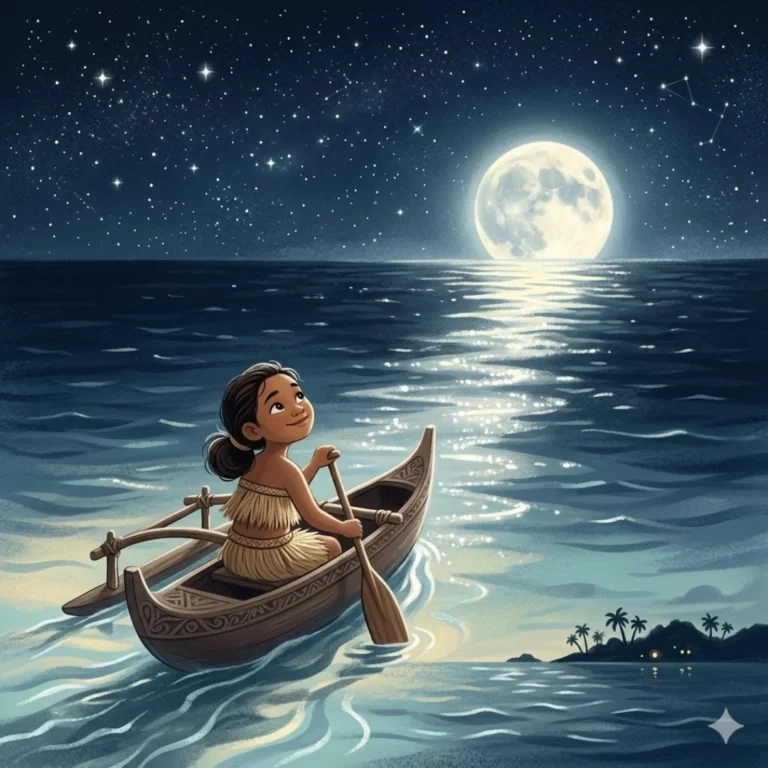
The moon goddess Hina paddles her canoe all the way to the moon to find a place of peace—and shows children that seeking your own space is not selfishness.
Long ago, the goddess Hina worked without rest.
She pounded bark cloth from morning to night. Her husband brought her more bark. Her children needed clothes. The village needed mats. There was always more.
Hina loved her family. She did not complain. But inside, something was slowly wearing thin—the part of her that needed quiet, needed her own thoughts, needed something that was simply hers.
One night she carried her board and her mallet to the shore and looked up.
The moon was full. It was far away and cold and utterly, perfectly quiet.
Hina pushed her canoe into the surf. She paddled.
The journey was long and strange. The stars watched. The fish below glowed. Her arms ached. But she kept paddling—toward that round silence in the sky.
She arrived on the moon. She sat. She put down the mallet. She breathed.
The quiet was not empty—it was full. She could hear herself think.
Her husband, furious, paddled after her. He tried to drag her back. She kicked out and sent him tumbling toward the earth.
She was not cruel. But she had made a choice.
She stayed on the moon. She still works there—her shadow is visible, they say, in the face of the full moon. The pattern you see is Hina, still pounding bark cloth, but in peace now, at her own pace, in her own light.
Her children grew up. They found her in the moonlight on dark nights.
“We understand,” they said, in the old Hawaiian stories. “You needed a place that was yours.”
She had not abandoned them. She had found herself again—so she could love them better from the place she had built alone.
Sometimes the most loving thing you can do for others is take care of yourself first.
Moral of the Story
Independence and self-care are not selfish. Having a space that is yours—a place to think and breathe—makes you more, not less, able to love and give.
Learn These Words
- mallet
- a hammer, often with a large wooden head, used to pound things
- bark cloth
- cloth made by pounding the bark of certain trees, used in Polynesian cultures
- surf
- waves breaking on a shore
- independence
- freedom from the control of others; the ability to make your own choices
- abandon
- to leave someone without intending to return
Test Your Understanding
1Why did Hina feel something wearing thin?
2Where did Hina paddle to?
3What did Hina find on the moon?
4What is said to be visible in the full moon?
5What lesson does this story teach?
Frequently Asked Questions
What is the story of Hina’s Moon Journey about?
Hina’s Moon Journey is a retelling of a Polynesian myth about the goddess Hina, who works tirelessly making bark cloth for her family and village. Exhausted and longing for peace, she paddles her canoe all the way to the moon. The story teaches children that needing your own quiet space is healthy, not selfish.
Is Hina’s Moon Journey a real myth or a made-up story?
Hina’s Moon Journey is rooted in a real Polynesian myth found across Hawaiian, Tahitian, and other Pacific Island traditions. Hina is one of the most important goddesses in Polynesian mythology, and many cultures in the region tell versions of her journey to the moon to explain the shapes people see on its surface.
What lesson does Hina’s Moon Journey teach kids?
The story teaches children that wanting time alone or a quiet space of your own is completely normal and healthy—not a sign of selfishness. Through Hina’s experience of burnout and her brave decision to seek peace, kids learn that even people who love their families deeply still need rest and personal boundaries.
📚 Recommended Books
Handpicked for readers like you
As an Amazon Associate, we earn from qualifying purchases. These recommendations are personalized based on this story's themes and your reading history.
What age group is this Hina moon goddess story best for?
This retelling of Hina’s Moon Journey uses simple, vivid language and a gentle narrative tone that works well for children ages four to eight. Younger kids enjoy the adventure of paddling a canoe to the moon, while older children can engage with the deeper theme of recognizing and respecting other people’s need for space.
Why did Hina paddle her canoe to the moon instead of staying with her family?
Hina loved her family but was exhausted from working without rest—pounding bark cloth endlessly while everyone around her demanded more. She wasn’t abandoning her family; she was listening to a deep inner need for quiet and something that was simply hers. Her journey shows that caring for yourself makes you stronger, not weaker.