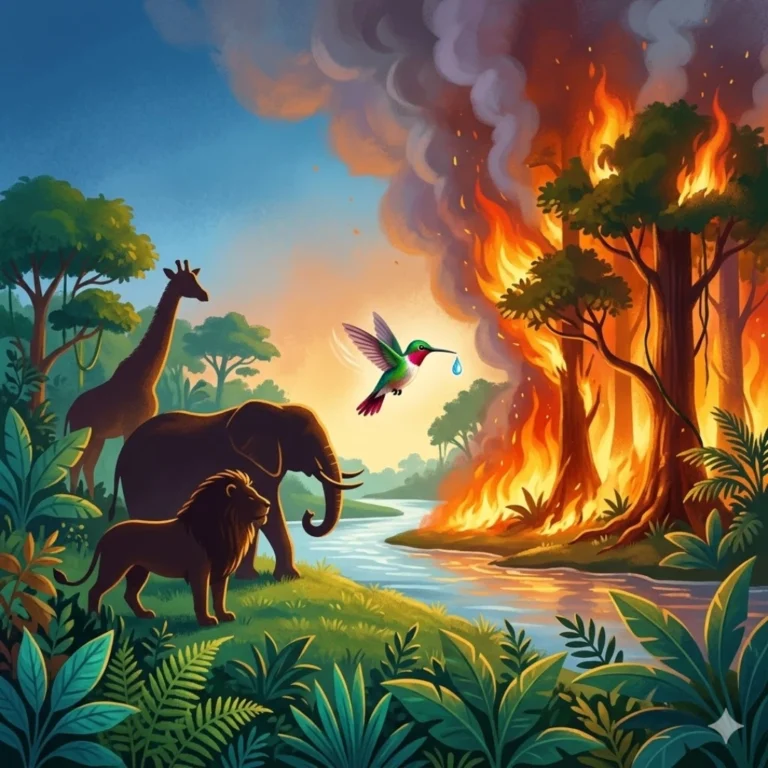
When a great forest fire breaks out, all animals flee—except one tiny hummingbird who carries drops of water in her beak. Her answer to why she tries changes everything.
In the rainforests of East Africa, a great fire broke out one dry season. The flames were enormous, crackling through the canopy, chasing the animals toward the river.
The lion ran. The elephant ran. The giraffe’s long legs carried it over the hill in great strides. The monkeys screamed and leaped from tree to tree ahead of the flames.
All the animals gathered by the great river, watching the forest burn.
All except a small hummingbird.
She flew to the river, dipped her tiny beak into the water, flew back to the fire, and released the single drop she carried. Then she flew back. And again. And again.
The lion watched this for a while. Then he called out.
“Little bird! What are you doing? You have a beak the size of a seed. The fire is the size of a mountain. What can you possibly hope to do?”
The hummingbird paused for just a moment.
“I am doing what I can,” she said.
Then she turned and flew back to the river.
The animals were quiet.
One by one, they began to look at each other. The elephant looked at his great trunk, which could hold hundreds of litres. The zebra looked at its strong legs. The baboon looked at its clever hands.
“I am doing what I can,” the hummingbird had said.
What could they do?
The elephant waded into the river and began to fill its trunk.
The story does not say they put out the fire. Some fires are too large for any amount of water. But it says that all the animals tried, each with what they had—because a bird the size of a thumb had refused to stand on the bank and only watch.
A small act of courage invites larger ones.
Moral of the Story
You do not need to solve the whole problem. You only need to do what you can. Small, faithful action invites others to act too.
Learn These Words
- canopy
- the upper layer of a forest, formed by the tops of the tallest trees
- stride
- a long step taken when walking or running
- litre
- a unit of measurement for liquid
- faithful
- continuing to do something even when it is hard
- invite
- to make someone feel welcome or encouraged to join
Test Your Understanding
1What did all the animals do when the forest fire started?
2What was the hummingbird doing?
3What did the hummingbird say when the lion asked what she was doing?
4What did the elephant do after hearing the hummingbird?
5What lesson does this story teach?
Frequently Asked Questions
What is the story of the hummingbird and the forest fire about?
The Hummingbird and the Forest Fire is an East African folktale about a tiny hummingbird who refuses to flee a massive forest fire like the other animals. Instead, she carries single drops of water in her beak to fight the blaze. When the lion questions her efforts, she simply replies, ‘I am doing what I can’—inspiring others through her quiet courage.
What is the moral lesson of the hummingbird and the forest fire?
The central moral is that every small effort matters, even when a problem seems impossibly large. Rather than doing nothing because your contribution feels insignificant, the story encourages taking action within your ability. It teaches children that courage and perseverance—not size or strength—define true heroism.
Where does this hummingbird folktale originally come from?
This story originates from the rainforests of East Africa and is often attributed to the Quechua people of South America as well. It has been retold across many cultures as a parable about individual responsibility and environmental stewardship. The tale gained wider recognition through speakers like Wangari Maathai, the Kenyan Nobel Peace Prize laureate.
📚 Recommended Books
Handpicked for readers like you
As an Amazon Associate, we earn from qualifying purchases. These recommendations are personalized based on this story's themes and your reading history.
What age group is this hummingbird story best suited for?
This moral story works beautifully for children ages 4 to 10. Younger kids respond to the vivid animal characters and simple dialogue, while older children can discuss deeper themes like personal responsibility, environmental action, and the power of leading by example even when others stand by.
How can I use this story to teach kids about helping others?
Read the story aloud, then ask children what ‘doing what I can’ means in their own lives. Encourage them to name small actions—like picking up litter, comforting a friend, or sharing supplies—that feel tiny but matter. The hummingbird becomes a memorable symbol kids can reference whenever a problem feels too big to tackle.