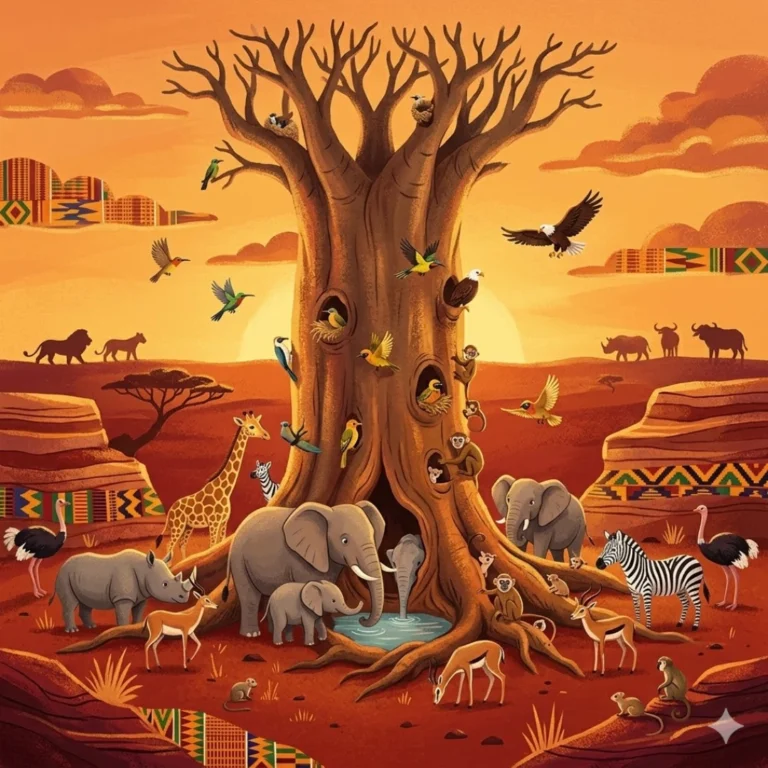
Why does the baobab tree look upside down? Because it once refused to share—and learned the true meaning of giving.
In the beginning, the baobab tree was the most beautiful tree in Africa. It grew straight and tall with glossy leaves, and it thought itself the finest of all God’s creations.
When the giraffe asked to shelter under its leaves, the baobab refused. “Your rough neck will scratch my bark.”
When the weaver birds asked to build nests in its branches, the baobab refused. “Your nests will tangle in my beautiful hair.”
When the elephant asked for its fruit during the dry season, the baobab refused. “If I feed you, I will have nothing for myself.”
God watched and grew sorrowful. He had given this tree deep roots, thick bark, and fruit full of vitamins—gifts meant to be shared with all the creatures of the savannah.
One evening, God called all the trees together. He listened to how each one had served the animals and birds. The fig tree fed the monkeys. The marula gave fruit to the elephants. The fever tree sheltered birds. The acacia fed the giraffes.
Then he listened to the baobab’s silence.
“You have received more than any tree,” God said quietly to the baobab. “And you have given nothing.”
That night, God pulled the baobab up by its roots and replanted it upside down—roots waving at the sky, branches buried in the earth.
Now the baobab cannot refuse. Bats drink its flowers. Elephants eat its bark. Birds nest in its hollows. Baboons devour its fruit. Small animals shelter in the cracks of its trunk.
Upside down and exposed, the baobab finally became what it was always meant to be: a great giver of life to the entire savannah.
The trees whisper to each other at sunset, and this is what they say: no matter how magnificent you are, your gifts are not truly yours until you share them.
Moral of the Story
Gifts and talents are not truly ours until we share them. Generosity is not loss—it is the reason we were given gifts in the first place.
Learn These Words
- savannah
- a flat grassland with some trees, found in Africa
- devour
- to eat something quickly and hungrily
- magnificent
- impressively beautiful or great
- shelter
- a place that provides protection from bad weather
- vitamins
- natural substances in food that keep us healthy
Test Your Understanding
1Why did the baobab refuse to help other animals?
2What did God do to teach the baobab a lesson?
3After being replanted upside down, who does the baobab help?
4What gift had God given the baobab?
5What lesson does this story teach?
Frequently Asked Questions
Why does the baobab tree look like it’s upside down?
According to African folklore, the baobab tree was once the most beautiful tree in Africa but refused to share its shade, branches, or fruit with any animals. As a consequence, God turned it upside down so its roots face the sky. The story teaches children that gifts and talents are meant to be shared with others, not hoarded selfishly.
What is the moral of the baobab tree story?
The moral is that true beauty comes from generosity, not appearance. The baobab received deep roots, thick bark, and nutritious fruit—all gifts meant for sharing. When it selfishly kept everything for itself, it lost its outward beauty. The story reminds children that what we give matters more than what we have.
What animals does the baobab tree refuse to help in the story?
The baobab refuses three animals: the giraffe, who asks for shelter under its leaves; the weaver birds, who want to build nests in its branches; and the elephant, who asks for fruit during the dry season. Each time, the baobab makes a selfish excuse, worried only about preserving its own beauty and resources.
📚 Recommended Books
Handpicked for readers like you
As an Amazon Associate, we earn from qualifying purchases. These recommendations are personalized based on this story's themes and your reading history.
Is the baobab tree story based on a real African folktale?
Yes, the tale of the upside-down baobab tree is rooted in traditional African folklore told across many cultures, including those of East and Southern Africa. Various versions exist, but they share the common theme that the baobab’s unusual appearance is a divine punishment for vanity or selfishness, making it a beloved teaching story for children.
What makes baobab fruit special in real life?
Baobab fruit is packed with vitamins, particularly vitamin C, calcium, and antioxidants. In the story, God specifically gave the baobab fruit full of vitamins as a gift meant to nourish savannah animals. In real life, baobab fruit is used across Africa in drinks, porridges, and health supplements, reflecting the story’s message that nature’s gifts are meant to be shared.