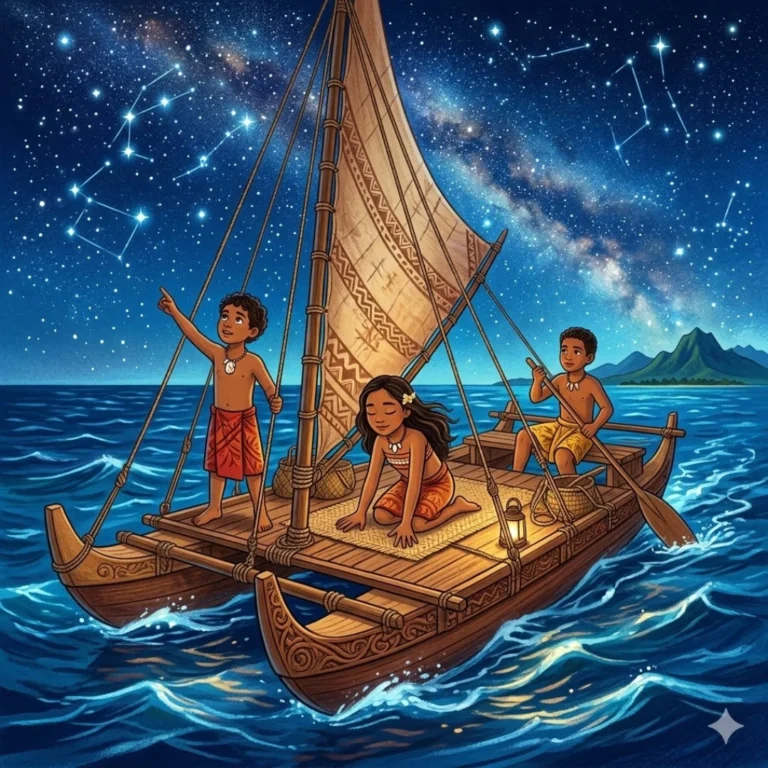
The island of Raiatea, which the old people call the cradle of Polynesia, lies in a lagoon of such perfect blue that looking at it from above – if the frigatebirds will lend you their view for a moment – it seems less like water than like the sky fallen sideways, with the coral reefs as clouds and the fish as small bright birds moving through them.
On this island lived a girl named Mehani, who was eleven years old and had a problem.
Her problem was this: she was the worst navigator in her family by a significant margin, and her family were navigators. Her father could steer a waka hourua – a double-hulled sailing canoe – across six hundred miles of open ocean using only the stars and the swells and the flight patterns of birds. Her mother had memorized the wind roses of thirty-seven island approaches. Her grandmother had, at the age of sixteen, piloted a canoe through the Cook Islands in zero visibility in a storm, using only her hands on the hull to feel the current patterns.
Mehani got seasick. This was extremely embarrassing.
It was not that she didn’t love the ocean. She loved it profoundly. She could sit on the reef for hours watching the way the swell came in from the northwest in the dry season, reading the patterns the way her family read pages. She understood currents. She knew the birds. She could tell you what the morning cloud formations meant for afternoon wind. She had all the knowledge.
She just could not steer a canoe in a straight line without the horizon going wrong on her.
The great voyage was coming.
Every three years, the community made a navigated voyage to the island of Huahine – sixty miles across open water, conducted without instruments, using only traditional wayfinding. Young people of twelve and above made the voyage under the instruction of the elders. It was, for Mehani’s family, the occasion of occasions. You either sailed or you were left behind, and being left behind was a thing she would not accept.
“What do I do?” she asked her grandmother, who was called Vahine Roa – the long woman – because she had been tall once and remembered it.
Vahine Roa sat with her for a long time without speaking, which was her way of thinking out loud.
“Tell me every star you know,” she said at last.
Mehani told her. She knew them all: the stars rising and setting and their seasonal positions, the star paths that linked the islands like roads. She knew them cold, knew them in her head with perfect precision.
“And the swells?”
“The long south swells run at that angle to the canoe in the crossing. The northern chop is short-period and comes from the right. You can feel which is which on the hull.”
“And the birds?”
“Noddy terns mean we’re within thirty miles of land. Frigatbirds fly toward islands at evening. Boobies point to fishing grounds which are downstream of reefs which are -“
“Stop,” said Vahine Roa. “You know everything.”
“But I cannot -“
“You cannot do it alone,” said her grandmother, with particular emphasis on the last word. “Who said the navigator does it alone?”
Mehani stopped.
“On the great voyages,” said Vahine Roa, “in the old times, there were always three navigators on every canoe. Not because one was not enough. Because two eyes see a star and three eyes see the path. Because when one is sick or tired or uncertain, the others carry what they know.” She looked at Mehani steadily. “What you have is knowledge. What you need is to share it and be held in return. That is navigation. That is also life.”
Mehani began to practice differently.
Instead of trying to steer alone, she worked with two others: her cousin Hiro, who had excellent sea-legs and directional instinct but couldn’t identify stars for anything, and a boy called Taane who could feel the swells through the hull better than anyone but panicked in open water and needed someone beside him talking through the logic.
They trained together every morning in the lagoon, then ventured outside the reef on calmer days. Mehani called the stars. Hiro held the course. Taane felt the current and reported. The three of them cross-checked each other constantly, and between them they held what none could hold alone.
Mehani’s seasickness did not disappear entirely. It lessened considerably, and she discovered that when she was actively navigating – calling stars, checking swells, staying focused – it was manageable in a way it hadn’t been when she’d been trying to steer and navigate simultaneously alone.
The voyage day came, grey and windy, the sea outside the lagoon serious with three-foot swells.
Mehani stood at the bow with her hand on the carved prow and looked at the horizon.
Behind her, Hiro said: “Ready when you are.”
Beside her, Taane said: “The swell’s from the south-southwest. We want it on our left quarter.”
The stars were there in her mind, the complete map of them, the path to Huahine laid out clear.
She gave the heading.
They sailed.
The crossing took eight hours in the following wind, and for seven of those eight hours Mehani was neither sick nor afraid. She was busy – reading the stars in the daytime by their positions relative to the horizon, checking the swells against Taane’s felt sense of them, watching the frigatebird that had appeared an hour before landfall and started flying southwest.
“Land ahead,” she said.
An elder two canoes over heard this and looked. The green smear of Huahine appeared on the horizon seventeen minutes later.
Vahine Roa came to find her that evening on the beach.
Mehani was sitting with Hiro and Taane, tired and salt-crusted and very pleased with themselves in the quiet way of people who have done something real.
“You found it,” said her grandmother.
“We found it,” said Mehani.
Vahine Roa looked at the three of them. The approval on her face was the kind that requires no words, and she gave it no words.
She sat down on the sand with them to watch the stars come out over the Pacific, each one in its place, the whole sky mapping the ocean below, everyone needed, everyone connected, the whole thing making sense only because of all its parts together.
The wayfinding sky. The community of stars.
The Moral of This Story
We are each a star, but together we are the sky that guides the navigator home
About This Story’s Culture
This story is set in Raiatea (Society Islands, French Polynesia), traditionally considered the religious and cultural center of ancient Polynesian civilization and the departure point for migrations across the Pacific. Polynesian wayfinding navigation is one of humanity’s great achievements – Polynesian navigators settled the Pacific using only stars, ocean swells, cloud patterns, and bird behavior, navigating distances up to 4,000 miles without instruments. The Polynesian Voyaging Society and the Hokule’a project have revived this tradition since the 1970s. The waka hourua (double-hulled voyaging canoe) is central to Pacific cultures from Hawaii to New Zealand. Traditional Polynesian navigation was often practiced by specialist families and passed from generation to generation. The names Mehani, Hiro, and Taane are authentic Polynesian/Tahitian names.
Key Story Elements
- Mehani – an eleven-year-old Polynesian girl from a family of navigators who gets seasick
- Vahine Roa – the grandmother who teaches that navigation was never meant to be solo
- The three-person crew: Mehani (stars), Hiro (course-holding), Taane (swell-reading)
- The triennial voyage to Huahine as the high-stakes test of traditional wayfinding knowledge
- Lagerlöf’s epic-journey structure: preparation, departure, the crossing, arrival
- The frigatebird appearing an hour before landfall – traditional wayfinding in action
- The final image: stars as community, the whole sky making sense only because of all its parts
Frequently Asked Questions
What is ‘The Girl Who Sailed by Stars’ about?
It’s a children’s story about Mehani, an eleven-year-old girl from the Polynesian island of Raiatea who struggles to become a navigator like her talented family. The story explores themes of community, perseverance, and finding your own unique strengths through the lens of traditional Polynesian wayfinding.
What age group is ‘The Girl Who Sailed by Stars’ suitable for?
The story is written for children aged 6 to 12, with a reading time of about 8 to 10 minutes. It uses rich, descriptive language that slightly older children can fully appreciate, while younger kids will enjoy the adventure and relatable main character struggling to fit in.
What Polynesian tradition is this story based on?
The story draws on traditional Polynesian navigation, where skilled wayfinders sailed thousands of miles across open ocean using only stars, ocean swells, wind patterns, and bird flight paths — no modern instruments. This ancient practice, known as wayfinding, originated around islands like Raiatea in what is now French Polynesia.
📚 Recommended Books
Handpicked for readers like you
As an Amazon Associate, we earn from qualifying purchases. These recommendations are personalized based on this story's themes and your reading history.
What is a waka hourua?
A waka hourua is a traditional Polynesian double-hulled sailing canoe designed for long-distance ocean voyaging. These remarkable vessels carried Polynesian explorers across hundreds or even thousands of miles of open Pacific Ocean, guided purely by natural navigation techniques passed down through generations.
What lessons or themes does ‘The Girl Who Sailed by Stars’ teach children?
The story centres on community and belonging, showing that everyone contributes differently to a group. Mehani’s journey teaches children that struggling at something others find easy doesn’t make you a failure — it can lead you to discover a unique strength that the whole community needs.