

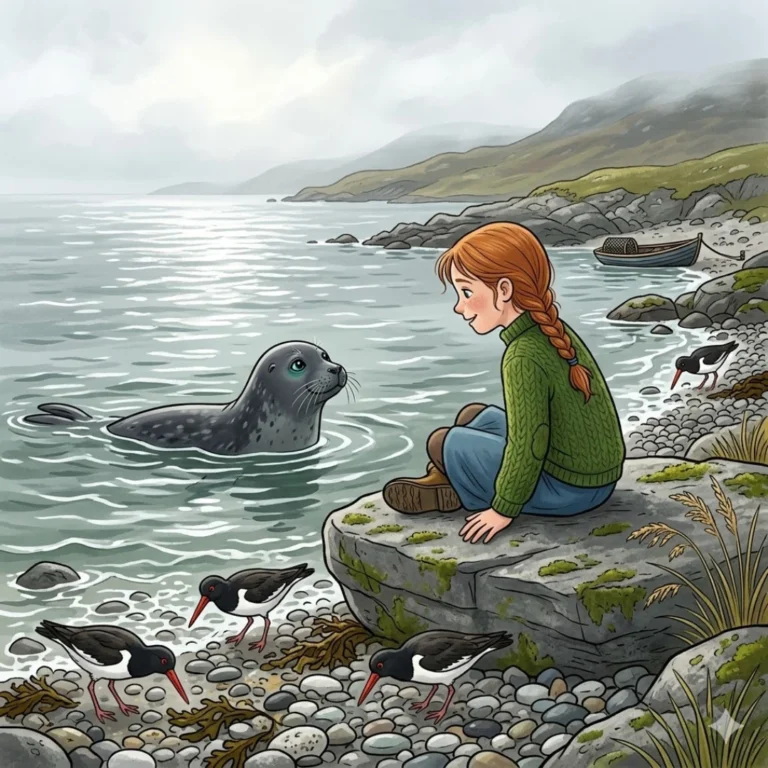
There are two shores to every sea.
One shore you can walk on, and that is the ordinary shore of stones and wrack and the smell of brine, where the oystercatchers run in the tideline and the seals come out to sun themselves on the flat rocks in long patient rows. This is the shore of the ordinary world.
The other shore is the one inside things, the one that the waves remember in their deepest motion, the one the selkies know and hold the way they hold their skins when they come ashore – carefully, because it is the difference between what they are and what they appear to be.
Caitriona was ten years old and she had grown up on the stone shore of the Hebrides, in a house where the wind came off the Atlantic sideways and the garden grew low to the ground because anything that grew upward was taught quickly by the weather to reconsider.
Her mother had a sealskin.
This was not the strange part. Her mother had explained it to her when she was seven, in the matter-of-fact way of someone who has lived with a truth long enough that it has become simply a fact: she was a selkie, born in the sea, and the skin hung in the cupboard wrapped in oilcloth was the seal-shape she had been before she came ashore. She had chosen to stay. She had wanted a family more than she had wanted the sea. But the skin was kept, because a selkie without her skin is not quite herself, only slightly less than herself, and that slightly-less must be honoured.
Caitriona had understood this at seven the way children understand things that are true in their house: as simply the case. She had grown up in a house that smelled faintly of salt even on dry days, and her mother swam in November while other people’s mothers stayed indoors, and some mornings her mother stood at the kitchen window looking out at the sea with an expression Caitriona couldn’t name.
On a Tuesday in November, when Caitriona was ten and the sea was grey-green and serious, her mother came to her and sat down at the kitchen table and said: “I need to go back.”
Caitriona had always known this was possible. She had not always believed it would happen.
“For how long?” she said.
Her mother’s hands were folded on the table in the careful way of someone who is holding something heavy. “I don’t know. the sea calls when it calls and the length of it is not mine to decide.” She looked at her daughter. “You have my eyes. And your father’s stubbornness. And something of your own that is not from either of us, which is the best inheritance.”
“I don’t want you to go.”
“I know.”
“Then why -“
“Because I am also that,” said her mother simply, looking at the cupboard where the oilcloth was. “I love you and your father and this house and the low garden and the oystercatchers. And I am also something that needs the sea the way you need air. I cannot be fully myself on land any longer. And a mother who is not fully herself is not what you need.”
Caitriona sat with this for a long time. The November wind talked to the window.
“Will I see you again?”
“On the shore,” said her mother. “When the seals come up on the flat rocks. You will know me.”
“How?”
“Because I will look at you the way I always look at you.”
The morning her mother left, Caitriona walked with her to the shore. The oilcloth bundle was under her mother’s arm. The sea was the color of pewter in the grey morning light, and the waves came in from the northwest the way they always came, the long Atlantic swells that had traveled a thousand miles to arrive at this specific shore.
Her mother paused at the waterline. She turned and held Caitriona for a long time without saying anything.
Then she walked into the water.
Caitriona stood on the shore and watched the thing that happens next, which is not described here because some things are for the person watching only.
She walked home alone. The oystercatchers were already on the tideline, doing what oystercatchers do. The low garden was still there. The house still smelled of salt.
She was a different shape now, she thought. The way the shore is a different shape after each tide. Not broken. Reshaped.
In the spring, when the seals came up on the flat rocks in their long patient rows, she walked to the shore.
One seal was watching her from the moment she came over the rise. Waiting for her to appear, the way something watches for a specific person in a crowd.
She sat on the cold stone and they looked at each other.
The seal looked at her the way she always looked at her.
Caitriona breathed.
She had thought loss was an ending. She understood now that it was also a shore – another shore, the one inside things, the one that the waves remember. She had arrived here. She was standing on it. It was solid under her feet.
The seal slipped back into the water as silently as a thought that has done what it came to do.
Caitriona walked home along the stone shore, which was her shore – the one she could walk on, the one of oystercatchers and wrack and brine – and she walked it fully and entirely, because she was Caitriona of both shores now, and she was learning what that meant.
The Moral of This Story
Every ending is a becoming – what we let go of makes room for what we are meant to be
About This Story’s Culture
The selkie myth is one of the oldest and most distinctive legends of the Scottish and Irish coastal traditions, particularly the Hebrides and Orkney islands. Selkies are seal-people who can shed their skins to take human form – in most traditional versions, a fisherman steals a selkie woman’s skin, forcing her to stay on land, often as his wife, until she finds the skin and returns to the sea. This story reimagines the tradition with the selkie’s choice respected and explained to her child, reflecting a more contemporary understanding while honoring the authentic mythological structure. The Hebrides setting with its characteristic weather (Atlantic winds, November storms), wildlife (oystercatchers, grey seals on flat rocks), and coastal landscape is authentic. The name Caitriona is the Scottish Gaelic form of Catherine, and is pronounced approximately KAH-tree-on-ah.
Key Story Elements
- Caitriona – a ten-year-old Hebridean girl whose selkie mother must return to the sea
- The mother’s honesty: I love you and I am also that – two truths at once, neither canceling the other
- Andersen’s poetic melancholy: the November sea grey-green and serious, the low garden, the salt smell
- The oilcloth bundle: the sealskin kept because a selkie without her skin is slightly less than herself
- The transformation as two shores: the ordinary shore and the one inside things
- The spring reunion on the flat rocks: the seal who looks at her the way she always looked at her
- Caitriona walking home as a child of both shores – not broken, reshaped
Frequently Asked Questions
What is The Selkie’s Child and the Stone Shore about?
It’s a Celtic fantasy story for children aged 6-12 about a girl named Caitriona who grows up on the Hebrides shore and discovers her mother has a sealskin, revealing her selkie heritage. The story explores themes of transformation, identity, and belonging between two worlds — the ordinary world and the magical one beneath the waves.
What is a selkie in Celtic mythology?
A selkie is a creature from Celtic and Norse folklore that lives as a seal in the sea but can shed its skin to take human form on land. Selkies appear widely in Scottish, Irish, and Icelandic traditions. In stories like The Selkie’s Child, the sealskin is deeply important — it represents the selkie’s true nature and their connection to the sea.
Is The Selkie’s Child and the Stone Shore suitable for young children?
Yes, the story is written for children aged 6-12 and takes about 8-10 minutes to read. It uses gentle, lyrical language rooted in Celtic tradition and explores themes of transformation and identity in an age-appropriate way, making it ideal for bedtime reading or classroom storytelling.
📚 Recommended Books
Handpicked for readers like you
As an Amazon Associate, we earn from qualifying purchases. These recommendations are personalized based on this story's themes and your reading history.
What themes does this selkie story explore for kids?
The main theme is transformation — the idea that people, and magical beings, can exist between two different worlds or identities. It also touches on family secrets, belonging, and the difference between how things appear and what they truly are, all explored through the eyes of a curious ten-year-old girl on a Scottish island.
Where is the stone shore setting in this story?
The stone shore is set in the Hebrides, a group of islands off the west coast of Scotland. It’s described as a wild, windswept Atlantic coastline where seals sun themselves on flat rocks and the weather shapes everything that grows. The rugged, real-world setting contrasts beautifully with the hidden magical world the selkies know.
