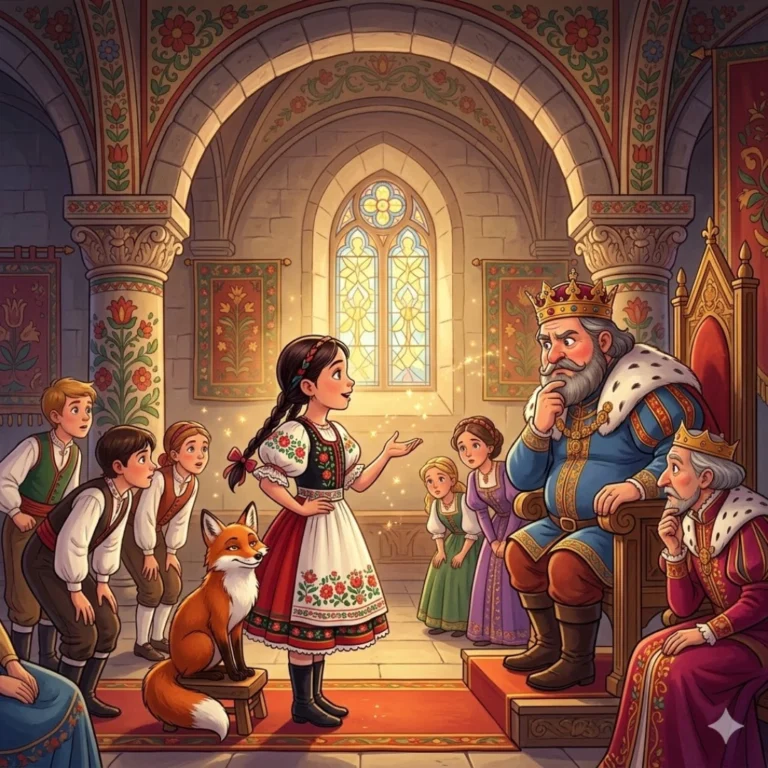
In the kingdom of Greater Hungary, which was surrounded by the Carpathians on three sides and a great deal of national pride on all four, there was a king who had a problem with his riddles.
The problem was not, as you might expect, that nobody could solve them. The problem was that everybody could. The king had been posing riddles at court for thirty-seven years and in that time had never once stumped anybody permanently, which he found deeply unsatisfying. He was a decent king in most respects – reasonable tax policy, excellent paprikás, a genuine fondness for the Danube – but he had the unfortunate habit of all puzzle-solvers: the moment a puzzle was solved, it stopped being interesting.
He announced the Royal Riddle Competition.
The terms were these: whoever posed a riddle that the king could not solve would receive a prize beyond all prizes – which was, specifically, the king’s favorite horse, his best sword, and the right to be called Clever for the rest of their life, which was more valuable in that particular kingdom than it sounds.
A girl called Bori, who was eleven years old and lived in the village of Tata by the lake that reflects the old castle walls, heard about the competition and decided to enter.
This was considered, by her three older brothers and her father and the miller’s wife who lived next door, to be an ambitious decision for an eleven-year-old who was not even the third son, let alone the king.
“I have an advantage,” said Bori.
“What advantage?” said her oldest brother.
“I have a fox,” she said.
The fox had arrived three weeks ago. It had appeared in the kitchen doorway one evening, assessed the situation (warm, food on the table, relatively chaos-free), and had apparently decided to stay. It was a red fox, the regular kind, with the additional quality of being able to talk, which nobody in the family had commented on directly because they weren’t sure what the correct etiquette was.
The fox’s name was Ravasz, which means clever in Hungarian and also, as it happens, fox, which suggested the fox had named itself, which was exactly the kind of thing Ravasz would do.
“I cannot go to the competition,” said Ravasz. “I am a fox and they will make me into a hat.”
“Then tell me a riddle that a king cannot solve.”
“I will do better than that,” said Ravasz. “I will tell you the secret of all riddles, which is more useful than any single riddle.”
“Is the secret of all riddles also a riddle?”
“Obviously,” said the fox. “The secret of all riddles is this: a riddle is not a question. It is an invitation to think differently. The king cannot solve the riddles because he cannot solve them, which is a different problem than the riddles themselves being unsolvable.”
Bori thought about this. “He can solve them. He’s solved thirty-seven years’ worth.”
“He can solve riddles that are shaped like riddles. He cannot solve a riddle that is shaped like a conversation.” The fox cleaned its ear with its paw in the thoughtful way of foxes. “Here is your riddle. You must ask it in three parts and the third part is the answer to the first part and the king will not know when the riddle is finished.”
Bori listened very carefully.
At court, she was not the youngest contestant – there was a child of eight from Debrecen who had brought a riddle about shadows that was genuinely good. Nor was she the only girl – there was a grandmother from Sopron who had a riddle about time that kept three advisors busy for an hour. But Bori waited, because Ravasz had said the order mattered.
When her turn came, she said:
“Your Majesty. I have a riddle that begins before I start and ends after I stop. May I ask it?”
The king was intrigued despite himself. “Ask.”
“First part,” said Bori: “What has legs but cannot walk?”
“A table,” said the king immediately.
“Second part,” said Bori: “What walks without legs?”
“Water,” said the king, also immediately.
“Third part,” said Bori: “What fills the space between a table and water?”
The king opened his mouth. Closed it. Opened it again.
His advisors leaned together and murmured.
The king thought about tables and thought about water and thought about what lived between them. A tablecloth? A floor? A boat? The space between solid and liquid?
“The table is near water,” he said. “It is – a pier? A dock?”
“No, Your Majesty.”
“A fish market table?”
“No.”
A long, interesting silence.
“What is the answer?” said the king.
“Thirst,” said Bori. “Thirst has no legs but is carried everywhere. Thirst is filled by water. Thirst lives in the space between the table set for dinner and the water not yet poured. And thirst was the answer to the first riddle too, if you think about it – what has legs but cannot walk by itself, because it needs someone else’s legs to take it to water.”
The king looked at her for a long moment. Around the room, the advisors were doing the thing that advisors do when someone has surprised them: making various faces at the ceiling.
“That,” said the king, “is either a very good riddle or a very poor one. I cannot decide which.”
“Both,” said Bori. “The secret of a riddle that cannot be solved is that it exists at the border between a good riddle and a poor one. You can’t solve a border. You can only cross it.”
The king was quiet for a moment that stretched pleasantly.
“Where did you learn this?”
“A fox told me,” said Bori.
“Foxes are not known for wisdom.”
“This one is. He is also very warm in winter, which is a different kind of wisdom.”
The king awarded her the prize. He also kept corresponding with her about riddles for the next eleven years, which was, if anything, more satisfying than the horse.
Ravasz was waiting at home, cleaning his other ear.
“You won,” he observed.
“The clever mind won,” said Bori. “The clever heart is that I came home to tell you about it.”
The fox made a sound that was either a laugh or a sneeze. With foxes, these can be difficult to distinguish.
The Moral of This Story
A clever mind is a gift; a clever heart is a treasure
About This Story’s Culture
Hungary has a rich folk tale tradition featuring cunning heroes, talking animals, and clever peasants who outwit nobles. The fox (ravasz, meaning both ‘fox’ and ‘cunning/clever’ in Hungarian) is a quintessential trickster figure in Hungarian and broader Central European folklore. The setting features authentic Hungarian geography: Tata is a real lakeside town with a famous castle reflection; the Danube, Sopron, and Debrecen are all real Hungarian places. Paprikás (chicken or veal in paprika sauce) is an authentic Hungarian national dish. The Royal Riddle Competition as a story device draws on the widespread Hungarian fairy tale tradition of tasks set by kings or magic beings – these stories (meséks) are a major part of Hungarian oral literary tradition, often featuring clever youngest children or unlikely heroes.
Key Story Elements
- Bori – an eleven-year-old Hungarian girl who enters the Royal Riddle Competition with a talking fox’s help
- Ravasz the fox – self-named ‘Clever’, who teaches the secret of all riddles rather than a single riddle
- The king who cannot be stumped because every riddle is shaped like a riddle
- Carroll’s absurdist whimsy: the fox arriving and being kept because ‘the etiquette wasn’t clear’
- The three-part riddle about thirst – a riddle shaped like a conversation that you can’t solve, only cross
- The border between a good riddle and a poor one as the unanswerable space
- The fox’s sneeze/laugh – Carroll’s final undecidable element
Frequently Asked Questions
What is The Talking Fox and the King’s Riddle about?
It’s a Hungarian folk tale about a king who loves riddles but can never be stumped, and a clever girl named Bori who teams up with a talking fox to challenge him. The story blends wit, humor, and old-world charm, making it perfect for kids who enjoy puzzle-solving and trickster tales.
What age group is The Talking Fox and the King’s Riddle suitable for?
This story is recommended for children aged 6 to 12. It has an 8 to 10 minute reading time, making it great for a bedtime story or a quick classroom read. The language is playful and accessible, though older kids will enjoy the clever wordplay even more.
Where does the talking fox story come from?
The story is rooted in Hungarian folk tradition. It’s set in a fictional version of Greater Hungary, drawing on the cultural flavor of the Carpathian region. Talking animal helpers are a classic feature of Central and Eastern European fairy tales, where clever creatures often guide young heroes to outsmart those in power.
📚 Recommended Books
Handpicked for readers like you
As an Amazon Associate, we earn from qualifying purchases. These recommendations are personalized based on this story's themes and your reading history.
What is the main theme of The Talking Fox and the King’s Riddle?
The main theme is cleverness. The story celebrates quick thinking and creative problem-solving over wealth or status. It shows that an ordinary village girl with a sharp mind — and a little help from a witty fox — can outwit even a king who believes he’s seen everything.
What prize does the king offer in the riddle competition?
The king promises his favorite horse, his best sword, and the lifelong title of ‘Clever’ to anyone who poses a riddle he cannot solve. In the story’s world, being officially called Clever is described as more valuable than it sounds — which gives you a hint about how much wit is prized in this kingdom.