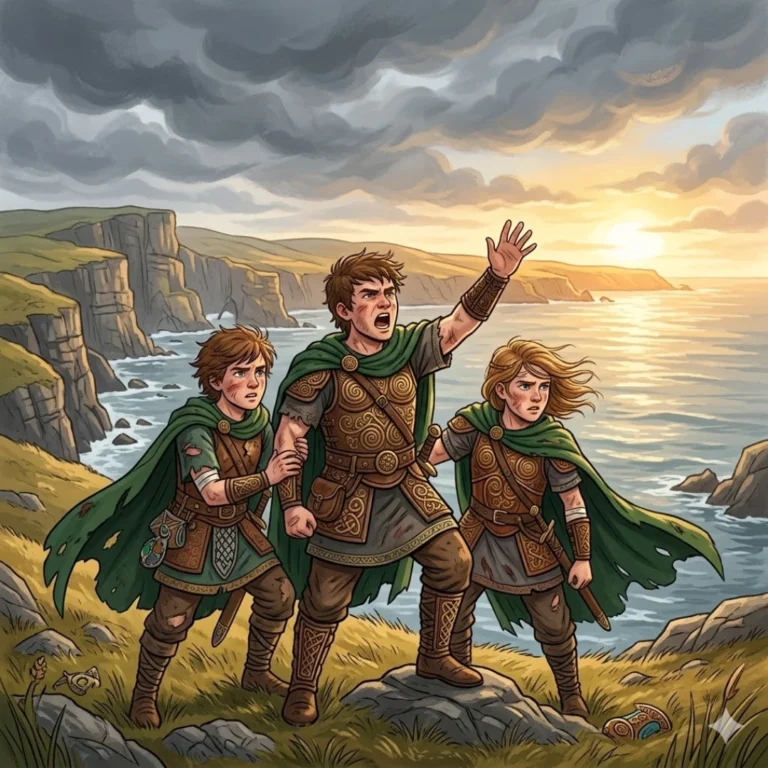
Three brothers commit a terrible act and must complete eight impossible quests to pay for it—teaching that responsibility means finishing what you started.
In ancient Ireland, the three sons of Tuireann—Brian, Iuchar, and Iucharba—did a terrible thing. In a quarrel, they killed Cian, who was the father of the great god Lugh.
When Lugh discovered what had happened, he did not draw his sword. Instead, he folded his hands.
“You must pay the eric fine,” he said. The eric fine was the ancient Irish way: if you caused harm, you must make it right.
The fine he named was this: eight tasks. Each one harder than the last.
The brothers had to bring three golden apples from the garden at the world’s end. A poisoned pigskin that could heal any wound. A magical spear that always found its mark. A chariot pulled by horses that could run across water and sky. Seven pigs that could be killed and eaten each evening and would be alive again each morning. A hound puppy from the king of Ioruaidhe. A cooking spit from the underwater women of Fincara. Three shouts on the Hill of Miochaoin where shouting was forbidden.
Task by task, wounded and exhausted, the three brothers completed seven of the eight.
The last—the three shouts on the forbidden hill—nearly killed them. Brian carried his brothers up the hill. He gave the first shout. Iuchar gave the second. Iucharba, though dying, gave the third.
They had done it.
They brought Lugh the final token. But they were mortally wounded.
Their father Tuireann begged Lugh for the healing pigskin they had won. Lugh refused.
Some stories end there. But the sons of Tuireann are remembered not for how they died—but for the fact that however terrible their crime and however cruel the penalty, they completed every task they were given. They did not run. They did not stop.
Responsibility means finishing what you started, even when the cost is high.
Moral of the Story
When we cause harm, responsibility means facing the consequences fully and not stopping until we have done all we can to make things right.
Learn These Words
- eric fine
- in ancient Irish law, a payment made to compensate for a wrong done to someone
- mortal
- relating to death; unable to live forever
- penalty
- a punishment for breaking a rule or law
- quest
- a long journey undertaken to find or achieve something
- token
- an object that represents something larger or more important
Test Your Understanding
1What wrong did the sons of Tuireann commit?
2How many tasks did Lugh give the brothers as punishment?
3What happened to the brothers at the Hill of Miochaoin?
4What did the brothers’ father ask Lugh for?
5What lesson does this story teach?
Frequently Asked Questions
What is the story of the Children of Tuireann about?
The Children of Tuireann is an ancient Irish myth about three brothers—Brian, Iuchar, and Iucharba—who kill Cian, father of the god Lugh. As punishment, they must complete eight nearly impossible quests. The story teaches that when you cause harm, you are responsible for making it right, no matter how difficult that becomes.
What are the eight tasks the sons of Tuireann had to complete?
Lugh assigned the brothers eight legendary quests: retrieving three golden apples, a healing pigskin, a magical spear, a sky-crossing chariot, seven regenerating pigs, a king’s hound puppy, an underwater cooking spit, and giving three shouts on a hill where shouting was forbidden. Each task was harder and more dangerous than the last.
What is an eric fine in Irish mythology?
An eric fine was a traditional ancient Irish form of justice requiring someone who caused harm to make full restitution to the victim or their family. Rather than seeking revenge through violence, the wronged party could demand payment or the completion of set tasks—a way of restoring balance and accountability.
📚 Recommended Books
Handpicked for readers like you
As an Amazon Associate, we earn from qualifying purchases. These recommendations are personalized based on this story's themes and your reading history.
What moral lesson does the Children of Tuireann teach children?
The story teaches that true responsibility means finishing what you started, even when it’s hard. The brothers caused harm through a terrible act and had to face the consequences by completing every quest, no matter how exhausted or wounded they became. It shows that making things right requires courage and follow-through.
Is the Children of Tuireann suitable for kids?
Yes, with some guidance. While the story involves a killing and dangerous quests, it’s a classic Irish myth rich in adventure and moral meaning. The core themes—accountability, perseverance, and repairing harm—are very relevant for children. Parents may want to read it alongside younger kids to discuss the consequences of the brothers’ actions.