

The trickster god makes a bet he plans to cheat—but learns that the gods and dwarves do not forget, and that dishonesty always carries a price.
Loki, the trickster god of Asgard, had a talent for promises he did not intend to keep.
One day, the gods were arguing about the walls of Asgard, which had crumbled. A stranger on a large horse offered to rebuild them—better than before, in exchange for Freya, the sun, and the moon.
The gods refused. But Loki suggested they accept, with an impossible condition: the walls must be finished in one winter, using no other help than the horse.
The stranger agreed.
Loki thought: impossible. We’ll get half a wall and pay nothing.
But the horse was no ordinary horse—it was Svadilfari, the strongest animal alive. The walls grew at astonishing speed. As the last night of winter approached, the walls were nearly complete.
The gods turned on Loki. “You got us into this. Fix it.”
Loki did fix it—in the most Loki way imaginable. He transformed himself into a mare and led Svadilfari away from the work, causing the stranger (who was revealed as a frost giant) to miss the deadline.
The frost giant raged. Thor dispatched him.
Asgard was saved. Loki had been clever, as always.
But the dwarves heard of Loki’s tricks. Later, when Loki made a bet with the dwarf Brok—wagering his own head—and then tried to escape with a loophole, Brok caught him.
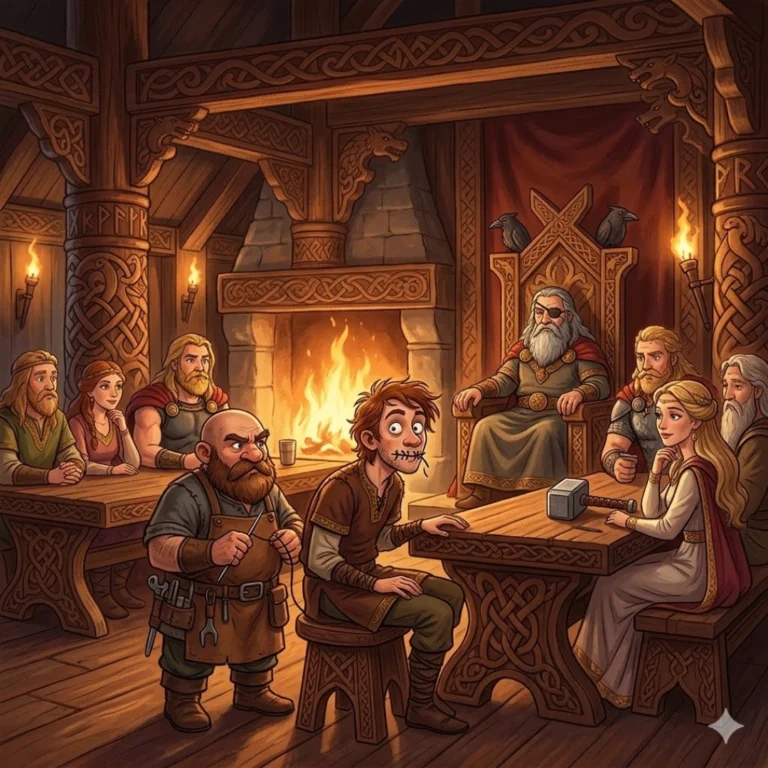
“You bet your head,” said Brok. “I cannot cut your neck—you said so yourself. But I can sew your lips shut.”
He did.
Loki sat in the great hall of Asgard with his lips sewn closed, unable to speak, unable to trick.
the gods watched quietly. Some felt sorry for him. But all of them remembered: he had done this to himself.
Tricks work once, twice, many times. But people who are tricked remember. Eventually, the one who cannot keep a promise runs out of people who believe them.
Moral of the Story
Dishonesty and trickery may work in the short run—but every broken promise builds a wall between you and the trust of others. Eventually the tricks run out.
Learn These Words
- trickster
- someone who uses cleverness and deception to get what they want
- loophole
- an ambiguity in a rule or agreement that allows someone to avoid it
- astonishing
- extremely surprising
- dispatch
- to deal with someone quickly and decisively
- wager
- a bet; an agreement where you risk something on an outcome
Test Your Understanding
1What did the stranger demand in exchange for rebuilding Asgard’s walls?
2How did Loki stop the horse Svadilfari?
3What did Brok do to Loki when he tried to escape the bet?
4What was Loki unable to do with his lips sewn?
5What lesson does this story teach?
Frequently Asked Questions
What is the story of Loki’s broken promise about?
Loki’s Broken Promise retells the Norse myth in which Loki convinces the gods to accept a stranger’s offer to rebuild Asgard’s walls, believing the task is impossible to finish on time. When the builder nearly succeeds, Loki must use trickery to prevent the gods from losing Freya, the sun, and the moon—learning that dishonesty always carries consequences.
Who was the stranger that offered to rebuild Asgard’s walls?
The stranger who offered to rebuild the walls of Asgard turned out to be a frost giant in disguise. He used his incredibly powerful horse, Svadilfari, to haul stones at superhuman speed. The gods only discovered his true identity after he nearly completed the impossible task within the single-winter deadline Loki had set.
Why did Loki suggest accepting the stranger’s deal?
Loki believed the condition he attached—finishing the walls in one winter using only the builder’s horse—was truly impossible. He assumed the gods would get a partially rebuilt wall for free, paying nothing. It was a bet Loki planned to cheat from the start, but the scheme backfired when Svadilfari proved extraordinarily strong.
📚 Recommended Books
Handpicked for readers like you
As an Amazon Associate, we earn from qualifying purchases. These recommendations are personalized based on this story's themes and your reading history.
What moral lesson does Loki’s broken promise teach kids?
The story teaches children that dishonesty and broken promises always come with a price. Even though Loki thought he was being clever, his trickery put everyone at risk and damaged the trust others had in him. It’s a powerful reminder that making promises you never intend to keep can harm your relationships and reputation.
Is the myth of Loki and the builder of Asgard’s walls a real Norse legend?
Yes, this story comes from the Prose Edda, a 13th-century collection of Norse mythology written by Snorri Sturluson. It is one of the most well-known tales about Loki and explains how Asgard’s great fortifications were built. The retelling here is adapted for younger readers with a focus on its moral lesson.
