A warrior goddess loses everything—then chooses what kind of life to build from the ruins.
When the Norse gods killed Thiazi the frost giant, his daughter Skadi put on her armour, picked up her weapons, and marched to Asgard to demand justice.
The gods were impressed by her boldness. They offered her compensation: she could choose a husband from among them—but she had to choose by looking only at feet.
Skadi wanted Baldur the Beautiful. She chose the most elegant feet she saw.
They belonged to Njord, the god of the sea.
They were married. For a time, they tried to make it work. They spent some months in his home by the ocean, and some months in her mountain hall.
But Njord could not bear the howling wolves of the mountain. And Skadi could not bear the screaming of the seabirds by the shore. They tried to love each other. They simply could not share a home.
They parted. Some poems say sadly. Others say—and this is what Skadi remembered—with respect.
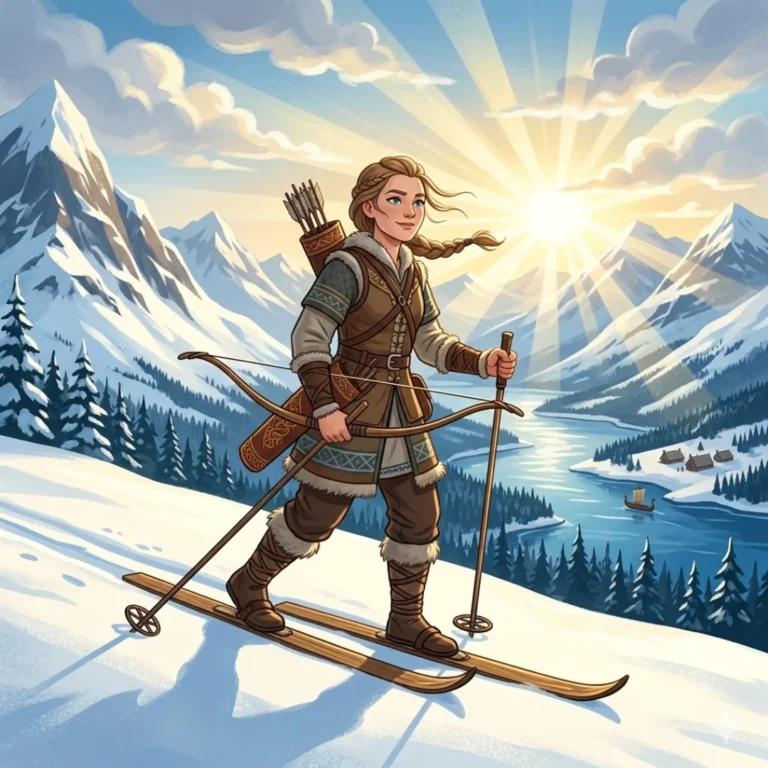
Skadi returned to her mountains. She put her skis on, picked up her bow, and went hunting.
She did not spend her days mourning what she had lost. She was, by nature, a creature of cold peaks and deep silence, and she returned to herself with something like relief.
The Norse peoples remembered Skadi as the goddess of hunting, skiing, and winter—not as the widow of a failed marriage, but as the image of someone who knew herself, survived loss, and chose the life that was truly hers.
Some losses cannot be fixed. Some wrong turns cannot be reversed. But Skadi showed that what you do after the loss matters more than the loss itself.
She buckled her skis. The mountain was bright with new snow. She began to move—and the mountain held her, as it always had.
Moral of the Story
Resilience is not pretending things are fine after loss—it is knowing who you are deeply enough to find your way back to yourself.
Learn These Words
- resilience
- the ability to recover from difficulty and keep going
- compensation
- something given to make up for a loss or wrong
- mourn
- to feel or show deep sadness after a loss
- elegant
- graceful and stylish
- nature
- a person’s basic character and personality
Test Your Understanding
1Why did Skadi march to Asgard?
2How did Skadi choose her husband?
3Why did Skadi and Njord separate?
4What did Skadi do after returning to her mountains?
5What lesson does this story teach?
Frequently Asked Questions
Who is Skadi in Norse mythology?
Skadi is a Norse goddess associated with mountains, skiing, and hunting. She is the daughter of the frost giant Thiazi. After the gods killed her father, she boldly marched to Asgard to demand justice, earning the gods’ respect. She eventually became known as a fierce, independent figure who thrived in the snowy wilderness on her own terms.
Why did Skadi and Njord separate in the myth?
Skadi and Njord separated because they couldn’t find a shared home that made both happy. Njord hated the howling wolves of Skadi’s mountains, and Skadi couldn’t stand the screaming seabirds by his ocean shore. Despite genuinely trying, they parted ways—not bitterly, but with mutual respect, recognising they simply weren’t compatible.
What is the moral lesson of Skadi’s Mountains for kids?
The story teaches children that losing something important—a parent, a relationship, or a dream—doesn’t have to define you. Skadi shows that you can grieve, accept what happened, and then actively choose to build a meaningful life from what remains. It’s a powerful message about resilience, self-reliance, and moving forward with dignity.
📚 Recommended Books
Handpicked for readers like you
As an Amazon Associate, we earn from qualifying purchases. These recommendations are personalized based on this story's themes and your reading history.
Why did Skadi have to choose a husband by looking only at feet?
The gods offered Skadi a husband as compensation for her father’s death, but added an unusual condition: she could only see the candidates’ feet before choosing. Skadi picked the most elegant pair, hoping they belonged to Baldur the Beautiful. Instead, they belonged to Njord, the sea god—setting up the story’s lesson about unexpected outcomes.
What age group is the story of Skadi best suited for?
This retelling of Skadi’s myth works well for children aged roughly 6 to 12. Younger listeners connect with the adventure and strong heroine, while older readers appreciate deeper themes like coping with loss and choosing your own path. It’s also a great entry point for kids curious about Norse mythology and its powerful female figures.