A beautiful boy falls in love with his own reflection—and learns too late the difference between vanity and true connection.
Long ago in the forests of Greece, there lived a youth named Narcissus who was so beautiful that everyone who saw him fell in love. Nymphs followed him through the meadows. Young men offered him friendship. But Narcissus turned them all away. He was too beautiful, he thought, for ordinary company.
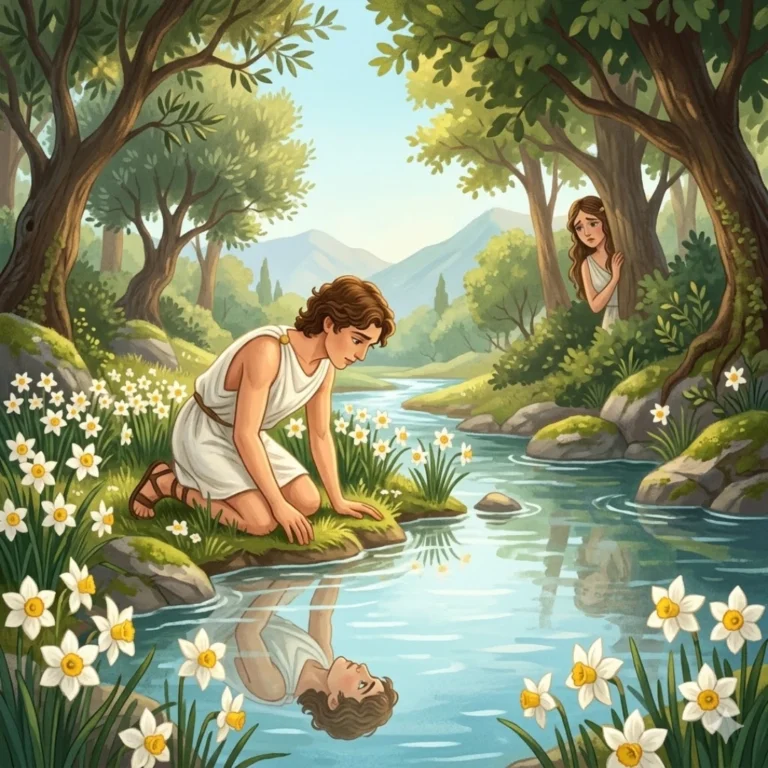
One day, exhausted from hunting, he knelt beside a clear mountain pool to drink. The water was so still it held a perfect reflection. Narcissus looked down—and saw a face more beautiful than any he had ever seen.
He did not recognise himself.
He reached toward the face. It reached back. He whispered to it. It answered with moving lips. He tried to embrace it and it shattered into ripples—then slowly returned, as perfect as before.
For days and then weeks, Narcissus stayed beside the pool. He forgot to eat. He forgot to sleep. He spoke endlessly to the face that always seemed about to answer but never quite did.
In the forest nearby, a mountain nymph named Echo watched. She had loved Narcissus for a long time—but a curse had taken her voice, leaving her only able to repeat the last words she heard.
“Why do you not answer me?” Narcissus cried to the water.
“Answer me,” Echo called softly from the trees.
He did not turn. He never heard her.
The gods watched sadly. Here was someone surrounded by those who cared for him, and he could see nothing beyond his own face.
He withered by that pool. And where he died, a flower grew—white petals and a golden centre—which still bends over still water as if looking for its reflection.
The wisest of the Greeks said this: the boy who could not see anything but himself saw, in the end, nothing at all. The saddest blindness is not in the eyes but in a heart turned entirely inward.
Know yourself—but also know the world around you. The people beside the pool are always worth more than the face in it.
Moral of the Story
Self-awareness means seeing both yourself and others clearly. A heart turned entirely inward cannot connect with the world that is waiting outside.
Learn These Words
- nymph
- a spirit of nature in Greek mythology, often appearing as a young woman
- vanity
- too much pride in one’s own appearance or abilities
- reflection
- an image seen in a mirror or still water
- wither
- to gradually weaken and die
- inward
- directed toward oneself, rather than toward others
Test Your Understanding
1Why did Narcissus reject everyone who loved him?
2What did Narcissus fall in love with?
3Why could Echo only repeat words?
4What grew where Narcissus died?
5What lesson does this story teach?
Frequently Asked Questions
What is the story of Narcissus and the Pool about?
The story of Narcissus and the Pool is a Greek myth about a beautiful youth who rejects the friendship and love of everyone around him. When he discovers his own reflection in a pool of water, he becomes obsessed with it, unable to recognise himself. The tale teaches children the difference between vanity and genuine human connection.
Who is Echo in the Narcissus myth?
Echo is a mountain nymph who loved Narcissus but was cursed to only repeat the last words spoken to her, never able to express her own feelings. She represents the people who genuinely care for us but go unnoticed when we are too focused on ourselves. Her character adds emotional depth to the story’s moral lesson.
What moral lesson does the Narcissus and the Pool story teach kids?
The story teaches children that obsessing over yourself—your appearance, your importance—can isolate you from the people who truly care about you. It shows the difference between vanity and true connection, reminding young readers that real relationships require looking outward at others, not endlessly gazing at yourself.
📚 Recommended Books
Handpicked for readers like you
As an Amazon Associate, we earn from qualifying purchases. These recommendations are personalized based on this story's themes and your reading history.
Why didn’t Narcissus recognise his own reflection in the water?
Narcissus didn’t recognise himself because his vanity blinded him. He was so accustomed to admiring beauty in a self-centred way that when he saw the perfect face in the pool, he assumed it was someone else worth pursuing. This misunderstanding symbolises how self-obsession can distort our perception of reality.
Is the Narcissus story appropriate for young children?
Yes, the Narcissus story is a classic Greek myth frequently retold for children. It uses simple, vivid imagery—a boy, a pool, a reflection—to convey its lesson about vanity and kindness. While some versions include sadder endings, kid-friendly retellings like this one focus on the positive moral about valuing real connections over self-admiration.