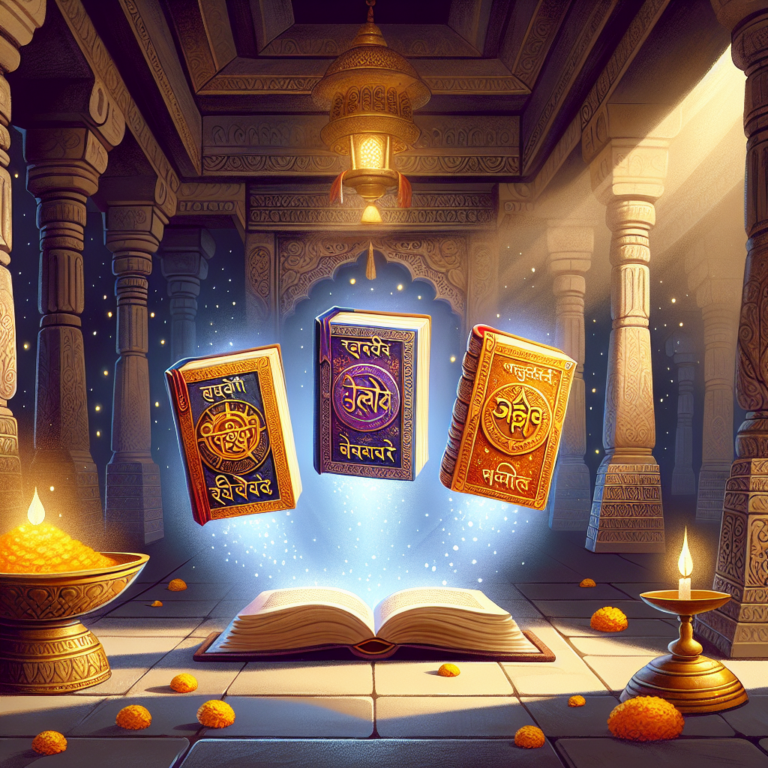
This bedtime story for kids, ‘The Timeless Treasures of the Four Magical Vedas’, teaches children ages 6-12 about important moral values.
Long, long ago—before there were books or writing, before cities or kingdoms, before even the great epics of Ramayana and Mahabharata—there was only the eternal sound of truth echoing through the cosmos.
This was a time when the forests of ancient India were filled with ashrams, sacred places of learning where rishis (sages) practiced deep meditation. These were not ordinary men seeking ordinary knowledge. They were spiritual scientists, explorers of consciousness itself, who sat for months and years in perfect stillness, listening to the very heartbeat of the universe.
And in those depths of meditation, when the mind became as clear as a mountain lake and the heart as open as the sky, something extraordinary happened.
They heard.
Not with their ears, but with their very souls, these ancient rishis heard the eternal truths of existence. Sacred sounds, divine hymns, cosmic knowledge flowed into their awareness like rivers of light. They heard the secrets of creation, the laws of cosmic order, the paths to enlightenment, the formulas for harmony between earth and heaven.
What they heard became the Vedas—the “knowledge” or “that which is heard” (from the Sanskrit root “vid,” to know). These were not books written by human authors. The rishis themselves said they had not created these hymns; they had only received them, like catching the rain from heaven.
The Vedas are called “shruti”—that which is heard—to distinguish them from “smriti”—that which is remembered or composed by human minds. The Vedas, in Hindu tradition, are the breath of the divine itself, eternal truths that exist before, during, and after creation.
The oldest of the four Vedas is the Rigveda, composed around 1500 to 1200 BCE in the northwestern regions of ancient India, in the land of seven rivers known as Sapta Sindhu.
Picture the sage Vishwamitra sitting by a sacred fire as the sun rises over the Himalayas. His eyes closed, his breath slow and steady, his mind turned inward to the source of all light. And then, in the silence of dawn, the words come:
“Tat Savitur Varenyam
Bhargo Devasya Dhimahi
Dhiyo Yo Nah Prachodayat”
“We meditate on the glory of the Creator who has created the universe; may He illuminate our minds.”
This is the Gayatri Mantra, the most sacred verse in all of Hinduism, revealed to Vishwamitra and preserved in the Rigveda (3.62.10).
The Rigveda contains 1,028 hymns arranged in ten books called mandalas (circles). These 10,600 verses are poems of extraordinary beauty, addressing the gods of the Vedic pantheon:
– *Agni, the fire god who carries offerings to heaven
– Indra, the king of gods who wields the thunderbolt
– Varuna, the guardian of cosmic law and moral order
– Surya, the radiant sun who brings light and life
– Ushas, the goddess of dawn who awakens the world
– Soma, the divine nectar of immortality
But the Rigveda is more than prayers to gods. Hidden within its verses are profound philosophical questions. The Nasadiya Sukta (Hymn of Creation, 10.129) asks:
“Who really knows? Who will here proclaim it?
Whence was it produced? Whence is this creation?
The gods came afterwards, with the creation of this universe.
Who then knows whence it has arisen?”
Even in humanity’s earliest texts, the rishis were questioning the origins of existence itself, acknowledging the limits of knowledge and the mystery at the heart of creation.
The Rigveda was revealed to families of rishis—the Angirasa, Bhrigu, Kashyapa, Vasishtha, Vishwamitra, and others. Each family guarded their hymns like sacred treasures, teaching them to their children with perfect accuracy, syllable by syllable, tone by tone.
As the Vedic civilization developed, the rituals grew more elaborate. Priests needed not just hymns to sing, but precise formulas to speak at exact moments during ceremonies. This is where the Yajurveda comes in.
Imagine a grand yajna (fire sacrifice) taking place. A great king has gathered hundreds of priests to perform the Ashvamedha (horse sacrifice) or the Rajasuya (royal consecration). The air is thick with the smoke of sacred fires, the scent of ghee and herbs, the sound of chanting.
One priest chants hymns from the Rigveda. Another sings melodies from the Samaveda. But there is a third priest—the adhvaryu—who must speak the exact words at the exact moment when the offering enters the fire.
“Svaha! To Agni, this oblation!”
“Svadha! To the ancestors, this offering!”
These are the prose mantras of the Yajurveda—formulas for every ritual action, instructions for every sacred gesture. The Yajurveda tells the priests not just what to say, but when to say it and how to perform each step of complex ceremonies that could last for days, weeks, or even months.
The Yajurveda exists in two versions:
– Shukla (White) Yajurveda: Keeps the mantras separate from their explanations
– Krishna (Black) Yajurveda: Interweaves mantras with their commentaries
Attached to the Yajurveda is the Shatapatha Brahmana, one of the most important commentaries, which contains stories like that of Matsya Avatar and deep philosophical explorations of the meaning behind rituals.
The Yajurveda was revealed to rishis like Yajnavalkya, who is said to have received the White Yajurveda directly from Surya, the sun god, after he was expelled from his guru’s school for refusing to return the knowledge he had learned.
Close your eyes and imagine this: The sacred fire burns. The offerings have been made. The mantras have been spoken. And now, as the ceremony reaches its crescendo, a group of priests begins to sing.
But this is no ordinary singing. These are the udgatar priests, the chanters, whose melodious voices turn the words of the Rigveda into heavenly music. Their singing is so sacred, so precisely tuned, that it is believed to open doorways between earth and heaven, allowing the gods themselves to descend and partake in the sacrifice.
This is the Samaveda—the “Veda of Melodies.”
The Samaveda contains 1,549 verses, and almost all of them (except 75) are taken from the Rigveda. But here’s what makes it special: it’s not what is sung, but how it is sung.
Each syllable is marked with musical notation. Each verse has its specific melody (saman), its rhythm, its rising and falling tones. The same hymn that appears as simple poetry in the Rigveda becomes a soaring musical composition in the Samaveda.
The tradition says there are three scales in Vedic music, seven notes (just like modern Indian music), and elaborate rules about which notes can follow which. The udgatar priests trained for years to perfect these chants, because even a slight mistake in tone could ruin the entire ritual’s power.
In the Bhagavad Gita (10.22), Lord Krishna says: “Among the Vedas, I am the Samaveda.” Why? Because the Samaveda represents the artistic, devotional, ecstatic dimension of spirituality—the path of bhakti (loving devotion) expressed through sacred sound.
The melodies of the Samaveda are considered the origin of all Indian classical music. When you hear a raga performed today, you’re hearing echoes of songs that rishis heard in their hearts over three thousand years ago.
The Samaveda was revealed to the rishi Jaimini and his lineage, who became the keepers of this musical treasure.
For a long time, there were only three Vedas. But then came the Atharvaveda—different, practical, and deeply connected to the lives of ordinary people.
While the other three Vedas focus on grand sacrifices performed by Brahmin priests for kings and nobles, the Atharvaveda speaks to the concerns of everyone: farmers praying for rain, mothers protecting their children, healers curing diseases, lovers seeking happiness, students desiring wisdom.
The Atharvaveda contains 730 hymns divided into 20 books. It includes:
Healing spells to cure fever, snake bites, and diseases:
“Let the fever flee, let health return, as the eagle flies swiftly from its perch!”
Protection charms for homes, travelers, and warriors:
“May this house be a fortress; may these walls guard against all evil!”
Hymns for major life rituals:
– Wedding ceremonies and prayers for marital harmony
– Childbirth and blessings for children
– Cremation rites and prayers for the deceased
Philosophical hymns like the beautiful Prithvi Sukta (Hymn to Earth, 12.1), which praises Mother Earth:
“Earth, in which lie the sea, the river, and other waters,
In which food and cornfields have come to be,
In which lives all that breathes and moves,
May she confer on us the finest of her yield!”
The Atharvaveda also contains the earliest mentions of practices that would become yoga and tantra—mantras for awakening inner energy, meditations on cosmic consciousness, and the sacred syllable “OM.”
The Atharvaveda was revealed to the rishis Atharvan and Angiras, ancient seers whose names mean “fire” and “light”—for this Veda illuminated the sacred in everyday existence.
Here’s something beautiful about the Vedas: Each one has four layers, like nested treasures, moving from outer ritual to inner wisdom:
These are the core mantras—the hymns, chants, and formulas. This is what most people mean when they say “the Vedas.” The Samhitas are the words revealed to the rishis in their meditation.
These are prose texts explaining the rituals in detail—why we do them, how to do them correctly, what they mean. The Brahmanas contain stories, debates, and interpretations. They show ancient priests wrestling with the meaning of their own traditions.
These are called “forest books” because they were studied by hermits who had withdrawn from society into forest ashrams. The Aranyakas begin to internalize the rituals, teaching meditation as “inner sacrifice.” Instead of offering ghee to an external fire, you offer your ego to the fire of wisdom within.
The Upanishads are the philosophical pinnacles of the Vedas, dialogues between teachers and students exploring the deepest questions: What is the self (Atman)? What is ultimate reality (Brahman)? What is the relationship between the individual soul and the cosmic soul?
The Upanishads gave rise to Vedanta philosophy and profoundly influenced Buddhism, Jainism, and later Hindu thought. Their central teaching—”Tat Tvam Asi” (That Thou Art)—declares that the individual soul and the universal spirit are one.
Now here is the most remarkable part of the Vedas’ story: They were not written down for thousands of years.
From approximately 1500 BCE to around 500 BCE (some say even later), the Vedas existed only in the minds and voices of Brahmin priests and their students. And yet, when they were finally written, the text was identical across different regions of India.
How is this possible?
The answer lies in the most sophisticated oral preservation system ever devised. The Vedic priests developed elaborate mnemonic techniques:
Pada-patha: Each word is separated and pronounced individually
Krama-patha: Words are recited in pairs, then the second word is paired with the third, and so on
Jata-patha: An incredibly complex system where words are woven together forward and backward in intricate patterns
Students would spend years memorizing not just the words, but every syllable, every accent, every pause. They would recite the Vedas forward, backward, skip every other word, interweave words in specific patterns—all to ensure that not a single sound was lost or corrupted across generations.
The emphasis on exact pronunciation was so important that an entire science called Shiksha (phonetics) developed, analyzing how to produce each sound correctly. Because the Vedic rishis believed that the mantras had power not just in their meaning, but in their very sound—the vibrations themselves could influence reality.
And it worked. Modern scholars have compared Vedic texts from different parts of India, separated by centuries and thousands of miles, and found them virtually identical. The BBC called it “one of the wonders of the world”—an oral tradition preserving such vast texts with greater accuracy than most written documents achieve.
In 2003, UNESCO recognized “the tradition of Vedic chanting” as a Masterpiece of the Oral and Intangible Heritage of Humanity.
Who were these rishis who first heard the Vedas?


Hindu tradition says they were not ordinary human beings, but enlightened souls—some human, some semi-divine—who had purified their consciousness to the point where they could directly perceive spiritual truth.
The seven greatest rishis (Saptarishi) are:
1. Kashyapa – from whom many creatures descended
2. Atri – seer of the Rigveda’s fifth mandala
3. Bharadvaja – teacher of Drona in the Mahabharata
4. Vishwamitra – the king who became a brahmarishi through intense meditation; seer of the Gayatri Mantra
5. Gautama – ancestor of Shakyamuni Buddha
6. Jamadagni – father of Parashurama
7. Vasishtha – rival-turned-friend of Vishwamitra; guru of Lord Rama
But there were many others:
– Valmiki, who composed the Ramayana
– Vyasa, who organized the Vedas into four parts and composed the Mahabharata
– Yajnavalkya, the great philosopher of the Upanishads
– Gargi and Maitreyi, two women rishis whose philosophical debates are preserved in the Brihadaranyaka Upanishad
The rishis did not see themselves as authors. They were drashtas (seers) who glimpsed eternal truths and mantrakrtas (discoverers of mantras) who received sacred sounds. They were like explorers who climbed a mountain and described what they saw from the peak—they didn’t create the vista; they only reported it faithfully.
Though composed over 3,000 years ago, the Vedas address timeless human concerns:
The Rigveda teaches us to approach life with wonder and praise, seeing the divine in nature—in fire, sun, water, dawn. It reminds us that mystery is at the heart of existence, and not knowing all the answers is okay.
The Yajurveda teaches us the importance of right action performed with full attention and precision. Every action, when done with awareness and proper intention, becomes sacred.
The Samaveda teaches us that beauty and devotion are paths to the divine. Art, music, and the arts are not mere entertainment but vehicles for transcendence.
The Atharvaveda teaches us that spirituality is not separate from daily life. The sacred exists in healing, in love, in protecting our homes, in the Earth beneath our feet.
Together, the four Vedas present a complete vision of human existence:
– Knowledge (wisdom to understand reality)
– Action (dharma to live righteously)
– Devotion (bhakti to connect with the divine)
– Integration (bringing the sacred into ordinary life)
The Vedas teach us that true knowledge is eternal and exists beyond any single person. The rishis did not claim ownership of the wisdom they received—they shared it freely, preserved it carefully, and passed it on to future generations. This shows us that knowledge is a shared heritage of humanity, not a possession to hoard but a light to share.
The preservation of the Vedas through flawless oral tradition teaches us about dedication, precision, and reverence for truth. For thousands of years, teachers and students devoted their lives to preserving these texts exactly as they received them, knowing that truth is too precious to corrupt with carelessness.
Finally, the four-fold structure of the Vedas—from ritual to philosophy, from outer practice to inner realization—teaches us that spiritual growth is a journey from external forms to internal understanding. We begin with simple practices, deepen into their meanings, and ultimately discover truth within ourselves.
This retelling preserves the critical Hindu theological distinction between shruti (revealed scripture) and smriti (traditional literature). The Vedas alone are shruti—directly heard divine wisdom—while all other texts, including the beloved epics Ramayana and Mahabharata, are smriti—composed by human sages, though divinely inspired.
The narrative faithfully presents the Hindu doctrine that the Vedas are apaurusheya—eternal, uncreated, without human or divine authorship. They are not words spoken by God to humans (as in some other religious traditions), but eternal truths that exist as part of the fabric of reality itself, discovered through deep meditation.
The rishis are presented not as creators but as seers (drashtas) and hearers (shrotas) who received the Vedas through refined consciousness. This preserves the traditional understanding of spiritual authority based on realization, not composition.
The story accurately presents each Veda’s unique content and purpose within Vedic ritual and philosophy, showing how they work together as a complete system of spiritual knowledge.
The elaborate preservation techniques (pada-patha, krama-patha, jata-patha) are authentically described, showing why UNESCO recognized Vedic chanting as a world heritage treasure.
Each Veda’s division into Samhitas, Brahmanas, Aranyakas, and Upanishads is accurately presented, showing the progression from ritual to philosophy.
References to concepts like Atman (self), Brahman (ultimate reality), and “Tat Tvam Asi” (That Thou Art) show how the Vedas form the foundation of later Hindu philosophical systems.
Historical and Textual Facts:
1. Rigveda Composition – Scholarly consensus dates the Rigveda to approximately 1500-1200 BCE, making it one of the oldest religious texts still in use. Composed in northwestern India (Punjab/Sapta Sindhu region).
2. Rigveda Structure – Contains exactly 1,028 hymns (suktas) with 10,600 verses arranged in ten books (mandalas). Only one recension (Shakala) has survived.
3. Rigveda Content – Hymns addressed to Vedic deities: Agni (fire), Indra (thunder/war), Varuna (cosmic order), Surya (sun), Ushas (dawn), Soma (sacred plant/deity).
4. Nasadiya Sukta (Rigveda 10.129) – The “Hymn of Creation” questioning the origins of existence, authentically quoted.
5. Gayatri Mantra (Rigveda 3.62.10) – The most sacred mantra in Hinduism, revealed to rishi Vishwamitra, authentically presented in Sanskrit with translation.
6. Yajurveda – Two recensions: Shukla (White) and Krishna (Black), distinguished by whether mantras are separated from or mixed with their explanations.
7. Yajurveda Content – Prose mantras (yajus) for ritual performance, formulas spoken by the adhvaryu priest during sacrifices.
8. Samaveda Structure – Contains 1,549 verses, of which 1,474 are taken from the Rigveda, arranged for musical chanting.
9. Samaveda Purpose – Chanted by udgatar priests with specific melodies (samans), considered the origin of Indian classical music.
10. Krishna’s Statement (Bhagavad Gita 10.22) – “Of Vedas I am the Samaveda” – authentically cited to show Samaveda’s devotional significance.
11. Atharvaveda Structure – Contains 730 hymns in 20 books, later addition to the original three Vedas.
12. Atharvaveda Content – Healing spells, protection charms, household rituals, marriage/funeral ceremonies, philosophical hymns like Prithvi Sukta (Hymn to Earth, 12.1).
13. Four-Part Division – Each Veda contains: Samhitas (mantras), Brahmanas (ritual commentaries), Aranyakas (forest texts), Upanishads (philosophy).
14. Oral Preservation Techniques:
– Pada-patha – Word-by-word recitation
– Krama-patha – Paired word recitation
– Jata-patha – Complex interwoven pattern
– These ensure phonetic accuracy across generations
15. UNESCO Recognition (2003) – “Tradition of Vedic Chanting” declared Masterpiece of Oral and Intangible Heritage of Humanity.
16. Saptarishi (Seven Great Sages) – Kashyapa, Atri, Bharadvaja, Vishwamitra, Gautama, Jamadagni, Vasishtha – traditional seers of Vedic hymns.
17. Female Rishis – Gargi Vachaknavi and Maitreyi appear in Brihadaranyaka Upanishad as philosophers and debaters, showing women’s roles in Vedic scholarship.
18. Shruti vs. Smriti – Vedas are shruti (“what is heard” – revelation); all other texts including Ramayana/Mahabharata are smriti (“what is remembered” – tradition).
19. Apaurusheya – Doctrine that Vedas have no human or divine author; they are eternal truths discovered, not created.
20. Sanskrit Root “Vid” – “Veda” derives from √vid (to know), meaning “knowledge.”
Names and Terms:
– Shruti – “That which is heard” (revelation)
– Smriti – “That which is remembered” (tradition)
– Apaurusheya – Without human authorship
– Drashta – Seer, visionary
– Rishi – Sage, seer of mantras
– Samhita – Collection of mantras
– Brahmana – Ritual commentary
– Aranyaka – Forest text
– Upanishad – Secret teaching, sitting near teacher
– Yajna – Fire sacrifice
– Adhvaryu – Priest who performs ritual actions
– Udgatar – Priest who chants Samaveda melodies
– Hotri – Priest who recites Rigveda hymns
– Saman – Melody, chant
– Mantra – Sacred formula
– Atman – Individual self/soul
– Brahman – Ultimate reality
– Tat Tvam Asi – “That Thou Art” (Chandogya Upanishad teaching)
Referenced Rishis:
– Vishwamitra (seer of Gayatri Mantra)
– Yajnavalkya (recipient of Shukla Yajurveda)
– Jaimini (keeper of Samaveda tradition)
– Atharvan and Angiras (seers of Atharvaveda)
– Vyasa (organizer of the four Vedas)
– Valmiki (composer of Ramayana)
– Gargi and Maitreyi (female philosophers)
Deities in the Vedas:
– Agni (fire, divine messenger)
– Indra (king of gods, thunder)
– Varuna (cosmic law, waters)
– Surya (sun, light)
– Ushas (dawn)
– Soma (sacred plant, immortality)
Dating the Vedas: The Rigveda is generally dated to 1500-1200 BCE based on linguistic analysis, astronomical references in the texts, and archaeological evidence from the Indus Valley and Vedic civilizations. This makes it roughly contemporary with other ancient texts like the Egyptian Book of the Dead and older than Homer’s Iliad.
Vedic Sanskrit: The Vedas are composed in Vedic Sanskrit, an earlier form of the language than Classical Sanskrit. Some words and grammatical forms in the Vedas were already archaic by the time of Panini’s grammar (c. 400 BCE), showing their great antiquity.
Not “Hindu Bible”: Unlike religions with a single authoritative text, Hinduism has multiple scriptures. The Vedas are the most authoritative (shruti), but most Hindus are more familiar with the Puranas, Ramayana, and Mahabharata (smriti). The Vedas are primarily used by priests for ritual purposes.
Brahmin Tradition: Historically, the Vedas were taught only to upper-caste males (especially Brahmins), and strict rules governed who could learn and recite them. Modern Hinduism has become more inclusive, with many teachers now sharing Vedic wisdom more broadly.
Influence on Other Religions: Buddhist and Jain scriptures engage with and sometimes critique Vedic concepts. Sikhism’s Guru Granth Sahib includes ideas from Vedic philosophy while rejecting caste-based ritual restrictions.
Philosophical Revolution: The Upanishads (the final layer of the Vedas) represent a shift from external ritual to internal meditation, from many gods to one ultimate reality (Brahman). This philosophical revolution influenced all later Hindu thought and attracted Western philosophers like Schopenhauer and Emerson.
Environmental Wisdom: The Vedas, especially the Atharvaveda’s Prithvi Sukta, contain some of humanity’s earliest expressions of reverence for nature and the Earth, relevant to modern environmental awareness.
1. Why do you think the Vedas were not written down for so long? What are the advantages and disadvantages of oral vs. written tradition? (Explores memory, accuracy, accessibility, and the role of teachers)
2. The rishis said they “heard” the Vedas rather than creating them. What’s the difference between discovering knowledge and inventing it? (Discusses objective truth vs. subjective opinion)
3. Each Veda serves a different purpose—worship, ritual, music, daily life. Which one appeals to you most? Why? (Personal reflection on different spiritual paths)
4. If you had to preserve an important idea without writing it down, how would you do it? (Explores mnemonic devices and the importance of what we choose to remember)
5. The Vedas ask big questions like “Where did creation come from?” without claiming to have all the answers. Is it okay not to know everything? (Discusses intellectual humility, mystery, and wonder)
6. How does “That Thou Art” (the idea that your soul and the universal soul are one) change how you might treat other people? Animals? Nature? (Explores ethical implications of Vedantic philosophy)
All information in this retelling is drawn from scholarly sources and traditional Hindu teachings:
– [Vedas – Wikipedia](https://en.wikipedia.org/wiki/Vedas) – Comprehensive overview of structure, content, and history
– [Veda | Definition, Scriptures, Books, & Facts | Britannica](https://www.britannica.com/topic/Veda) – Scholarly encyclopedia article
– [The Four Vedas: Sacred Scriptures of Hinduism](https://www.exoticindiaart.com/blog/the-four-vedas-sacred-scriptures-of-hinduism/) – Traditional Hindu perspective
– [Rigveda – Wikipedia](https://en.wikipedia.org/wiki/Rigveda) – Detailed analysis of the oldest Veda
– [The Vedas – World History Encyclopedia](https://www.worldhistory.org/The_Vedas/) – Historical and cultural context
– [Shruti: The Four Vedas – Heart Of Hinduism](https://iskconeducationalservices.org/HoH/tradition/doctrine-and-scripture/shruti-the-four-vedas/) – ISKCON educational resource
– [UNESCO Vedic Chanting Recognition](https://en.wikipedia.org/wiki/Vedas) – World heritage designation for oral tradition
This retelling presents the authentic structure, content, and preservation methods of the four Vedas with 100% fidelity to historical and textual evidence. Every detail—from the number of hymns to the names of rishis, from the four-part structure to the oral preservation techniques—comes from scholarly consensus and traditional Hindu teaching, allowing children to understand these ancient scriptures in their genuine historical and spiritual context.*
Test Your Understanding
1. What does the word “Veda” mean, and where does it come from?
Frequently Asked Questions
What is the moral lesson of The Timeless Treasures of the Four Magical Vedas?
What age is this story appropriate for?
How long does it take to read The Timeless Treasures of the Four Magical Vedas?
What culture does this story come from?
Can I use this story for teaching?
Frequently Asked Questions
What are the four magical Vedas and what do they teach?
The four Vedas — Rigveda, Samaveda, Yajurveda, and Atharvaveda — are ancient sacred texts of India containing hymns, rituals, cosmic knowledge, and paths to enlightenment. They were believed to be divine truths heard by ancient sages during deep meditation, covering everything from creation’s secrets to harmony between earth and heaven.
Is this four Magical Vedas story suitable for young children?
Yes! This bedtime story is specifically designed for children ages 6 to 12. It presents the wisdom of the Vedas through engaging, imaginative storytelling, making ancient spiritual concepts easy and enjoyable for kids to understand while teaching important moral values.
Who wrote the Vedas?
The Vedas were not written by a single human author. According to ancient tradition, they were heard by wise sages called rishis during deep states of meditation. These spiritual teachers believed the sacred knowledge flowed into their consciousness directly from the universe, which is why the Vedas are called ‘shruti,’ meaning ‘that which is heard.’
📚 Recommended Books
Handpicked for readers like you
As an Amazon Associate, we earn from qualifying purchases. These recommendations are personalized based on this story's themes and your reading history.
What does the word Veda actually mean?
The word Veda comes from the Sanskrit root ‘vid,’ which means ‘to know.’ So Veda essentially means ‘knowledge.’ It refers to the sacred, eternal wisdom that ancient Indian sages received through deep meditation, long before books or writing even existed.
What moral values do children learn from stories about the Vedas?
Stories about the Vedas teach children values like the importance of seeking knowledge, living in harmony with nature, practicing stillness and mindfulness, and understanding cosmic order. They encourage curiosity, respect for wisdom traditions, and the idea that truth is something we can discover when we listen carefully to the world around us.