

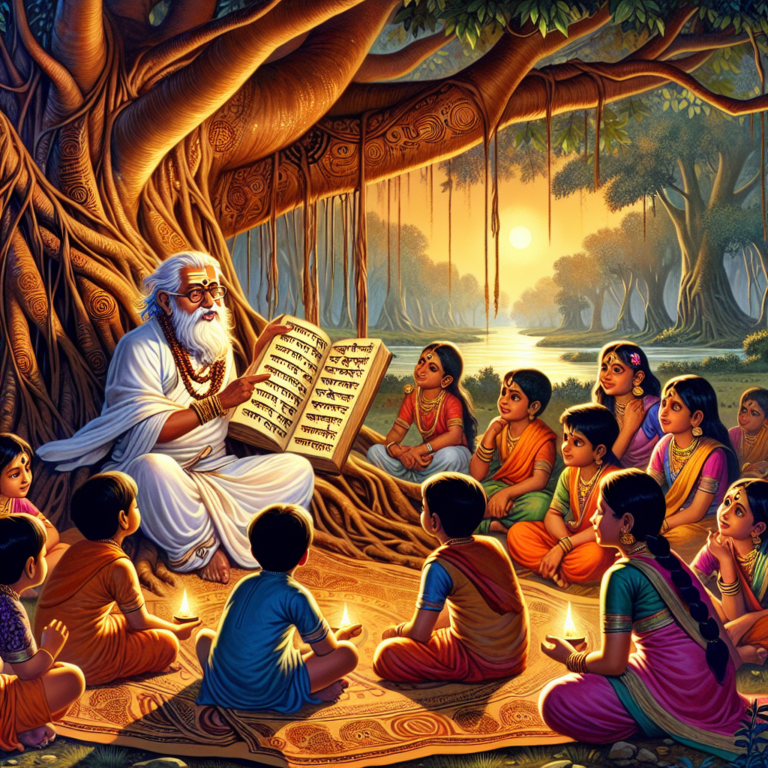
This bedtime story for kids, ‘Rishi’s Enchanted Journey through the Universe’s Secrets’, teaches children ages 6-12 about important moral values.
## Chapter One: The Storyteller Under the Banyan
In a village nestled in the foothills of the great Himalayas, where the air was sweet with the scent of jasmine and the sound of temple bells drifted on the breeze, there lived an old sage named Rishi.
Rishi was not his birth name – it was a title, meaning “seer” or “wise one,” given to him because of the depth of his knowledge and the clarity of his vision. His real name had been forgotten long ago, even by himself. For when you spend your life contemplating the mysteries of the universe, such small details as personal names begin to seem unimportant.
Rishi lived simply, in a small hut at the edge of the village. He owned almost nothing – a few robes, a water pot, some books wrapped in faded cloth. But in his mind, he possessed treasures beyond imagining: the stories and teachings of ancient India, passed down through countless generations, now living in him like sacred flames waiting to be shared.
Every evening, as the sun painted the sky in shades of saffron and rose, the children of the village would gather beneath the great banyan tree where Rishi sat. The banyan was ancient – so old that its aerial roots had grown into secondary trunks, making it more like a small forest than a single tree. The children would settle themselves among its roots, their faces turned upward like flowers seeking the sun, and Rishi would begin to speak.
Tonight, as the first stars began to appear, something special was in the air. The children could feel it – a tingle of anticipation, a sense that this evening’s stories would be different from any they had heard before.
“Children,” Rishi said, his voice soft but carrying clearly in the still evening air, “tonight I am going to take you on a journey. Not a journey of the body – you will sit right here on the good earth. But a journey of the mind and spirit, to places beyond the stars, to times before time began. Are you ready?”
“Yes!” the children called out in unison.
Rishi smiled. “Then let us begin.”
## Chapter Two: The Books That Hold the Universe
“Thousands of years ago,” Rishi began, “long before your great-great-grandparents’ great-great-grandparents were born, there existed a collection of sacred knowledge called the Upanishads. These were not ordinary books. They were maps of the universe, keys to understanding everything that exists.”
He paused, letting the weight of his words settle over the children.
“The word ‘Upanishad’ means ‘sitting down near.’ It describes how students would sit close to their teachers to receive these precious teachings. The knowledge was so sacred, so powerful, that it could only be passed from person to person, heart to heart, like a flame being passed from one lamp to another.”
A young boy named Arun raised his hand. “What did the Upanishads teach, Rishi-ji?”
“Ah,” Rishi said, his eyes twinkling, “they taught the three great truths that govern all of existence. Shall I tell you?”
“Yes, please!”
“The first truth is Dharma – the sacred law that holds the universe together. The second is Karma – the invisible thread that connects all our actions to their consequences. And the third is Shakti – the divine energy that flows through everything, giving life to the stars and the stones, the flowers and the fish, you and me.”
## Chapter Three: Understanding Dharma
“Let me tell you about Dharma,” Rishi continued. “Close your eyes and imagine a great wheel – bigger than the earth, bigger than the sun, spinning slowly in the darkness of space. This wheel is the wheel of Dharma, and everything in the universe turns upon it.”
The children closed their eyes, and in their imaginations, they saw the great wheel turning.
“Dharma is not just one thing. It is many things. It is the law that makes the sun rise in the east and set in the west. It is the force that makes water flow downhill and fire burn upward. It is the principle that tells a seed how to become a tree and a caterpillar how to become a butterfly.
“But for us humans, Dharma has a special meaning. It means living in accordance with what is right and true. It means doing our duty, fulfilling our responsibilities, walking the path of righteousness.”
“Is it like rules?” asked a girl named Priya. “Like when my mother tells me I must help with the cooking and treat my little brother kindly?”
“Exactly!” Rishi exclaimed. “Your mother is teaching you your Dharma. When you help with the cooking, you are fulfilling your duty as a member of the family. When you treat your brother kindly, you are following the Dharma of a sister. Every role we play in life – child, parent, teacher, student, friend, neighbor – has its own Dharma, its own set of right actions.”
“What happens if we don’t follow our Dharma?” Arun asked.
Rishi’s face grew serious. “When we ignore our Dharma, we step out of harmony with the universe. Things begin to go wrong – not as punishment, but as natural consequence. A river that tries to flow uphill will struggle and fail. A person who ignores their responsibilities will find their life becoming tangled and difficult. Dharma is not a cage that traps us – it is a path that guides us to our highest happiness.”
## Chapter Four: The Mystery of Karma
“Now let me tell you about Karma,” Rishi said. “This is a word you have heard before, yes?”
The children nodded. They had heard it many times.
“But do you truly understand it? Karma is often misunderstood. People think it means punishment and reward – do good things and good things happen to you, do bad things and bad things happen. But it is much deeper than that.”
He picked up a small stone from the ground.
“Watch,” he said, and threw the stone into a nearby pond. Ripples spread outward from where it landed, circles expanding until they reached the edges of the water.
“Karma is like those ripples. Every action we take – every word we speak, every thought we think – creates ripples that spread outward into the universe. These ripples touch other things, create new ripples, which create more ripples still.
“When you are kind to someone, that kindness ripples outward. Perhaps they become kinder to someone else, who becomes kinder to someone else, and on and on. Eventually, those ripples circle back to you – as kindness from others, as opportunities, as good fortune.
“When you are cruel, those ripples spread too. They touch others, create more cruelty, more pain. And eventually, they circle back to you as well.”
“So Karma isn’t about gods punishing us?” Priya asked.
“No, child. Karma is simply how the universe works. It is as natural as gravity. Throw a ball into the air, and it will come back down. Throw kindness into the world, and it will come back to you. Throw cruelty, and that too will return.
“But here is the most important thing about Karma,” Rishi leaned forward, his voice dropping to a whisper that drew the children in. “You are not trapped by your past Karma. Every moment, every breath, you are creating new Karma. Even if your past was filled with mistakes, your present can be filled with good actions that create new, positive ripples. We are always free to choose. Always.”
## Chapter Five: The Power of Shakti
“And now we come to Shakti,” Rishi said. “This may be the hardest concept to understand, but it is also the most wonderful.
“Shakti is the divine energy that powers everything in the universe. The energy that makes the sun burn. The energy that makes your heart beat. The energy that makes the flowers bloom and the rivers flow. All of it is Shakti.
“The ancient texts tell us that this energy is often pictured as feminine – as the Goddess, in her many forms. Durga, who fights against evil. Lakshmi, who brings prosperity. Saraswati, who gives wisdom and art. All of these are faces of Shakti.
“But Shakti is not separate from anything else. It is not something ‘out there’ that we must seek. It is in us, it is us. The energy you feel when you run and play, when you learn something new, when you love your family – that is Shakti flowing through you.”
“Can we use this energy?” Arun asked eagerly. “Can we make it stronger?”
“We do not ‘use’ Shakti the way we use a tool,” Rishi corrected gently. “We flow with it. We align ourselves with it. When we live in accordance with Dharma and create good Karma, we open ourselves to Shakti. It flows through us more freely, more powerfully. We feel more alive, more capable, more connected to everything.
“This is what the great yogis and sages discovered through their meditation and practice. They learned to stop blocking Shakti with fear and anger and selfishness. They let it flow freely through them, and they became capable of extraordinary things.”
## Chapter Six: Stories from the Puranas
“Now,” Rishi said, shifting his position and stretching his old legs, “let me tell you some of the wonderful stories that teach these truths. These stories come from books called the Puranas – ancient texts filled with tales of gods and heroes, demons and sages, love and war and cosmic adventure.”
The children perked up. Stories were always their favorite part.
“There are eighteen main Puranas, each dedicated to one of the great divine powers: Brahma the Creator, Vishnu the Preserver, or Shiva the Transformer. But tonight, I will tell you stories from the Vishnu Purana, which contains some of the most beloved tales in all of India.”
Rishi closed his eyes for a moment, gathering the ancient words.
“Long, long ago, when the world fell into darkness and evil, the great god Vishnu would descend to earth in a special form called an Avatar – a divine being born as a human or animal to restore balance and teach humanity.
“Two of the most famous Avatars were Krishna and Rama. Let me tell you of their adventures.”
## Chapter Seven: The Boyhood of Krishna
“Krishna,” Rishi began, “was born in a prison cell at midnight, during a great storm. His parents were prisoners of an evil king named Kamsa, who feared that a child of theirs would one day destroy him.


“But the gods had other plans. The moment Krishna was born, the prison gates opened by themselves, the guards fell into deep sleep, and Krishna’s father was able to carry the baby across the flooded Yamuna river to safety in the village of Vrindavan.”
“Why didn’t the evil king follow them?” a young boy asked.
“He tried! But when he discovered the baby was gone, it was too late. Krishna grew up in Vrindavan among cowherds and milkmaids, a mischievous child who loved to play pranks but whose divine nature sometimes shone through in moments of wonder.
“Once, when Krishna was very young, his foster mother Yashoda opened his mouth to check if he had eaten dirt. Do you know what she saw inside?”
The children shook their heads.
“She saw the entire universe! Stars and planets, mountains and oceans, past and future, all contained within the mouth of a little boy. For a moment, she glimpsed the infinite, and then the vision faded and he was just her mischievous child again.
“This is the mystery of the Avatar – the infinite appearing as the finite, the divine wearing a human mask, so that it can walk among us and teach us without terrifying us with its cosmic power.”
## Chapter Eight: The Prince Called Rama
“Rama,” Rishi continued, “was different from Krishna. Where Krishna was playful and mysterious, Rama was noble and straightforward. He was a prince, born to be king, the very image of what a human being should be.
“But his life was not easy. Though he was the rightful heir to the throne, through no fault of his own he was exiled to the forest for fourteen years. He accepted this unjust fate without complaint, because his Dharma as a son meant obeying his father, even when his father’s command was wrong.
“In the forest, Rama’s beautiful wife Sita was kidnapped by the demon king Ravana and taken to his island kingdom of Lanka. Rama gathered an army of devoted friends – including the great monkey-god Hanuman – and crossed the ocean to rescue her.”
“Did he win?” Priya asked, though she knew the answer.
“He did! After a great battle, Rama defeated Ravana and rescued Sita. Then he returned to his kingdom and ruled for many years in peace and justice. His reign became known as ‘Rama Rajya’ – the rule of Rama – and to this day, when Indians speak of a perfect, just society, they use that phrase.”
“Why do these stories matter?” asked an older boy who had been listening quietly. “They happened so long ago – if they happened at all.”
Rishi nodded approvingly. “A good question. These stories matter because they show us what is possible. Rama shows us that even in the worst circumstances, we can hold to our Dharma. Krishna shows us that the divine is closer than we think – not far away in some distant heaven, but here, now, in everything.
“These are not just stories about gods. They are stories about what it means to be human – to struggle, to suffer, to love, to triumph, to fail, and to keep going anyway.”
## Chapter Nine: The Soul’s Journey
As the night deepened and the stars grew brighter, Rishi turned to the most profound teaching of all.
“The Upanishads and Puranas together teach us about the journey of the soul – what Hindus call the Atman. Let me explain.
“You are not your body. Your body is like a set of clothes that the real you is wearing. When those clothes wear out – when your body grows old and dies – the real you does not die. The Atman, the soul, continues.
“According to our tradition, the soul is born again and again, in different bodies, different lives, different circumstances. This is called samsara – the wheel of birth and death.
“Each life is an opportunity to learn, to grow, to work off old Karma and create new, better Karma. Eventually, through many lives of spiritual growth, the soul becomes pure enough to break free from the wheel of rebirth and reunite with Brahman – the ultimate reality, the source of all existence.”
“So we’ve all lived before?” Arun asked, his eyes wide.
“According to our teachings, yes. And we will live again. But we do not remember our past lives, because each life is meant to be fresh, a new chance, unburdened by memories of what came before.
“But here is the most important truth,” Rishi said, leaning forward. “Your Atman – your true self – is not separate from Brahman. It is not separate from the divine. The drop of water and the ocean are both water. The spark and the fire are both flame. You and God are made of the same essence.
“This is what the sages discovered in their deepest meditation. They looked within themselves and found infinity. They searched for God in temples and mountains, and discovered God had been inside them all along.
“‘Tat tvam asi,’ the Upanishads say. ‘You are That.’ You are the divine. You just haven’t fully realized it yet.”
## Chapter Ten: The Gifts of Knowledge
As the moon rose high over the banyan tree, Rishi brought his teachings to a close.
“I have shared with you tonight the essence of what our ancestors discovered and preserved. The truth of Dharma – that there is a right way to live, a path of righteousness that brings harmony to ourselves and the world. The law of Karma – that our actions have consequences that ripple through time and space. The power of Shakti – that divine energy flows through all things, including us.
“I have told you stories of Krishna and Rama, who showed us what it looks like when the divine walks among us. I have spoken of the soul’s journey through many lives toward ultimate reunion with the Source.
“But I must tell you something important: these are not my words. They are not my inventions. They have been passed down through countless generations, teacher to student, parent to child, sage to seeker. They come from an unbroken chain of wisdom that stretches back thousands of years.
“And now they are yours. Not to keep locked away, but to carry forward. To live by. To share with others. One day, you will sit where I sit, and younger faces will look up at you, eager for knowledge. And you will pass on what you have received, adding your own understanding to it.”
## Chapter Eleven: The Living Wisdom
The children were quiet for a long moment, absorbing what they had heard.
Then little Priya spoke up. “Rishi-ji, how do we live all this? Dharma and Karma and Shakti and the soul’s journey – it’s so much to remember!”
Rishi laughed warmly. “You do not have to remember it all at once, child. Just remember this:
“Be kind. That follows Dharma, creates good Karma, and allows Shakti to flow through you.
“Be honest. That aligns you with truth, which is another face of Dharma.
“Be responsible. Do your duty, whatever it may be – as a child, a student, a friend. This is Dharma in action.
“Be curious. Keep learning, keep questioning, keep seeking. The journey of understanding never ends.
“And be peaceful. Remember that beneath all the differences you see – different people, different creatures, different things – there is one divine reality connecting everything. When you see others, try to see the Atman in them, the same essence that lives in you.
“If you do these things, you are living the teachings of the Upanishads and Puranas, whether you remember their details or not.”
## Chapter Twelve: Stars and Eternity
The children began to drift away to their homes, their parents calling them to dinner and bed. But a few lingered, gazing up at the stars that now filled the sky.
“Rishi-ji,” Arun asked, “do you think the stories are true? Do you think Krishna and Rama really lived?”
Rishi considered the question carefully. “There are different kinds of truth, young one. There is the truth of history – did these events happen exactly as described? I cannot say for certain. But there is also the truth of meaning – do these stories teach us real wisdom about how to live? Of that, I am certain.
“Whether Rama was a historical prince or a symbol of human potential, his example still inspires us to be noble and dutiful. Whether Krishna literally showed the universe in his mouth or that story represents a mystical experience, it still teaches us that the divine is present in the ordinary.
“The deepest truths cannot be captured in mere facts. They need stories to carry them – stories that touch the heart, not just the mind. That is why our ancestors wrapped their wisdom in tales of gods and heroes. Not to deceive us, but to reach us in ways that bare facts never could.”
He gazed up at the stars with the children.
“Look at those lights,” he said. “They have been shining since before our ancestors’ ancestors were born. They will keep shining long after we are gone. Yet here we are, on this small earth, capable of wondering about them, capable of seeking truth, capable of love and wisdom.
“That is the greatest miracle of all – that the universe has become conscious of itself through beings like us. That we can ask ‘Why?’ and ‘How?’ and ‘What does it all mean?’
“The Upanishads and Puranas do not answer every question. No text could. But they point us in the right direction. They remind us that we are part of something vast and beautiful. And they give us tools – Dharma, Karma, Shakti – for navigating this strange, wonderful journey called life.
“Use them well, children. And someday, pass them on.”
Moral Lessons
- Ancient wisdom teaches us that the universe operates according to sacred principles – Dharma (righteousness), Karma (cause and effect), and Shakti (divine energy). By understanding these principles and living in accordance with them, we find harmony, purpose, and connection to something greater than ourselves. The stories of gods and heroes are not mere entertainment – they are vehicles for truths that can transform our lives.
Test Your Understanding
1Who is Rishi in the story?
Frequently Asked Questions
What is the moral lesson of Rishi’s Enchanted Journey through the Universe’s Secrets?
What age is this story appropriate for?
How long does it take to read Rishi’s Enchanted Journey through the Universe’s Secrets?
What culture does this story come from?
Can I use this story for teaching?
Frequently Asked Questions
What is Rishi’s Enchanted Journey through the Universe’s Secrets about?
It’s a bedtime story for kids aged 6 to 12 set in a Himalayan village, following a wise sage named Rishi who shares ancient Indian teachings with children. The story weaves together adventure, wonder, and important moral values to help young readers learn meaningful life lessons in an engaging, magical way.
What age group is Rishi’s Enchanted Journey through the Universe’s Secrets suitable for?
The story is designed for children between the ages of 6 and 12. The language, themes, and storytelling style are crafted to be age-appropriate, keeping younger readers engaged while offering deeper moral lessons that older children can reflect on and discuss with parents or teachers.
What moral values does this bedtime story for kids teach?
The story explores values rooted in ancient Indian wisdom, including humility, the pursuit of knowledge, simplicity, and the importance of sharing what you know with others. Through Rishi’s character and his evening storytelling sessions, children learn that true wealth lies in wisdom, not possessions.
📚 Recommended Books
Handpicked for readers like you
As an Amazon Associate, we earn from qualifying purchases. These recommendations are personalized based on this story's themes and your reading history.
Who is Rishi in the story?
Rishi is an old sage living at the edge of a Himalayan village. His name means ‘seer’ or ‘wise one,’ a title earned through deep knowledge and clear vision. He lives simply but holds vast inner treasures — the stories and teachings of ancient India — which he shares with village children each evening.
Is this a good bedtime story to read aloud to young children?
Yes, absolutely. The story features calm, descriptive language with vivid imagery like jasmine-scented air and saffron sunsets, making it perfect for winding down at bedtime. Its gentle pacing and wise storytelling create a soothing atmosphere while naturally sparking curiosity and thoughtful conversation between parents and children.
