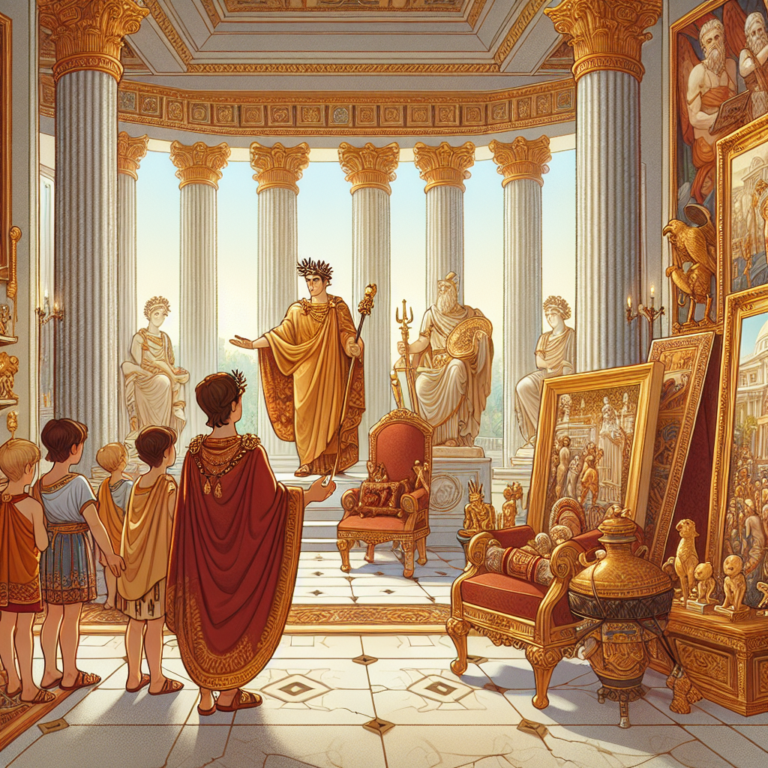
Share this engaging bedtime story with kids ages 6-12 to teach valuable life lessons.
## Chapter One: The City of Seven Hills
In the time when the world was younger, there rose a city on seven hills beside a river called the Tiber. This city began as a small gathering of huts, but it grew and grew until it became the greatest power the world had ever known.
This city was Rome.
At its height, the Roman Empire stretched from the misty shores of Britain in the north to the burning sands of Egypt in the south, from the wild forests of Germania in the east to the pillars that marked the edge of the known world in the west. Millions of people, speaking hundreds of languages, all called themselves Roman.
But Rome was more than just an empire of land and people. Rome was an idea – an idea about how human beings should live together, how they should govern themselves, how they should relate to the gods and to each other.
This is a story about that idea, and about a young emperor who had to learn what it truly meant.
## Chapter Two: The Boy Who Would Be Emperor
His name was Marcus Aurelius Cassius, and he was twelve years old when his father died and he became Emperor of Rome.
“Emperor” – what a word that was! It came from the Latin “imperator,” meaning commander, but it had grown to mean so much more. The Emperor was the supreme ruler of the known world, the living symbol of Roman power, the bridge between mortals and gods.
And now young Marcus wore the purple toga, the golden laurel wreath, the weight of a civilization on his narrow shoulders.
He did not feel like an emperor. He felt like a frightened boy, alone in rooms too large for him, surrounded by advisors who were too polite to say what they really thought and courtiers who smiled too much and meant too little.
At night, he would stand on his balcony and gaze out over the city. Rome spread before him like a sea of marble and brick, temples and theatres, forums and fountains. A million souls lived in that city, each one now technically his subject.
“How can I rule them?” he whispered to the stars. “I know nothing. I am nothing.”
But the stars gave no answer.
## Chapter Three: The Keeper of Stories
There was one person in the vast imperial palace who treated Marcus not as an emperor, but as a boy.
Her name was Livia, and she had been his nurse since his birth. Now that he was emperor, she had become his personal attendant – a position far beneath what palace protocol demanded for someone so close to the ruler, but Marcus had insisted. Livia was the only person who could make him feel human.
She was old now, her hair grey and her back bent, but her eyes were sharp and her memory was sharper. She had served three emperors before Marcus, and she knew things – things that were not written in any book.
One night, when Marcus could not sleep, Livia came to his chambers with a cup of warm honeyed wine.
“What troubles you, little hawk?” she asked, using the childhood nickname she had given him long ago.
“Everything,” Marcus said miserably. “The Senate meets tomorrow, and I am supposed to make a decision about the grain shipments from Egypt. The Praetorian Guard wants more pay. There are rumors of unrest on the Germanic frontier. And I don’t understand any of it.”
Livia sat down heavily in a chair near the fire. “You know what you need, young emperor? You need to understand where all of this came from. You cannot know where to go if you do not know where you have been.”
“I’ve studied history,” Marcus said. “Tutors have been cramming my head with dates and battles since I was old enough to hold a stylus.”
“Dates and battles!” Livia scoffed. “That is the skeleton of history, not its flesh and blood. No, what you need to understand is the spirit of Rome. The values that built this city from mud huts to marble palaces. The gods who watched over our ancestors and watch over us still.”
Marcus looked at her with interest. “Tell me, then.”
And Livia began to speak.
## Chapter Four: The Founding of Rome
“It began with Aeneas,” Livia said, her voice taking on the rhythm of ancient storytelling.
“Aeneas was a prince of Troy, a city far to the east that was destroyed in a great war. When Troy fell, Aeneas escaped with his aged father on his back and his young son by his hand, carrying the sacred images of his household gods.
“The gods – especially Venus, his divine mother – had told Aeneas that he was destined to found a new Troy, a new civilization that would one day rule the world. But first, he had to journey. For seven years he sailed the Mediterranean, facing storms and monsters, lost love and lost friends, always guided by the divine promise of a homeland.
“Finally, he reached the shores of Italy. There, after many more struggles, he founded the people who would eventually give birth to Rome.”
“But Rome wasn’t built by Aeneas,” Marcus said, showing off his tutor-taught knowledge.
“No,” Livia agreed. “Rome was founded by his distant descendants, Romulus and Remus – twin brothers, suckled by a wolf, who built a city on these very hills. But the spirit of Rome began with Aeneas. Do you know why?”
Marcus shook his head.
“Because Aeneas showed the Roman virtues before Rome even existed. He showed pietas – duty to his father, to his gods, to his destiny. He showed virtus – courage in the face of endless hardships. He showed fides – faithfulness to his mission, even when he was tempted to abandon it. And he showed gravitas – the seriousness and dignity of purpose that carries a person through impossible challenges.”
## Chapter Five: The Virtues of Rome
“Pietas, virtus, fides, gravitas,” Marcus repeated. “These are the virtues my tutors are always lecturing about.”
“They are not just words to memorize,” Livia said sternly. “They are the pillars that hold up Rome. When Romans lived by these virtues, Rome was strong. When we forgot them, Rome faltered.
“Let me explain each one.
“Pietas is more than our word ‘piety’ suggests. It means duty – duty to your family, your ancestors, your city, your gods. A Roman with pietas honors those who came before, serves those who depend on him, and respects the divine powers that govern the universe.
“Virtus is more than courage, though it includes courage. It is manliness in the best sense – not aggression, but strength, capability, the willingness to face challenges head-on rather than flee from them.
“Fides is faithfulness – keeping your word, honoring your obligations, being someone others can rely upon. A Roman’s word was supposed to be as good as a signed contract.
“And gravitas is seriousness of purpose. Not being grim or humorless, but being someone of substance, someone whose thoughts and actions carry weight.”
Marcus listened, turning these ideas over in his mind like polished stones.
“But Livia,” he said, “these sound like virtues for individuals. What do they have to do with ruling an empire?”
“Everything,” Livia said. “An empire is nothing but individuals, acting together or against each other. When the emperor embodies these virtues, the empire thrives. When the emperor forgets them, the empire suffers.”
## Chapter Six: The Gods of Rome
“Tell me about the gods,” Marcus said. “My tutors say they are important, but they spend more time teaching me the Greek myths than the Roman rituals.”
Livia nodded grimly. “That is the problem with modern education. The Greeks told better stories, so everyone studies their versions. But the Roman gods are different from the Greek gods, even when they share the same names.
“Jupiter is not just Zeus with a Latin name. To the Romans, Jupiter is the king of gods, yes, but more importantly, he is the guardian of the state. The greatest temple in Rome is the Temple of Jupiter Optimus Maximus on the Capitoline Hill. Every triumph, every important state event, ends at that temple, because Jupiter protects Rome itself.
“Mars is not just Ares. To the Greeks, Ares was a brutal god of slaughter. To the Romans, Mars is the father of Romulus and Remus, the divine ancestor of the Roman people, the god of military courage used in defense of home and family.
“Vesta is not just Hestia. The eternal flame of Vesta, tended by the Vestal Virgins, represents the eternal life of Rome itself. As long as that flame burns, Rome will endure.
“Do you see the pattern, young emperor? To the Romans, the gods are not just powerful beings who might help or harm us. They are partners in the great project of civilization. They protect Rome because Rome honors them. The relationship goes both ways.”
Marcus was silent for a moment, thinking.
“So when I sacrifice to the gods as emperor,” he said slowly, “I am not just performing a ritual. I am renewing the partnership between Rome and heaven.”
“Exactly,” Livia said with satisfaction. “You are beginning to understand.”
## Chapter Seven: The Weight of History
Over the following weeks, Livia continued her education of the young emperor. Not the dry facts his tutors droned about, but the living stories that gave those facts meaning.
She told him about Cincinnatus, the farmer who was called from his plow to be dictator of Rome in a crisis. He defeated the enemy, resigned his power, and returned to his farm – all within sixteen days. “Power is a tool,” she said, “not a treasure. Use it when needed, release it when not.”
She told him about Regulus, the general captured by Carthage and sent back to Rome to negotiate peace. He advised the Senate to reject the peace terms, knowing it meant his own torture and death, because honor demanded he tell the truth.
She told him about the Horatii and the Curiatii, champions who fought for their cities rather than have their armies slaughter each other. “Even in war,” she said, “there can be honor and the desire to minimize bloodshed.”
She told him about Mucius Scaevola, who thrust his own hand into a fire to show the enemy that Romans did not fear pain or death when their city was threatened.
Each story taught a lesson. Each lesson added another layer to Marcus’s understanding of what it meant to be Roman.
## Chapter Eight: The Crisis


Then came the day that tested everything Marcus had learned.
Messengers arrived with terrible news: a massive Germanic tribe had crossed the frontier. Three legions had been destroyed. The barbarians were marching toward Rome.
Panic swept through the city. People began hoarding food, buying weapons, planning to flee. Senators who had always supported Marcus suddenly began whispering about finding a “stronger” emperor.
Marcus gathered his council. The advisors argued and blamed each other. Some wanted to make peace at any cost. Others wanted to strip the remaining legions from other frontiers, leaving those borders undefended. No one could agree on anything.
That night, Marcus stood alone on his balcony, watching the torchlight flicker across the nervous city.
He thought about Aeneas, carrying his father through the flames of Troy.
He thought about Cincinnatus, called from his farm to face an enemy.
He thought about all the men and women whose stories Livia had shared – ordinary Romans who faced extraordinary challenges and met them with the virtues that had built the empire.
And something shifted inside him.
## Chapter Nine: The Emperor’s Choice
The next morning, Marcus called a meeting of the Senate.
He walked in not as a frightened boy, but as an emperor. His back was straight, his eyes clear, his voice steady.
“Senators of Rome,” he said, “I have listened to your debates and your fears. Now I will tell you what we will do.
“We will not surrender to barbarians. That would betray the pietas we owe to our ancestors who built this empire.
“We will not strip our other frontiers. That would be cowardice, not virtus.
“We will not break our treaties with our allies. Our fides, our faithfulness, is what makes Rome worth saving.
“Instead, we will call upon every able citizen to defend our city. Not as slaves conscripted against their will, but as Romans proud to stand for their homes.
“I will lead them personally.”
A gasp ran through the Senate. Emperors did not lead armies anymore – they stayed safe in the palace while generals fought their wars.
“But Caesar-” one senator began.
“I am the emperor,” Marcus said, and for the first time, he truly believed it. “If I ask Romans to risk their lives for Rome, I must be willing to risk mine. That is what the virtues demand.”
## Chapter Ten: The March
And so Marcus Aurelius Cassius, twelve years old, rode out of Rome at the head of an army.
It was not a mighty host – many of Rome’s best soldiers had died in the first defeats. But those who marched were men and women of courage. They were bakers and blacksmiths, merchants and farmers, people who had lived soft lives in the protected heart of the empire and were now called to defend it.
Marcus rode among them, not at the front where an emperor “should” be, but throughout the column, speaking with ordinary soldiers, learning their names, sharing their rations. He was still young, still inexperienced in war. But he had something more important: he had the soul of Rome in his heart.
At night, the soldiers would gather around campfires, and Marcus would join them. He would tell them the stories Livia had told him – the stories of Roman heroes, Roman virtues, Roman triumphs against impossible odds.
The soldiers began to look at him differently. Not as a child playing emperor, but as a true leader who understood what they were fighting for.
“For Rome,” they would say to each other when the march grew hard. “For Rome and the little emperor who fights beside us.”
## Chapter Eleven: The Battle
The barbarians were fierce, and they were many. When the two armies met on a plain north of Rome, Marcus looked out at the sea of enemies and felt fear clench his stomach.
But he did not show it.
“Romans!” he shouted, riding before the lines. “Our ancestors built an empire that has lasted a thousand years! They did it not because they were fearless, but because they faced their fears and did not let those fears master them!
“Today, we fight for our homes, our families, our city. We fight for the temples of our gods, the graves of our ancestors, the future of our children.
“And we fight for the idea of Rome – the idea that ordinary people can come together in common purpose and create something greater than themselves!
“Stand with me now. Show the virtus of your forefathers. Keep the fides you owe to your comrades. Fulfill the pietas you owe to Rome. And let us send these barbarians back to their forests with a story they will tell their grandchildren: ‘Do not attack Rome. The Romans fight like demons!’”
The battle that followed was brutal and long. There were moments when it seemed all was lost. But again and again, the Roman line held. Again and again, soldiers who wanted to flee remembered their virtus and stood fast.
And at the crucial moment, when the barbarian chieftain was pressing hardest against the Roman center, it was Marcus himself who led the countercharge – a twelve-year-old boy on a white horse, riding straight at the enemy, screaming the war cry that Romans had screamed for a thousand years.
The barbarians broke.
## Chapter Twelve: The Return
Marcus returned to Rome a hero.
The city that had trembled now celebrated. Flowers rained down from balconies. Citizens lined the streets to cheer. The Senate voted him a triumph – the highest honor Rome could bestow.
But Marcus, riding through the cheering crowds, felt strangely calm.
He had learned something in the campaign and the battle. He had learned that being emperor was not about wearing the purple toga or sitting on the golden throne. It was not about power or glory or making people bow.
Being emperor was about carrying the best of Rome within himself and reflecting it back to his people. It was about embodying the virtues so that others could be inspired by them. It was about being a guardian – not just of territory, but of ideals.
That night, he went to Livia.
“You were right,” he said. “I needed to understand the spirit of Rome to rule it. But now I understand something else too.”
“What is that, little hawk?”
“The stories you told me – Aeneas and Cincinnatus and all the others – they were not just about the past. They were instructions for the present. They showed me how to be the kind of person Rome needs.”
Livia smiled, and tears glistened in her old eyes. “You have learned well, my emperor. Your ancestors would be proud.”
## Chapter Thirteen: The Eternal City
Marcus Aurelius Cassius ruled Rome for many years after that first crisis. There were other challenges – there are always challenges in the life of an empire – but he met each one with the virtues he had learned.
He was not perfect. No human is. But he tried, every day, to live up to the ideals that had built Rome. And when he failed, he acknowledged his failure and tried again.
On the last night of his life, old now and tired, he stood once more on his balcony, gazing out over the city he had served.
Rome spread before him, eternal and beautiful. The temples gleamed in the moonlight. The Tiber flowed as it had always flowed. And somewhere out there, children were being born who would grow up to face their own challenges, carrying the virtues forward into the future.
“We are all guardians,” he whispered to the night. “Guardians of something greater than ourselves. That is the secret of Rome.”
And as if in answer, a shooting star traced a bright line across the heavens – perhaps Jupiter himself, nodding in approval at a life well lived.
The virtues endure. The stories continue. And as long as there are people who strive to live with honor, courage, duty, and faithfulness, the spirit of Rome will never truly die.
For Rome was never just a city or an empire.
Rome was – and is – an idea.
An idea about what human beings can become when they reach for their best selves.
That idea belongs to everyone now. To you, wherever you are.
What will you do with it?
Moral Lessons
- True leadership comes from embodying noble values and being willing to live by them, not just talk about them. The virtues of honor, courage, duty, and faithfulness are not ancient relics – they are timeless principles that can guide us through any challenge. When we connect ourselves to something greater than our individual lives – a family, a community, an ideal – we find strength we didn’t know we had.
Test Your Understanding
1Who was the ruler of the grand empire of Rome?
Frequently Asked Questions
What is the moral lesson of Emperor’s Echo: The Unseen Guardians of Rome’s Glory?
What age is this story appropriate for?
How long does it take to read Emperor’s Echo: The Unseen Guardians of Rome’s Glory?
What culture does this story come from?
Can I use this story for teaching?
Frequently Asked Questions
What is Emperor’s Echo: The Unseen Guardians of Rome’s Glory about?
Emperor’s Echo is a bedtime story for kids ages 6-12 set in ancient Rome. It follows a young emperor named Marcus Aurelius Cassius, who becomes ruler at just twelve years old after his father’s death. The story explores what it truly means to lead and uphold Rome’s values, teaching children important life lessons through an adventure in the Roman Empire.
What age group is Emperor’s Echo suitable for?
Emperor’s Echo is designed for children between the ages of 6 and 12. It works especially well as a bedtime story, combining historical adventure with meaningful moral lessons about leadership, responsibility, and community. Parents can read it aloud or older children in that age range can enjoy it independently.
What life lessons does Emperor’s Echo teach kids?
The story uses ancient Rome as a backdrop to teach children about leadership, duty, and what it means to be part of a community. Through the young emperor’s journey, kids learn that true power comes with responsibility, that good governance matters, and that upholding shared values is more important than personal glory.
📚 Recommended Books
Handpicked for readers like you
As an Amazon Associate, we earn from qualifying purchases. These recommendations are personalized based on this story's themes and your reading history.
Is Emperor’s Echo based on real Roman history?
Emperor’s Echo draws inspiration from real Roman history, including the actual Roman Empire’s vast reach across Britain, Egypt, Germania, and beyond. While the main character Marcus Aurelius Cassius is a fictional young emperor, the story is rooted in authentic historical details about Roman culture, language, and values to make the setting feel real and educational.
Who were the unseen guardians of Rome’s glory mentioned in the title?
The ‘unseen guardians’ referenced in the title are central to the story’s mystery and moral theme. Without giving away spoilers, they represent the people, principles, and traditions that quietly protect Rome’s core idea — that human beings can live, govern, and thrive together. Reading the story reveals how young Marcus discovers who or what these guardians truly are.