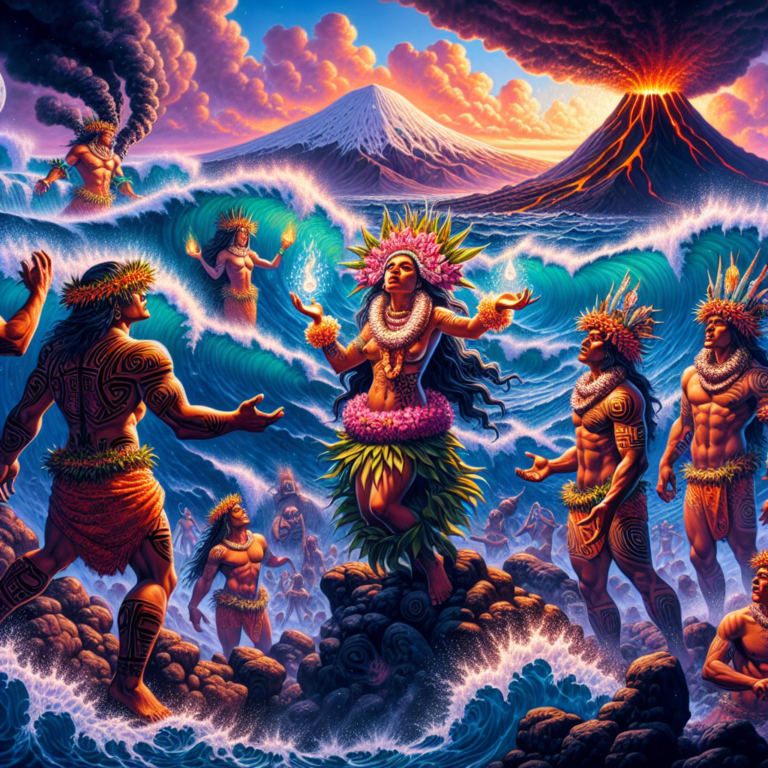
This bedtime story for kids, ‘The Brave Whisper of Hawaii: A Tale of Courage and Magic’, teaches children ages 6-12 about important moral values.
Before the mountains rose from the sea, before the palm trees swayed in the trade winds, before the first humans set foot on these volcanic shores, there was the Kumulipo—the sacred creation chant of Hawaii.
The Kumulipo is one of the longest and most profound creation stories in the world. Over two thousand lines, passed down through generations of memory, tell the story of how everything came to be.
It begins in darkness—a darkness called Po.
Po was not empty darkness. It was full of potential, like a seed buried in the earth, like a child waiting to be born. In this darkness, things began to form, to grow, to emerge into the light called Ao.
First came the simple creatures of the sea: the coral, the starfish, the sea urchin. Then came the fish of many colors, then the birds of many songs, then the animals of the land.
With each stage of creation, the Kumulipo names what appeared and when, organizing all of existence into a great genealogy—a family tree of the cosmos itself.
And at the end of this family tree stood the gods, and then the chiefs, and then the common people, all connected, all part of one great story.
Among all the gods of Hawaii, none is more powerful or more present than Pele, the goddess of fire, lightning, wind, and volcanoes.
The stories say that Pele came to Hawaii from a distant homeland, sailing across the vast Pacific in her canoe, fleeing from her angry older sister Namakaokahai, the goddess of the sea.
Pele carried with her a sacred egg, which contained the fires of creation. She sought a place where she could make her home, a place where her fires could burn without her sister’s waves putting them out.
She tried island after island, digging into the earth with her magical digging stick called Paoa, searching for a home for her flames. But wherever she dug, her sister’s waves followed, flooding her fire pits and driving her onward.
Finally, Pele came to the Big Island of Hawaii, the youngest and largest of the islands. Here, she dug deep into the mountain of Kilauea, and her sister’s waves could not reach her.
She made her home in the fiery caldera, and there she has lived ever since—sometimes quiet, sometimes raging, always powerful. The lava that flows from Kilauea is said to be Pele’s creation, her way of building new land, of continuing the work of creation that began in the time of Po.
Even today, when lava flows to the sea and new land is born from cooling rock, Hawaiians know that Pele is at work.
While Pele represented the raw power of creation, another figure showed what clever thinking could achieve: the demigod Maui.
Maui was not a full god. His father was divine, but his mother was human, making him something in between—powerful enough to attempt impossible tasks, human enough to care about the struggles of ordinary people.
Maui was born so small and sickly that his mother wrapped him in a lock of her hair and threw him into the sea, believing he could not survive. But the gods took pity on him. The ocean creatures protected him, and he grew strong and clever.
When Maui returned to his family, he was no longer weak. He was a hero in the making, with a mind that was always spinning with plans and schemes.
“Why do things have to be the way they are?” Maui would ask. And then he would figure out how to change them.
The most famous of Maui’s deeds was the slowing of the sun.
In the old days, the story goes, the sun raced across the sky so quickly that the days were very short. There was not enough time to dry the kapa cloth that people made from bark, not enough time to grow and harvest crops, not enough time for anything.
Maui’s mother, Hina, complained about this constantly. “The day is too short! My cloth will not dry! The food will not cook!”
Maui listened to his mother’s complaints and decided to do something about it. But how does one slow the sun itself?
First, Maui needed strong rope. He went to his grandmother, who gave him her magical hair, unbreakable and strong. He braided this hair into ropes and fashioned a great snare.
Then Maui climbed to the top of Haleakala, the great volcano on Maui (the island that now bears his name), where the sun rose each morning. He hid among the rocks and waited.
When the sun began to climb over the horizon, Maui leaped out and threw his snare. One by one, he caught the sun’s rays, holding them fast.
“Let me go!” roared the sun, blazing with anger.
“Not until you promise to slow down,” Maui said, holding tight despite the terrible heat. “The people need longer days. You must cross the sky more slowly.”
The sun struggled and raged, but Maui’s ropes held. Finally, exhausted, the sun agreed to Maui’s terms.
From that day forward, the sun moved more slowly during the summer months, giving the people of Hawaii long, warm days for their work. Even now, the longest days come when the sun passes near Hawaii, remembering its promise to Maui.
Another of Maui’s gifts to humanity was the secret of fire.
The story goes that humans did not always have fire. They ate their food raw and shivered through cold nights. Fire was the jealously guarded secret of the mud hens, magical birds who kept it hidden from everyone else.
Maui was determined to learn this secret.
He tried watching the mud hens from a distance, but they saw him and hid their fire. He tried sneaking up on them, but they were too clever. Day after day, he failed.
Finally, Maui had an idea. He made a shape that looked like himself out of banana stalks and placed it near his usual hiding spot. Then he crept to a completely different place and waited.
The mud hens saw the decoy and thought Maui was in his usual spot. They relaxed and began to make their fire, not knowing that Maui was watching from his new hiding place.
Maui saw them rub two sticks together, the friction creating heat, the heat creating fire. He saw which kinds of wood they used and how they blew gently on the sparks.
Then Maui leaped out and grabbed the chief of the mud hens!
“Tell me your secret,” he demanded, “or I will squeeze the life out of you!”
The terrified mud hen tried to lie, telling Maui to rub water plants together, then to rub banana stalks. But when these didn’t work, Maui squeezed harder.
Finally, the mud hen revealed the true secret: fire comes from rubbing certain dry woods together, like the sandalwood and the hau tree.
Maui released the bird, but as punishment for its lies, he rubbed the mud hen’s head until the feathers were worn away. That is why mud hens today have a red, bald spot on their heads—a reminder of their ancient encounter with Maui.
And humans gained fire, which changed everything.
Perhaps the most miraculous of all Maui’s deeds was the creation of the Hawaiian islands themselves.
One day, Maui went fishing with his brothers. He had a magical fishhook called Manaiakalani, made from the bone of his grandmother and baited with the wing of a sacred bird.
Maui cast his hook deep into the sea—deeper than anyone had ever cast before. The hook sank down, down, down, until it caught on something enormous at the bottom of the ocean.
“Row!” Maui commanded his brothers. “Row with all your might, and do not look back!”
His brothers rowed, straining at the oars. The canoe barely moved at first, but slowly, slowly, they began to make progress. Something massive was rising from the depths.
“Keep rowing! Do not look back!”
But one brother’s curiosity overcame him. He glanced over his shoulder to see what Maui had caught.
At that moment, the line snapped.
What rose from the sea was not a fish at all—it was land. Great mountains, green valleys, coral-fringed shores. But because the brother looked back and broke the spell, the land shattered into pieces.
These pieces became the Hawaiian Islands.
If only his brothers had obeyed, the legend says, all the islands would be one great land mass. Instead, we have an archipelago—beautiful, but broken—a reminder of what happens when we do not trust and obey.
All of these stories—Pele’s fires, Maui’s tricks, the creation chant of the Kumulipo—share a common thread: the concept of Mana.
Mana is the spiritual energy that flows through all things. It is the power that makes Pele’s lava flow and Maui’s fishhook lift islands from the sea. It is present in the ocean waves and the mountain peaks, in the chiefs and the commoners, in the stones and the stars.
Mana can be gained or lost. Great deeds increase mana. Shameful acts decrease it. This is why Hawaiian culture placed such importance on proper behavior, on respect, on honoring the gods and the ancestors.
A person with strong mana was believed to be blessed, their actions favored by the gods. A person who had lost their mana was vulnerable, weakened, unlucky.
The Hawaiian word for understanding this balance is *pono—righteousness, balance, living in harmony with the world. To live pono was to maintain one’s mana, to honor the gods, to respect nature, and to fulfill one’s duties to family and community.
Unlike the gods of some ancient cultures, the Hawaiian gods never really went away.
Pele still lives in Kilauea, and Hawaiians still tell of seeing her as an old woman or a beautiful young girl, walking the roads near the volcano. Offerings are still made to her—not out of fear, but out of respect for the power of creation she represents.
The lessons of Maui still inspire: that cleverness can overcome raw strength, that difficult problems often have solutions if we think creatively, that even small actions can change the world.
And the Kumulipo still connects modern Hawaiians to their ancestors, to the land, and to the great chain of creation that links everything together.
When Hawaiian children learn these stories, they learn more than entertaining tales. They learn who they are, where they come from, and what values their ancestors held dear.
They learn that the land beneath their feet was created by divine forces and deserves respect.
They learn that courage, wit, and perseverance can overcome obstacles that seem impossible.
They learn that they are part of something larger than themselves—a family that includes not just living relatives, but ancestors going back to the time of creation itself.
These Hawaiian legends teach several important lessons.
First, creation is ongoing. Pele is still creating new land in Hawaii today. The world is not a finished thing but a work in progress, and we are all part of that continuing creation.
Second, cleverness can triumph over brute force. Maui was not the strongest god, but his quick thinking allowed him to accomplish what even the mightiest could not. This teaches us to use our minds, not just our muscles.
Third, all things are connected. The concept of mana shows that everything in existence shares spiritual energy. When we harm the land, we harm ourselves. When we honor our ancestors, we strengthen our communities.
Finally, stories preserve wisdom across generations. The Kumulipo and the tales of Maui and Pele have been passed down for centuries, each telling adding to the chain that connects past to present to future.
This retelling faithfully preserves authentic Hawaiian mythology:
The Kumulipo is a genuine Hawaiian creation chant, over 2,000 lines long, that traces creation from darkness (Po) through various stages of life to the gods and humans. It was performed at the birth of high chiefs to establish their divine genealogy.
Pele is one of the most actively worshipped Hawaiian deities. Her home at Kilauea volcano is still considered sacred, and offerings are still made to her. Stories of her appearances in human form continue to be reported.
Maui is a pan-Polynesian figure, with stories about him found throughout the Pacific Islands. The versions here—slowing the sun, discovering fire, fishing up islands—are authentic Hawaiian variations of widespread Polynesian myths.
These are real Hawaiian concepts that remain important in Hawaiian culture today. Mana (spiritual power) and pono (righteousness, balance) continue to be taught and practiced.
– Kumulipo: The Hawaiian creation chant, tracing the origin of all things from primordial darkness
– Po: The darkness of creation, full of potential, from which all things emerged
– Ao: The world of light and life, emerging from Po
– Pele: The goddess of fire, lightning, wind, and volcanoes; creator of new land
– Maui: The demigod trickster who slowed the sun, discovered fire, and fished up the Hawaiian Islands
– Mana: Spiritual power or energy present in all things; can be gained or lost through one’s actions
– Pono: Righteousness, balance, proper behavior; living in harmony with the world
– Kilauea: The active volcano on the Big Island, home of Pele
– Haleakala: The great volcano on Maui where the demigod slowed the sun
1. Maui was smaller and weaker than many gods, but he accomplished more through cleverness. Can you think of times when thinking creatively solved a problem that strength could not? (Problem-solving, creativity)
2. The Kumulipo connects all living things in one great family tree. How does thinking of animals and nature as relatives change how we might treat them? (Environmental ethics, interconnection)
3. Pele is still creating new land in Hawaii today. What does it mean that creation is an ongoing process rather than something that happened once and stopped? (Change, natural processes)
4. Hawaiians believe that mana can be gained through good deeds and lost through bad ones. How is this similar to or different from ideas about character or reputation? (Ethics, consequences)
5. Why might storytelling be so important for preserving culture and values across generations? (Tradition, oral history, cultural identity)
– Beckwith, Martha Warren, “Hawaiian Mythology” – Standard academic reference
– The Kumulipo: Hawaiian Creation Chant
– Westervelt, W.D., “Legends of Maui” – Collection of Hawaiian Maui stories
– Pukui, Mary Kawena, and Samuel H. Elbert, “Hawaiian Dictionary” – Source for Hawaiian terms and concepts
This story preserves the rich mythology of Hawaii, from the creation chant of the Kumulipo to the adventures of the trickster Maui and the power of Pele, helping children understand the wisdom, values, and beliefs of Hawaiian culture.*
Test Your Understanding
1Who is Maui in the story?
Frequently Asked Questions
What is the moral lesson of The Brave Whisper of Hawaii: A Tale of Courage and Magic?
What age is this story appropriate for?
How long does it take to read The Brave Whisper of Hawaii: A Tale of Courage and Magic?
What culture does this story come from?
Can I use this story for teaching?
Frequently Asked Questions
What is ‘The Brave Whisper of Hawaii’ story about?
The Brave Whisper of Hawaii is a bedtime story for kids ages 6-12 that blends Hawaiian mythology with themes of courage and magic. It draws from the Kumulipo, Hawaii’s sacred creation chant, and teaches children important moral values about bravery, connection, and belonging.
What age group is The Brave Whisper of Hawaii suitable for?
This Hawaiian tale of courage and magic is designed for children between 6 and 12 years old. It works well as a bedtime story and introduces kids to rich cultural mythology in an engaging, age-appropriate way.
What is the Kumulipo in Hawaiian mythology?
The Kumulipo is Hawaii’s sacred creation chant, one of the longest creation stories in the world with over 2,000 lines. Passed down through generations, it describes how the universe came to be, starting from darkness called Po and progressing through sea creatures, birds, animals, gods, and humans.
📚 Recommended Books
Handpicked for readers like you
As an Amazon Associate, we earn from qualifying purchases. These recommendations are personalized based on this story's themes and your reading history.
What moral lessons does this Hawaiian bedtime story teach?
The story teaches children values like courage, resilience, and a sense of connection to something greater than themselves. By exploring Hawaiian creation mythology, kids learn that every living thing is part of one shared story, encouraging empathy, bravery, and respect for nature.
Is this story based on real Hawaiian mythology?
Yes, the story is rooted in authentic Hawaiian mythology, particularly the Kumulipo creation chant. It weaves real cultural elements, such as the concept of Po (darkness full of potential) and the genealogy of all living things, into a fictional narrative designed to inspire courage in young readers.