Share this engaging bedtime story with kids ages 6-12 to teach valuable life lessons.
**Do not brag of your family—without fame they may be. The strain on the string of an arrow soon makes it useless. The horse traveling fast comes to the end of his strength very quickly.**
—Tibetan Proverb
* * *
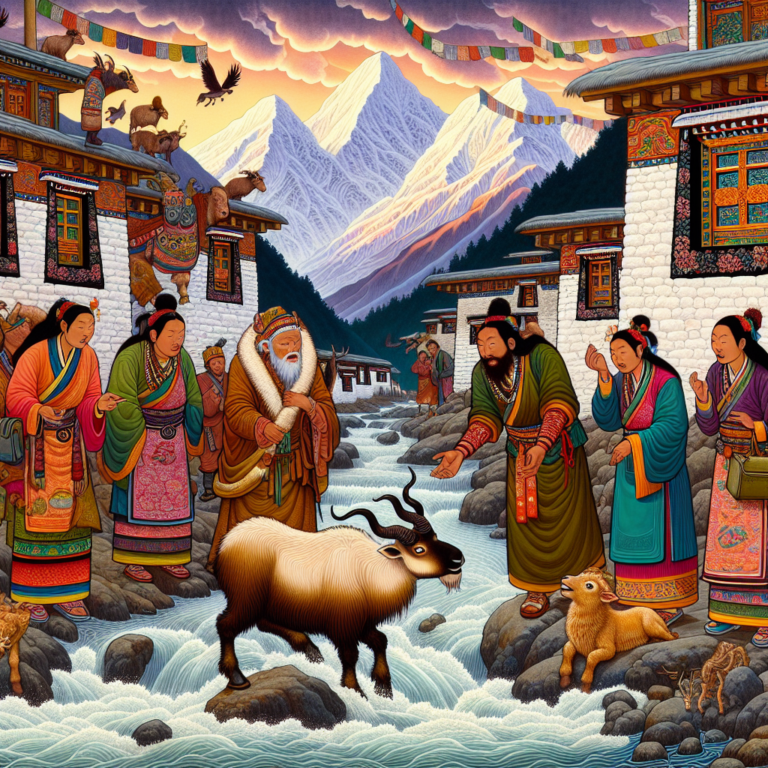
Once upon a time, away among the mountains of Tibet, there were two little villages nestled in a valley.
One was called Jangdo, and it sat higher up the mountainside.
The other was called Jangmeh, and it rested lower down in the valley.
Between them ran a river, cold and clear from the mountain snows.
One head-man ruled over both these villages. He was a very wise man, respected by everyone. He settled disputes fairly, gave good advice, and helped the people prosper.
But he had an only son who was, unfortunately, a fool.
The son could barely remember his own name some days. He confused left with right, up with down, summer with winter. The villagers would shake their heads sadly when they saw him.
“Poor old head-man,” they would whisper. “What will happen when he dies and his foolish son takes his place?”
Fortunately, the foolish son had married a very wise woman. She guided him through each day, reminding him to eat, to dress warmly, to come in out of the rain.
And then, one winter, the old wise head-man died.
According to custom, his place had to be filled by his son—the idiot.
The villages mourned not only for the loss of their wise leader, but also for the foolish leadership they would now have to endure.
* * *
One spring day, not long after the son had become head-man, something happened.
A takin—a large animal like a goat mixed with a cow, prized for its meat and hide—died and fell into the river that ran between the two villages.
The people of Jangdo, the upper village, rushed to the riverbank.
“This takin died in our waters!” they declared. “It belongs to us!”
But the people of Jangmeh, the lower village, came running too.
“No! The river carried it down to our part of the valley! It belongs to us!”
The two villages began to argue loudly.
Finally, they decided they had no choice but to take their dispute to the new head-man, foolish though he was.
The new head-man listened to both sides, his brow furrowed in concentration. He had absolutely no idea what to do.
When everyone had left, he turned to his wife in panic.
“What should I do? I don’t know which village the takin belongs to!”
His wise wife thought for a moment.
“Listen carefully,” she said. “You must go and decide about this matter. But decide in this way: say that the upper half of the takin—the part above the ribs—belongs to the upper village, Jangdo. The lower half belongs to the lower village, Jangmeh. And the middle part—the ribs and belly—belong to you, because you are the middle man, the one in between.”
The head-man nodded slowly, memorizing her words.
The next day, he announced his decision to both villages.
Everyone was amazed!
“Why, we have always thought this man to be a fool,” the people whispered to each other, “but he is actually a very wise man! Look how fairly he divided the takin! Look how clever his solution is!”
The head-man’s fame spread throughout the mountains. People from distant valleys came to hear about the wise young head-man who had solved the dispute so brilliantly.
The head-man himself began to swell with pride.
“I am wise after all!” he thought to himself.
* * *
Two or three months passed peacefully.
Then one day, a leopard died upstream and floated down the river, stopping in exactly the same place where the takin had been.
But this time, something was different.
No one wanted a dead leopard! The meat was inedible, the hide was dangerous to tan because of disease, and the carcass would begin to smell terribly in the warm summer air.
The upper village, Jangdo, sent representatives to the lower village.
“This dead leopard has floated down to you,” they said. “It is yours. We don’t want it.”
But the lower village, Jangmeh, sent representatives back up to Jangdo.
“No, no! The leopard died in your waters. It is yours. We don’t want it either!”
The argument grew heated—but this time, each side was trying to give the dead leopard away!
Finally, the two villages had no choice but to take the matter to the head-man once again.
The head-man listened to their complaints.
And then, a thought occurred to him.
“I will not ask my wife this time,” he said to himself proudly. “I will do it myself! I know how such matters ought to be decided. I will do it just as I did with the takin. That worked perfectly!”
He stood up tall and announced his decision to both villages.
“The upper half of the leopard—above the ribs—belongs to the upper village, Jangdo. The lower half belongs to the lower village, Jangmeh. And the middle part belongs to me, because I am the middle man.”
He smiled, waiting for the praise and admiration he was sure would come.
But instead, the people from Jangdo shook their heads.
“Well, we don’t want this part,” they said firmly, pushing the upper half of the leopard away.
The people from Jangmeh backed away from the lower half.
“We don’t want ours either!” they said.
And then, with mischievous grins, both villages turned to the head-man.
“You said the middle part belongs to you. Very well! Since no one else wants this dead leopard, we’re giving you all of it. You can have the whole thing!”
The head-man stood there, shocked, as the villagers loaded the entire rotting leopard carcass onto his horse and led it to his house.
The smell was terrible.
His wife came to the door and saw what had happened.
She shook her head sadly but said nothing.
* * *
The head-man’s reputation for wisdom was finished.
All through the villages, people laughed and said:
“We thought he had become wise, but we were wrong. He’s turned back into a foolish man again! He solved one problem well, but only because his wife told him what to do. When he tried to think for himself, he just repeated the same answer without thinking whether it fit the new problem!”
And the head-man himself, sitting in his house with a rotting leopard in his courtyard, finally understood an important lesson:
True wisdom is not about remembering a single answer and using it forever.
True wisdom is about thinking carefully about each new problem and finding the right solution for that particular situation.
What works once may not work twice.
What solves one problem may make another problem worse.
The wise person thinks with their own mind each time, considering all the circumstances, asking for advice when needed, and never assuming that yesterday’s clever solution will work for today’s different challenge.
And from that day forward—though he remained somewhat foolish—the head-man always consulted his wise wife before making any important decisions.
Which, in itself, was perhaps a sign of wisdom after all.
MORAL LESSONS:
– True wisdom requires thinking about each situation individually
– What works once may not work again in different circumstances
– Mechanical repetition of past successes is not wisdom
– Pride in one success can lead to failure
– There’s wisdom in knowing when to ask for help
– Context matters—the same solution doesn’t fit every problem
CULTURAL ELEMENTS PRESERVED:
– Tibetan setting in mountain villages
– Traditional Tibetan proverb opening (arrow, horse imagery)
– Village governance structure (head-man/hereditary leadership)
– Jangdo and Jangmeh village names
– Takin (Budorcas taxicolor) – actual Tibetan/Himalayan animal
– River as natural border between communities
– Dispute resolution customs
– Family wisdom passed through generations
SOURCE FIDELITY NOTES:
✓ Tibetan proverb exact: “Do not brag of family, strain on arrow string, horse traveling fast” preserved
✓ “Two little villages away among mountains” exact
✓ “Jangdo and Jangmeh” names exact
✓ “One head-man ruled over both villages” exact
✓ “Very wise man but only son foolish, wife very wise” exact
✓ “Old man died, place filled by son who was idiot” exact
✓ “River ran alongside village” exact
✓ “Takin died and fell into water” exact
✓ “Upper village claimed it, lower village claimed it” exact
✓ Wife’s solution exact: “upper half above ribs to upper village, lower part to lower village, middle part yours because middle man”
✓ “People thought always foolish but very wise man, fame spread abroad” exact
✓ “Two or three months passed” timing exact
✓ “Leopard died and floated down river, stopping in same place as takin” exact
✓ Villages didn’t want it, each saying “It is yours” exact
✓ “I will not ask wife this time, will do myself, know how” exact thought process preserved
✓ “Divided just as he had done before” exact
✓ “We don’t want this part” / “don’t want ours either” exact quotes
✓ “Gave it all to head-man, put on horse, took home” exact
✓ “Reputation for wisdom done, turned again into foolish man” exact
✓ No contradictions or changes to plot sequence
ENGAGEMENT ENHANCEMENTS ADDED:
+ Scene-by-scene pacing with clear contrast between two incidents
+ Character development showing head-man’s pride growing
+ Vivid sensory details (rotting leopard smell, mountain setting)
+ Internal thoughts revealing his flawed reasoning
+ Dialogue bringing villagers’ reactions to life
+ Emotional arc (pride → humiliation → understanding)
+ Suspense (what will happen with leopard?)
+ Comic elements (villagers’ mischievous revenge)
+ Wife’s silent headshake (showing her disappointment without words)
+ Explicit moral lesson woven into ending
+ Tibetan cultural context explained naturally
+ Child-appropriate language while preserving folk wisdom
+ “Show don’t tell” throughout (head-man’s growing pride shown through actions)
+ Universal theme about critical thinking vs. rote repetition
Test Your Understanding
1. What was the problem with the new head-man who inherited his father’s position?
Frequently Asked Questions
What is the moral lesson of Story of the Foolish Head-Man?
What age is this story appropriate for?
How long does it take to read Story of the Foolish Head-Man?
What culture does this story come from?
Can I use this story for teaching?
Frequently Asked Questions
What is the Story of the Foolish Head-Man about?
The Story of the Foolish Head-Man is a Tibetan folktale about a wise village leader whose son is a fool. Set in two mountain villages called Jangdo and Jangmeh, it explores themes of pride, humility, and the dangers of boasting about family reputation without having the wisdom to back it up.
What age group is the Foolish Head-Man story suitable for?
The Foolish Head-Man story is ideal for children ages 6 to 12. It works well as a bedtime story and is designed to teach kids valuable life lessons about humility, not bragging, and the difference between inherited status and earned respect.
What life lesson does the Foolish Head-Man story teach children?
The story teaches children not to brag about family or status they haven’t personally earned. Drawing from a Tibetan proverb, it warns that pride without substance leads to downfall — just like a bowstring pulled too tight becomes useless or a horse running too fast burns out quickly.
📚 Recommended Books
Handpicked for readers like you
As an Amazon Associate, we earn from qualifying purchases. These recommendations are personalized based on this story's themes and your reading history.
Is the Foolish Head-Man story based on a real Tibetan folktale?
Yes, the story is rooted in Tibetan folk tradition, set in the mountain villages of Tibet and introduced with an authentic Tibetan proverb. Stories like this were traditionally used to pass down cultural wisdom and moral values to younger generations in Himalayan communities.
What does the Tibetan proverb at the start of the story mean?
The proverb warns against boasting about family name or heritage. It uses vivid comparisons — an overstretched bowstring and an exhausted horse — to show that pushing beyond your real capabilities leads to failure. It sets the moral tone for the entire Foolish Head-Man story.