

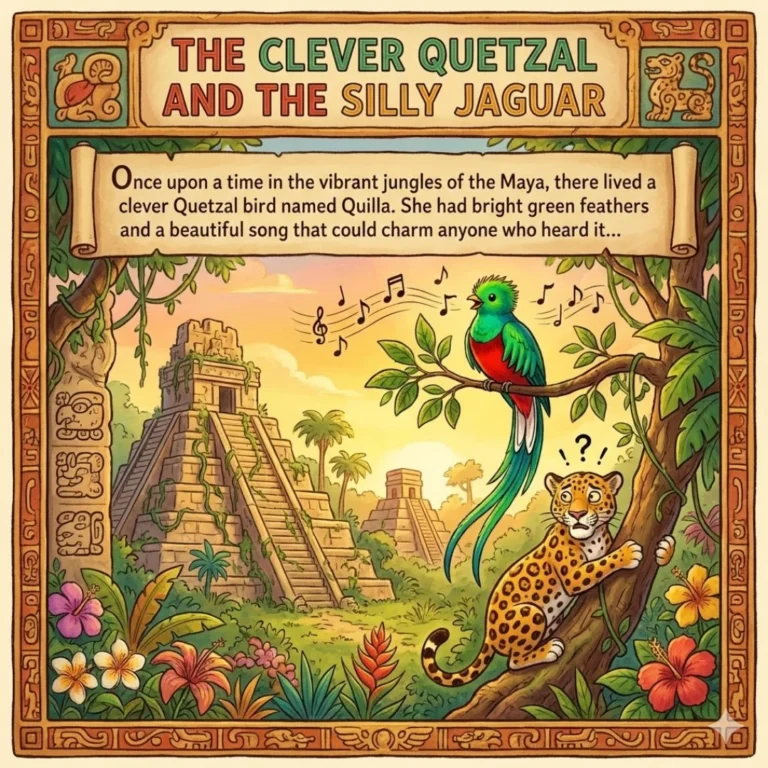
Share this engaging bedtime story with kids ages 6-12 to teach valuable life lessons.
In the days when the great ceiba tree still connected the underworld to the heavens, and the Hero Twins had not yet descended to Xibalba, there lived in the green heart of the forest two very different creatures.
One was Quetzal, the most beautiful bird in all creation. His chest glowed like rubies, his back shimmered like polished jade, and his tail feathers flowed behind him like streams of liquid emerald, longer than a man is tall. When Quetzal flew through the forest, even the flowers turned to watch, and the sun himself smiled with pride at his creation.
The other was Jaguar, the lord of the night. His coat was golden, spotted with the dark marks of Xibalba, and his eyes glowed like twin moons in the darkness. His claws could tear through the trunk of a tree, and his roar made the mountains tremble. All the animals of the forest feared him, for Jaguar was the mightiest hunter beneath the canopy.
Now, despite his beauty, Quetzal was a humble bird. He spent his days flying through the cloud forests, eating small fruits and insects, and singing songs of praise to the Heart of Sky. He bothered no one and asked nothing of the world except the freedom to fly where he pleased.
Jaguar, on the other hand, was proud of his power. He bullied the smaller animals, took the best hunting grounds for himself, and demanded that everyone treat him as king of the forest. “I am the greatest!” he would roar. “No creature is my equal!”
This is the story of how these two met, and what happened when cleverness faced power.
**The Jaguar’s Challenge**
One morning, Jaguar was stalking through the forest when he came upon Quetzal drinking from a crystal stream.
“You there!” Jaguar growled, annoyed at finding another creature in what he considered his territory. “What do you think you’re doing?”
Quetzal looked up calmly. “I am drinking water, great Jaguar. The stream belongs to no one, so I hope I am not offending you.”
Jaguar snorted. “Everything in this forest belongs to me! Every stream, every tree, every creature! Even you, pretty bird, exist only because I allow it!”
Quetzal tilted his head thoughtfully. “Is that so? Then you must be very powerful indeed. But tell me, great Jaguar, are you also wise?”
No one had ever asked Jaguar such a question. He blinked in confusion. “Wise? What does wisdom have to do with anything? I am powerful – that is what matters!”
“Perhaps,” Quetzal said gently. “But the old ones say that true greatness requires both strength and wisdom. A king who has only power is like a tree with strong roots but no branches – impressive, but incomplete.”
Jaguar felt irritated but also curious. “Are you saying you are wiser than me, little bird?”
“I would never say such a thing,” Quetzal replied. “But perhaps we could have a friendly competition – a series of challenges to see who is truly the greatest creature in the forest. What do you say?”
Jaguar’s eyes gleamed. A competition? Of course he would win! What could a fragile bird do against the lord of the night?
“Very well,” Jaguar purred. “Name your challenges. But when I win, you must tell everyone in the forest that I am the greatest – and give me those beautiful tail feathers of yours as a trophy.”
Quetzal nodded. “And if I win, you must promise to stop bullying the smaller creatures and share the forest fairly with all.”
“Impossible!” Jaguar laughed. “But since there is no chance of you winning, I agree. Let the challenges begin!”
**The First Challenge: Hunting**
“For the first challenge,” Jaguar announced, “we will hunt. Whoever catches the most prey by sunset wins. Surely even you cannot object – hunting is the truest test of a forest creature.”
Quetzal nodded. “A fair challenge. Let us begin.”
Jaguar immediately bounded into the undergrowth, his powerful muscles driving him forward. He chased deer, stalked tapirs, and cornered peccaries. By midday, he had caught a magnificent feast – more than any jaguar had ever caught in a single day.
“Ha!” he laughed to himself. “That silly bird is probably still looking for his first catch. This competition is already over.”
But when they met again at sunset, Jaguar stopped in surprise. Quetzal sat beside a pile of prey just as large as his own!
“How?” Jaguar sputtered. “You have no claws, no fangs, no speed! How did you catch so much?”
Quetzal smiled. “I made friends with the other hunters of the forest. The hawk shared his catch with me because I once warned him of a snake. The ocelot gave me his extra kill because I helped him find water during the dry season. The owl contributed her night’s hunt because I sing her chicks to sleep when they are restless.”
He tilted his head. “You hunt alone, great Jaguar, because you have frightened away all potential friends. I hunt with the help of many, because I have earned their trust. The result, as you see, is the same.”
Jaguar growled in frustration. “This proves nothing! Anyone can get lucky once. The next challenge will show who is truly superior.”
**The Second Challenge: Strength**
“For the second challenge,” Jaguar declared, “we will test pure strength. We will each try to move the great boulder that sits by the Temple of the Moon. The one who moves it farther wins.”
This time, Jaguar was certain of victory. He approached the massive stone, braced himself, and pushed with all his mighty strength. His muscles bulged, his claws dug into the earth, and slowly – ever so slowly – the boulder moved. He pushed it the length of ten jaguar tails before collapsing, exhausted.
“Beat that!” he panted triumphantly.
Quetzal looked at the boulder, then at his small body. “You are right, great Jaguar. I could never push this stone even a single feather’s length. You are far stronger than I.”
Jaguar preened with satisfaction. Finally, the bird admitted defeat!
“However,” Quetzal continued, “the challenge was to move the boulder. You did not specify how.”
He flew to a nearby cliff where a colony of leaf-cutter ants lived. Quetzal had always been kind to the ants, warning them of approaching anteaters and sharing news of good foraging. Now he asked for their help.
The ants marched down to the boulder, millions upon millions of them. Working together, carrying tiny pieces of earth from beneath the stone, they undermined its foundation. Within an hour, the boulder rolled down the hill – much farther than Jaguar had pushed it.
“I did not touch the boulder,” Quetzal admitted. “But I moved it. And it went farther than your push, did it not?”
Jaguar’s mouth fell open. “That… that is cheating!”
“Is it?” Quetzal asked innocently. “Or is it simply using wisdom instead of brute force? The challenge was to move the boulder. I moved it. The ants helped me because I have helped them many times. Is friendship cheating?”
Jaguar snarled but could not argue. The boulder had moved farther – that was undeniable.
**The Third Challenge: Speed**
“The final challenge,” Jaguar announced, his patience wearing thin, “will be speed. We will race from this tree to the river. The first one there wins. And this time, no tricks!”
Quetzal nodded. “As you wish. But may I request that we race at midday, when the sun is highest?”
“Fine! Whenever you want – I will still beat you!” Jaguar agreed.
The next day at noon, they gathered at the starting tree. The forest animals came to watch, whispering among themselves. Could Quetzal possibly outrace the swift jaguar?
“Ready?” called the toucan, who had agreed to start the race. “Go!”
Jaguar exploded forward, his powerful legs eating up the distance. Within seconds, he was already far ahead, the wind whipping past his ears. Victory was certain!
But then something strange happened. As Jaguar ran beneath the forest canopy, the golden fur of his coat grew warm, then hot, then unbearably hot. The sun’s rays, filtering through gaps in the leaves, seemed to seek him out specifically, heating his body like a fire.
He was forced to slow down, panting heavily. The jaguar’s dark spots absorbed the sunlight, and his body, designed for cool nighttime hunting, struggled in the midday heat.
Meanwhile, Quetzal flew above the canopy, where a cool breeze ruffled his feathers. His bright colors reflected the sunlight rather than absorbing it. He soared effortlessly toward the river, his long tail feathers streaming behind him like a green banner of victory.
By the time Jaguar stumbled to the riverbank, exhausted and overheated, Quetzal was already there, calmly preening his feathers.
“How?” Jaguar gasped.
“I asked to race at midday because I know myself,” Quetzal explained. “I know I am made for flight in the open sky, where the sun’s blessing cools rather than burns. I know you are made for hunting in the cool shadows. By choosing the right time and place, I turned my weakness into strength and your strength into weakness.”
He landed beside the panting jaguar. “That is wisdom, great Jaguar. Not tricks, not cheating – just understanding how the world works and using that knowledge well.”
**The True Victory**
Jaguar lay by the river for a long time, his pride as bruised as his overheated body. The forest animals watched nervously, expecting him to attack Quetzal in a rage.
But instead, something unexpected happened. Jaguar began to laugh.
“Little bird,” he said finally, “I thought I was the greatest creature in the forest because I was the strongest. I thought power was all that mattered. But you have shown me that I was a fool.”
He sat up slowly. “You caught as much prey as I did by using friendship. You moved a boulder farther than I did by using cooperation. You won a race against me by using knowledge. In every challenge, you found a way to succeed without matching my power – because you understood that there is more to greatness than strength alone.”
Quetzal bowed his beautiful head. “You are generous in defeat, great Jaguar. That itself is a form of wisdom.”
“I made a promise,” Jaguar continued, “and I will keep it. From this day forward, I will not bully the smaller creatures. I will share the forest fairly. And I will try to learn wisdom, not just rely on strength.”
The forest animals cheered. This was a miracle they had never expected – the proud Jaguar, humbled and transformed by a small bird with emerald feathers.
**The Jaguar’s Gift**
But Jaguar had one more surprise.
“You won fairly,” he told Quetzal, “and I lost fairly. I know you did not ask for any prize, only for me to change my ways. But I wish to give you something anyway – a gift from the lord of the night to the lord of the day.”
He padded to a secret place in the forest, where a spring of pure water bubbled up from beneath the roots of a sacred ceiba tree. No other animal knew this place – Jaguar had kept it for himself alone.
“This is the Spring of Forever,” Jaguar said. “The old ones say that any bird who drinks from it will be remembered for all time – as long as the Maya people live, that bird will be sacred and beloved. I give this gift to you, Quetzal, because you taught me something more valuable than territory or power. You taught me humility.”
Quetzal drank from the sacred spring.
And that is why, to this very day, the Quetzal is the most sacred bird of the Maya people. Its feathers were worn by kings and priests. Its image was carved on temples and painted in sacred books. When the nation of Guatemala was born, they put the Quetzal on their flag and named their money after it.
The Quetzal reminds the Maya – and all people – that wisdom is greater than power, that friendship is stronger than strength, and that the humblest creature can defeat the mightiest if it thinks clearly and acts with virtue.
And the jaguar? He kept his promise. He learned to share the forest, to cooperate instead of dominate. He became the guardian of the night, protecting the smaller creatures from true dangers. The Maya honored him too, carving his image beside the Quetzal’s, for they understood that even the powerful can learn wisdom, and that transformation is the greatest miracle of all.
In the green heart of the forest, the children of the Quetzal still fly through the cloud forests, and the children of the Jaguar still walk the night trails. And when they meet by crystal streams, they remember the ancient competition – and the friendship that came from it.
Moral Lessons
- Wisdom and virtue are greater than brute strength. True greatness comes from understanding oneself and working with others, not from dominating them. Even the powerful can learn humility, and even the small can achieve great things through cleverness and good character.
Test Your Understanding
1. Why was the Quetzal bird considered sacred by the Maya?
Frequently Asked Questions
What is the moral lesson of The Clever Quetzal and the Silly Jaguar?
What age is this story appropriate for?
How long does it take to read The Clever Quetzal and the Silly Jaguar?
What culture does this story come from?
Can I use this story for teaching?
Frequently Asked Questions
What is this bedtime story for kids about?
The Clever Quetzal and the Silly Jaguar is a Mayan-inspired tale about a humble, beautiful quetzal bird and a mighty jaguar who learn important lessons about wisdom and character. Set in an ancient forest connected to the heavens, this engaging story teaches children valuable life lessons through these contrasting characters.
What age group is this moral story for children appropriate for?
This story is designed for kids ages 6-12. It features age-appropriate themes and language while incorporating rich Mayan mythology elements like the ceiba tree and references to Xibalba, making it both educational and entertaining for elementary school children.
What lessons will my child learn from this quetzal and jaguar story?
This story teaches children about the value of humility versus pride, showing how true wisdom comes from character rather than physical strength or beauty. Through the quetzal’s humble nature and the jaguar’s mighty but potentially foolish behavior, kids learn important moral lessons.
📚 Recommended Books
Handpicked for readers like you
As an Amazon Associate, we earn from qualifying purchases. These recommendations are personalized based on this story's themes and your reading history.
Is this story based on real Mayan mythology?
Yes, this story incorporates authentic Mayan mythological elements including the sacred ceiba tree that connects the underworld to the heavens, references to the Hero Twins, and Xibalba (the Mayan underworld). The quetzal bird was also sacred in Mayan culture.
How long does this children’s story take to read?
Based on the story length and target age group of 6-12 years, this tale typically takes about 8-12 minutes to read aloud, making it perfect for bedtime reading or classroom storytelling sessions.
