

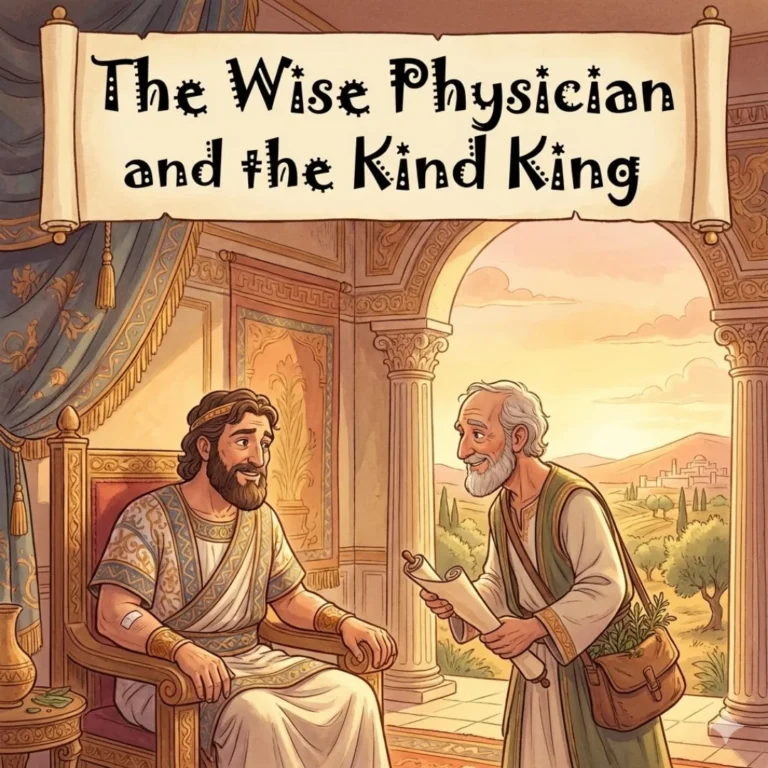
This moral story for children ages 6-12 combines entertainment with important values.
In the age when the great caliphs ruled from Baghdad to Cordoba, and scholars gathered wisdom from every corner of the known world, there lived in the land of the Greeks a king named Yunan. He was a powerful monarch, ruling over a vast kingdom with armies that made his enemies tremble and treasuries that overflowed with gold.
But King Yunan had a secret sorrow that no amount of power or wealth could cure.
The king suffered from a terrible disease – leprosy, the white sickness that spreads across the skin and slowly destroys the body. His court physicians had tried every remedy they knew: herbs from distant mountains, waters from sacred springs, prayers and incantations, medicines of gold and silver. Nothing worked. The disease continued to spread, and the king grew weaker and more desperate with each passing month.
“Is there no cure?” King Yunan would ask his doctors.
“We have tried everything, Your Majesty,” they would reply, bowing their heads in shame. “The disease is beyond our knowledge.”
The king fell into despair. What good was all his power if he could not even heal his own body? What use were his armies if the enemy killing him came from within?
Then one day, a stranger arrived at the palace gates.
**The Arrival of Duban**
The stranger was an old man with a long white beard and eyes that sparkled with intelligence. He carried no weapons, only a worn leather bag filled with books and instruments. His name was Duban, and he was a physician – but not an ordinary one.
Duban had spent his entire life studying the healing arts. He had traveled to India to learn the secrets of Ayurvedic medicine. He had journeyed to Persia to study the writings of ancient healers. He had sat at the feet of Greek masters in Constantinople and learned from Egyptian scholars in Alexandria. His knowledge of medicine was greater than any other physician in the world.
When Duban heard of King Yunan’s illness, he traveled many months to reach the kingdom.
“I can cure the king,” Duban announced to the royal court.
The court physicians laughed. “We have the finest medical knowledge in the land, and we could not cure His Majesty. How can a wandering stranger succeed where we have failed?”
But King Yunan, desperate for any hope, ordered Duban brought before him.
“Tell me, old man,” the king said, studying the physician’s calm face, “can you truly cure my disease? My own doctors say it is impossible.”
Duban bowed respectfully. “Great king, I have studied diseases for sixty years. I have cured ailments that other physicians believed incurable. If you will trust me and follow my instructions exactly, I can heal you – not with medicines that you swallow or ointments that you apply, but through a method that no other physician knows.”
“What method is this?” the king asked, intrigued.
“Allow me to demonstrate tomorrow, and you will see. I ask only that you trust me completely, even if my methods seem strange.”
The king, having nothing to lose, agreed.
**The Miraculous Cure**
The next morning, Duban appeared at the palace carrying a polo mallet – the kind used for the royal sport of horse-mounted ball games.
“Great king,” Duban said, “take this mallet and ride out to play polo. Grip it firmly and do not let go until you have worked up a good sweat. The medicine is contained within the handle of the mallet. As you play, the warmth of your hands will release the healing essences, which will enter your body through your palms and spread throughout your system.”
The court physicians scoffed. “This is madness! Medicine through a polo mallet? The old man is a charlatan!”
But King Yunan, remembering his promise to trust the physician, took the mallet and rode out to the polo field. He played vigorously for several hours, gripping the mallet tightly as instructed. When he returned to the palace, he was tired but felt strangely energized.
“Now bathe and rest,” Duban instructed. “By tomorrow morning, you will see the results.”
That night, King Yunan slept more peacefully than he had in months. When he awoke and looked at his body, he could not believe his eyes.
His skin was clear!
The white patches of leprosy were gone, replaced by healthy flesh. The disease that had tormented him for years, that his finest physicians had declared incurable, had vanished overnight.
King Yunan leaped from his bed and ran to find Duban.
“You have done it!” he cried, embracing the old physician. “You have cured me! Name your reward – anything in my kingdom is yours!”
Duban smiled gently. “My king, I seek no reward. The opportunity to use my knowledge to help others is payment enough. I am an old man with simple needs. Allow me only to remain in your kingdom and continue my studies.”
But the king would not hear of such modesty. He appointed Duban as his chief physician, gave him a magnificent palace to live in, showered him with gold and precious gifts, and insisted that the sage sit beside him at court, treating him with honor equal to his highest nobles.
For a time, everyone was happy – except for one person.
**The Vizier’s Jealousy**
The king’s chief minister, the vizier, watched Duban’s rise with growing envy. Before the physician’s arrival, the vizier had been the king’s closest advisor. Now, King Yunan spent hours in conversation with Duban, discussing philosophy, medicine, and the mysteries of the world.
“This foreigner has bewitched the king,” the vizier muttered to himself. “He has stolen the place that should be mine.”
The vizier began to whisper poison into the king’s ear.
“Great king,” he said one day, “be careful of this physician. How do you know he can be trusted?”
“What do you mean?” King Yunan asked, surprised. “Duban cured me when no one else could. He is the wisest man I have ever known.”
“Exactly my point,” the vizier said, his voice smooth as silk. “If he can cure disease so easily, might he not also cause disease just as easily? What if he is actually an assassin sent by your enemies? He cured you only to gain your trust, and when you least expect it, he will strike.”
King Yunan frowned. “That is nonsense. Duban has shown me nothing but loyalty.”
But the vizier persisted, day after day, finding new ways to plant doubt. “He healed you with strange methods – a polo mallet! Who knows what dark arts he really practices? Perhaps he is a sorcerer. Perhaps the cure was actually a curse in disguise, waiting to activate later.”
At first, King Yunan dismissed these accusations. But like water dripping on stone, the vizier’s constant whispers began to wear down his certainty.
“What if the vizier is right?” the king began to think. “Duban’s methods were unusual. He never explained how the cure actually worked. What does he really want?”
The seeds of suspicion, once planted, began to grow.
**Duban’s Warning**
One day, Duban was summoned before the king, but the atmosphere was different. Gone was the warmth and friendship. King Yunan sat on his throne with a cold expression, the vizier standing smugly at his side.
“Duban,” the king said, “I have decided that you must die.”
The physician’s face remained calm, though his heart was heavy. He had seen this before in his long life – the cruelty of suspicion, the tragedy of ingratitude.
“My king,” Duban said quietly, “may I ask what crime I have committed?”
“You are here to destroy me,” King Yunan replied, repeating the vizier’s accusations. “You gained my trust only to harm me later. I will not wait for your treachery to unfold.”
Duban shook his head sadly. “Great king, I cured you when you were dying. I have served you faithfully. And this is how you repay me? Please, listen to an old man’s wisdom: those who do evil to their benefactors are themselves destroyed by evil.”
He looked directly at the king. “Let me tell you a story – the tale of the husband who trusted the parrot.”
“There was once a woman who wished to meet her lover while her husband was away,” Duban began. “But the husband owned a parrot who reported everything that happened in the house. The wife, furious, tricked the parrot into believing it had dreamed the events. She placed candles around its cage to simulate lightning, dripped water to simulate rain, and banged pots to simulate thunder. The parrot, confused, told the husband that there had been a terrible storm and that it must have dreamed the wife’s infidelity.
“The husband, believing the parrot had gone mad, killed it. Later, he discovered that his wife had indeed betrayed him. He realized too late that he had murdered his only faithful friend because of lies and trickery.
“You, great king, are like that husband. Your vizier is like the treacherous wife, and I am like the innocent parrot. Kill me if you must, but know that you destroy the one being who has been truly faithful to you.”
King Yunan hesitated for a moment. The story touched something in his heart. But the vizier quickly spoke up.
“Do not listen to his tales, my king! He is trying to bewitch you again with words. Strike now, before he can work more of his magic!”
The king’s heart hardened. “Enough. The sentence stands. You will be executed tomorrow.”
**The Final Gift**
On the morning of his execution, Duban appeared before the king one last time.
“I accept my fate,” the old physician said. “But I have one final gift for you. In my library is a book of extraordinary power. If you cut off my head and place it on a plate, it will speak to you. It will answer any question you ask and reveal secrets that no living person knows. This is my parting gift to you – knowledge beyond anything you have ever possessed.”
The king, intrigued despite himself, agreed.
The executioner did his terrible work. Duban’s head was placed on a golden plate and carried before the king. To everyone’s amazement, the dead eyes opened.
“Great king,” the head spoke, “take the book from my library and turn to page seven. There you will find the knowledge I promised.”
The king took the book. But the pages were stuck together. As he licked his finger to separate them, as readers often do, he absorbed a poison that Duban had placed there long ago – not for any future victim, but for himself, as a final mercy in case he ever faced a death too painful to bear.
Within moments, King Yunan began to feel the poison’s effects.
“What have you done?” he gasped.
“I have done nothing you did not do to yourself,” the head replied. “You killed your faithful physician, the man who saved your life. Did you think there would be no consequence? He who shows no mercy to the merciful shows himself unworthy of mercy.”
King Yunan died that very hour.
And the vizier? When the nobles learned the truth of his manipulation, they executed him for causing the king’s death. He gained nothing from his scheming except his own destruction.
**The Lesson of the Story**
This tale was told by Scheherazade to King Shahryar, and through it she hoped to teach him a vital truth: that ingratitude and suspicion destroy not only the innocent but also the ungrateful.
King Yunan had everything – power, health restored, a wise advisor. But he threw it all away because he listened to jealous whispers instead of trusting his own experience.
The story teaches that we must guard against those who use envy and fear to poison our relationships. When someone has proven their worth through actions, we should not abandon them because of someone else’s suspicious words.
It also warns that those who harm their benefactors invite destruction upon themselves. The universe has a way of balancing accounts. King Yunan’s betrayal of Duban led directly to his own death.
Most of all, the story celebrates the power of knowledge and wisdom. Duban’s learning could cure the incurable and, in the end, deliver justice even from beyond death. Knowledge, the story suggests, is the most powerful force in the world – stronger than armies, more valuable than gold, capable of healing and also of judging.
In the courts of the caliphs, physicians were honored for this very reason. They held the power of life and death in their learned hands. Wise rulers treated them with respect; foolish rulers did so at their peril.
Let all who hear this tale remember: cherish those who help you, beware of jealous advisors, and never forget that actions have consequences. For in the end, we receive from the world what we give to it.
Moral Lessons
- Ingratitude toward those who help us leads to self-destruction. Listen to your own experience rather than jealous advisors. Knowledge and wisdom are powerful forces that demand respect. Every action brings consequences.
Test Your Understanding
1. What illness did King Yunan suffer from that no one could cure?
Frequently Asked Questions
What is the moral lesson of The Wise Physician and the Kind King?
What age is this story appropriate for?
How long does it take to read The Wise Physician and the Kind King?
What culture does this story come from?
Can I use this story for teaching?
Frequently Asked Questions
What is The Wise Physician and the Kind King moral story about?
This moral story for children follows King Yunan, a powerful ruler who suffers from leprosy that no doctor can cure. When a wise physician arrives offering help, the story explores themes of wisdom, kindness, and trust between a desperate king and a skilled healer.
Is this bedtime story appropriate for kids ages 6-12?
Yes, this educational story is specifically designed for children ages 6-12. While it deals with illness, it focuses on positive themes like wisdom, healing, and kindness rather than frightening medical details, making it perfect for bedtime reading.
What moral lessons do children learn from this story?
Children learn valuable lessons about wisdom, the importance of trusting skilled people, kindness between different social classes, and how knowledge and expertise can overcome seemingly impossible problems. It teaches respect for learning and healing.
📚 Recommended Books
Handpicked for readers like you
As an Amazon Associate, we earn from qualifying purchases. These recommendations are personalized based on this story's themes and your reading history.
Who are the main characters in The Wise Physician and the Kind King?
The main characters are King Yunan, a powerful but sick ruler suffering from leprosy, and a wise physician who comes to help him. The story takes place during the time of the great caliphs in the Middle Eastern world.
What cultural tradition does this story come from?
This story comes from Middle Eastern and Islamic literary tradition, set during the golden age of the caliphs when scholars gathered knowledge from around the world. It reflects the rich storytelling heritage of Arabic and Persian literature.
