

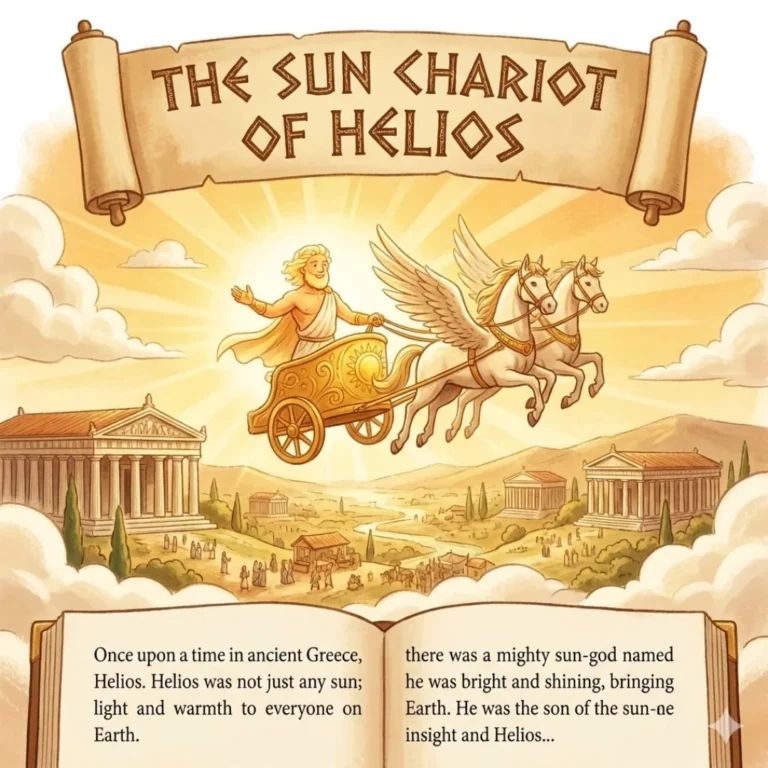
Share this engaging bedtime story with kids ages 6-12 to teach valuable life lessons.
Long ago, when gods walked the earth and heroes performed mighty deeds, there lived a boy named Phaethon. He was handsome and proud, with bright eyes and curling hair that caught the sunlight. But Phaethon carried a secret burden in his heart—he did not know if the story his mother told him could possibly be true.
His mother was Clymene, a beautiful sea-nymph. She had told Phaethon since he was small that his father was no mortal man, but Helios himself—the great god of the Sun, who drove his golden chariot across the sky each day, bringing light to the world.
“Your father is a god,” Clymene would say with pride. “The most radiant of all the gods drives his chariot from east to west, and you are his son.”
Phaethon wanted desperately to believe this. But his friends mocked him. “A god for a father?” they laughed. “You’re just a boy like us! Your mother tells you stories to make you feel special.”
One day, after particularly harsh teasing from a boy named Epaphus, Phaethon could bear it no longer. He ran home to his mother, tears of shame and anger streaming down his face.
“Mother!” he cried. “Tell me true—is Helios really my father? Or do you speak false? I cannot bear this uncertainty anymore!”
Clymene raised her hands to the heavens. “I swear by the Sun himself, by his all-seeing light, that you are indeed his son! If I speak false, may I never see his rays again. Go to him, my child. His palace stands in the far East where he begins his daily journey. Ask him yourself, and he will tell you the truth.”
And so Phaethon set out on a journey to the ends of the earth, to the palace of the Sun. He traveled beyond the lands of men, beyond the ordinary world, until he came to a place where the sky blazed with perpetual dawn.
There stood the palace of Helios—a marvel beyond description. Its columns were solid gold, its doors were silver that gleamed like moonlight, and its roof was made of polished ivory that shone like pearl. Carved upon its gates were all the wonders of the world: the seas and lands, the cities of men, the creatures of the deep, and the constellations that wheeled through the heavens.
Phaethon approached with trembling steps. The light grew brighter and brighter, until he could barely keep his eyes open. There, seated on a throne of emeralds, wearing a crown of blazing rays, sat Helios himself.
The god was so bright that Phaethon had to stop and shield his eyes. But Helios saw him and softened his radiance so the boy could approach.
“My son,” said Helios, his voice warm as summer sunlight. “Why have you come to your father’s house?”
“Father?” Phaethon asked, hope and doubt warring in his heart. “Are you truly my father? Can it be true?”
“I am indeed your father,” Helios replied. “And to prove it, to remove all doubt from your heart, I will grant you any wish you ask. I swear this by the River Styx, the oath that binds even the gods. Ask anything, and it shall be yours.”
Phaethon’s heart soared. Here was proof! Here was honor! But instead of asking for wisdom or virtue or any sensible gift, pride filled his chest. There was one thing that would prove to everyone—to Epaphus, to all his doubting friends—that he was truly the son of a god.
“Father,” Phaethon said, “let me drive your chariot for one day. Let me guide the horses of the Sun across the sky!”
Immediately, Helios’s face filled with dismay. The crown of rays around his head dimmed. “My son, no! Ask for anything but that! That wish alone I cannot grant with joy.”
“But you swore!” Phaethon protested. “You swore by the Styx!”
“I did swear,” Helios said heavily, “and I will keep my oath. But oh, my son, you ask for something dangerous beyond imagining! The path across the sky is treacherous. It climbs so steeply that even my horses struggle to ascend. At midday, the height is so great that even I grow dizzy looking down at the earth below. And the descent is so steep that it requires the surest hand to control the reins.”
Helios rose from his throne and took his son’s hands. “The heavens themselves rotate, spinning eastward against my path. I must drive westward against the turning stars—it takes all my divine strength! And the sky is filled with dangers: the fearsome Bull with his sharp horns, the Lion breathing fire, the great Scorpion with his curving poisonous tail. These constellations are not mere pictures, but living beasts placed in the heavens by Zeus himself.”
“I can do it,” Phaethon insisted stubbornly. “I am your son. Your blood runs in my veins!”
“You are also your mother’s son,” Helios said sadly. “You are mortal, Phaethon. This task requires divine strength. Please, ask for anything else. Ask for riches, for kingdoms, for fame—these I can give you gladly!”
But Phaethon would not be swayed. His pride had been wounded too deeply. He had come too far. “You gave your oath. Will the Sun-god break his sacred word?”
Helios closed his eyes in grief. “I will not break my oath. Come, then. Night is ending, and I must prepare.”
With heavy heart, Helios led Phaethon to the chariot. It was a thing of wonder—forged by Hephaestus himself, made of gold and silver, set with chrysolite and diamonds that reflected the sun’s light in every color imaginable. The wheels had twelve spokes, representing the twelve hours of daylight.
The Hours, goddesses of the times, led forth the four horses. Their names were Pyrois, Eous, Aethon, and Phlegon—Fire, Dawn, Blazing, and Burning. They breathed flames from their nostrils and stamped hooves that struck sparks from the golden floor.
“Listen to me,” Helios said urgently, rubbing protective ointment on Phaethon’s face to shield him from the heat. “Follow the wheel tracks in the sky—they will show you the path. Don’t go too high or you’ll set the heavens ablaze. Don’t go too low or you’ll burn the earth. Stay in the middle path! And hold the reins tight—the horses will try to run wild. Are you certain you won’t reconsider?”
“I’m ready,” Phaethon said, though his hands trembled as he took the reins.
“Then go,” Helios whispered. “And may the gods protect you.”
The gates of dawn opened. The horses leaped forward, and the chariot shot into the sky like an arrow from a bow.
At first, Phaethon felt a wild joy. He was flying! He was driving the Sun itself across the sky! Below him, the earth spread out like a vast garden. Above him, the stars retreated before his light. He was the son of Helios, and now everyone would know it!
But the chariot felt strange—too light. The horses sensed immediately that their master was not holding the reins. These were not the strong, sure hands of Helios. The team began to veer off course.
“Steady!” Phaethon cried, pulling on the reins. But his mortal strength was nothing to the immortal horses. They didn’t even feel his tugging.
Higher and higher they climbed, leaving the marked path. The celestial constellations, which had always kept their distance from the Sun, now felt his fire too close. The Great Bear growled and tried to plunge into the forbidden sea to cool himself. The Serpent, usually sluggish with cold at the edge of the pole, grew warm and angry.
Phaethon looked down—and the vast height terrified him. His knees buckled. He wished he had never asked for this, had never insisted, had listened to his father’s warnings. But it was too late.
The horses, sensing his fear, went completely wild. They plunged downward, bringing the sun far too close to the earth. Mountains began to smoke. Rivers boiled and dried up. Great forests burst into flame. Cities burned. The fertile plains of Libya turned to desert in moments. The peoples of Africa found their skin turned dark by the terrible heat—and so it has remained ever since, the Greeks said.
The earth itself cried out to Zeus for mercy. “Great king of the gods! If this is your will, if I am to perish, then let it be by your lightning bolt, not by this fire! Look! Your own sky is burning! Even Olympus is threatened!”
Zeus looked down and saw the catastrophe. The world itself was in danger. If he did not act, everything would burn—gods and mortals alike. His face grave, Zeus reached for his most terrible weapon: the lightning bolt forged by the Cyclopes, the weapon that never missed.
He took aim and threw.
The bolt struck Phaethon, knocking him from the chariot. The boy fell, trailing fire like a shooting star, down and down through the vast sky. He landed far away in the River Eridanus, the water cooling his burning form.
The horses, freed from the chariot’s weight, galloped back to their stable. Helios, seeing what had happened, extinguished his rays and sat in darkness, grief-stricken. For one day, the world went dark, lit only by the fires that Phaethon had started.
Far away, in the land of Italy, the nymphs found Phaethon’s body and buried him. They carved upon his tomb these words:
“Here lies Phaethon, who drove his father’s chariot. Though he failed, it was a grand attempt.”
And his mother Clymene, and his sisters the Heliades, wept so long at his grave that the gods took pity. The sisters were transformed into poplar trees that forever weep tears of amber. Clymene wandered the world, mad with grief.
As for Helios, he mourned his son deeply. But the next day, he climbed again into his chariot—for the sun must rise, no matter how heavy the heart that drives it. Every dawn thereafter, he remembered his lost son, the boy who reached too high and learned too late that some things are beyond mortal reach, no matter whose blood runs in their veins.
The story of Phaethon is told to this day as a warning: Know your limits. Pride and ambition are not enough. Some tasks require not just brave hearts, but skilled hands and divine power. And those who love us often know better than we do what is beyond our strength.
Moral Lessons
- Know your limitations and listen to wise counsel. Pride and ambition without wisdom can lead to disaster. Some burdens are too great for us to bear, regardless of our lineage or intentions.
Test Your Understanding
1. Who was Phaethon’s father?
Frequently Asked Questions
What is the moral lesson of The Sun Chariot of Helios?
What age is this story appropriate for?
How long does it take to read The Sun Chariot of Helios?
What culture does this story come from?
Can I use this story for teaching?
Frequently Asked Questions
Who was Helios in Greek mythology?
Helios was the Greek god of the sun who drove a golden chariot across the sky each day, bringing light to the world. In this bedtime story for kids ages 6-12, he’s portrayed as Phaethon’s divine father, setting up a tale about proving one’s identity and the dangers of pride.
What is the sun chariot story about?
The story follows Phaethon, a young boy who desperately wants to prove that Helios, the sun god, is really his father. When his friends mock him for claiming divine parentage, Phaethon embarks on a dangerous quest that teaches important lessons about pride and knowing our limits.
Is this Greek mythology story appropriate for young children?
Yes, this version is specifically adapted as a bedtime story for kids ages 6-12. It focuses on relatable themes like wanting to fit in, dealing with bullies, and learning about pride while introducing children to fascinating Greek mythology in an age-appropriate way.
📚 Recommended Books
Handpicked for readers like you
As an Amazon Associate, we earn from qualifying purchases. These recommendations are personalized based on this story's themes and your reading history.
What moral lesson does this story teach kids?
This educational story teaches children about the dangers of excessive pride and the importance of listening to wise advice. It shows how Phaethon’s desperate need to prove himself leads to consequences, helping kids understand that sometimes our limitations exist for good reasons.
How does Phaethon try to prove Helios is his father?
The story shows Phaethon’s journey to find proof of his divine heritage after being teased by friends who don’t believe his mother’s claims. His quest to validate his identity as the son of a god drives the entire narrative and its important life lessons.
