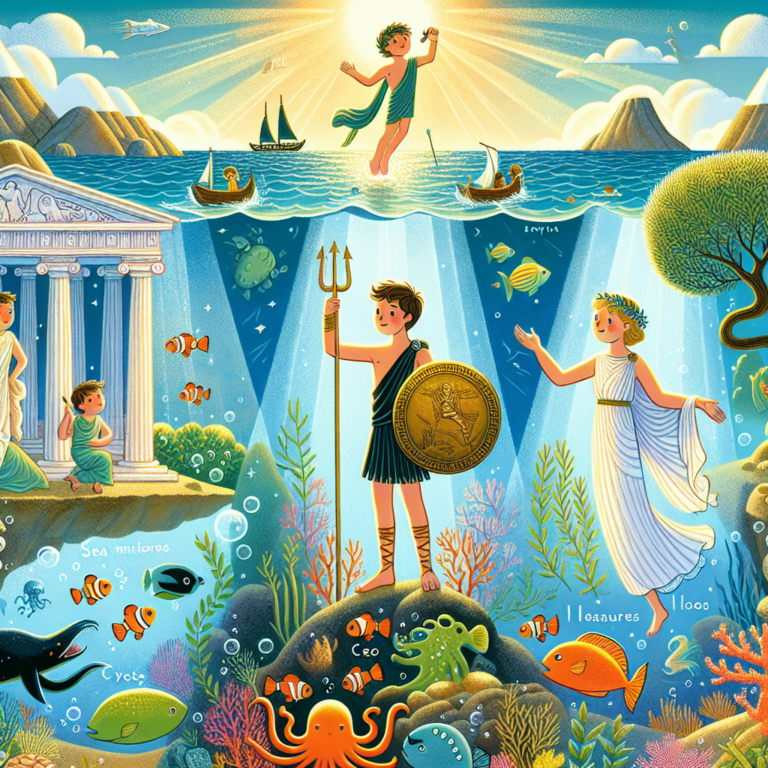
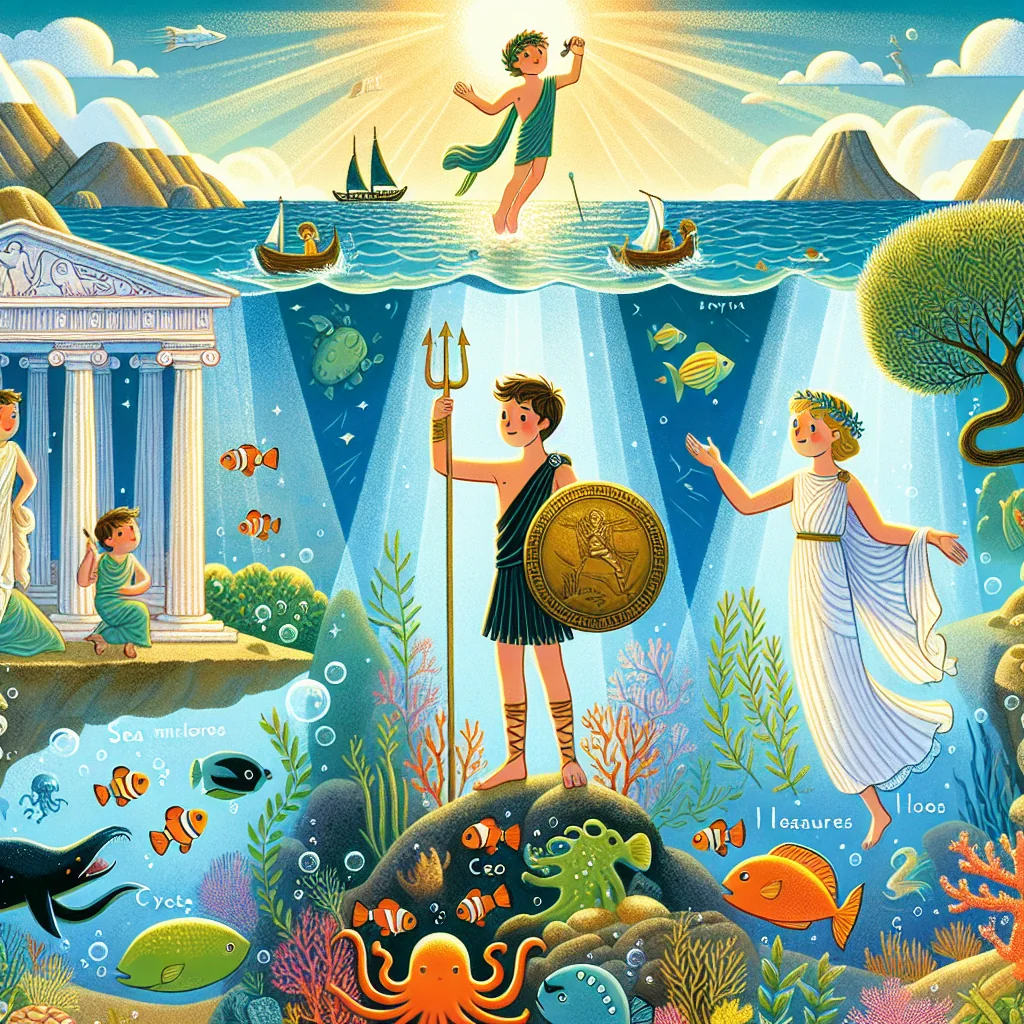
Share this engaging bedtime story with kids ages 6-12 to teach valuable life lessons.
IMPROVED STORY – POST 1677
Based on: “Thaumas, Phorcys, and Ceto” (Greek mythology)
Original Source: https://www.gutenberg.org/files/22381/22381-h/22381-h.htm#40
Improvements: Transformed encyclopedia entry into engaging narrative while maintaining source fidelity
================================================================================
THE CHILDREN OF THE SEA
================================================================================
The early Greeks had an extraordinary power: they could look at Nature and see personalities everywhere.
Where we might see just wind, they saw Aeolus, the keeper of the winds.
Where we might see just thunder, they saw Zeus, hurling lightning bolts.
And where we might see just the ocean, they saw dozens of different gods and goddesses, each representing a different wonder of the deep.
Among these mighty wonders of the sea—which in all ages have afforded matter of speculation to educated and uneducated alike—were three remarkable siblings, all children of Pontus, the ancient god of the sea itself:
Thaumas, whose name meant “Wonder.”
Phorcys, who represented the hidden terrors.
And their sister Ceto, who embodied the secret perils lurking beneath the waves.
Each had their own story, their own purpose, their own domain.
And together, they shaped how the ancient Greeks understood the beautiful, mysterious, and sometimes frightening nature of the ocean.
* * *
**THE STORY OF THAUMAS: THE MIRROR OF THE SEA**
Have you ever stood on a beach at twilight and watched the ocean become perfectly still?
When the wind dies down and the waves stop moving, something magical happens: the surface of the sea becomes like glass.
It reflects everything above it—the flaming stars beginning to appear in the darkening sky, the illuminated cities glowing on the distant shore, even the face of the moon floating on its glassy bosom.
The sea seems to hold all these images in its transparent embrace, mirror-like and perfect.
This was Thaumas.
He was the personification of that peculiar, translucent condition of the sea’s surface when it reflects the world like a mirror. He was Wonder itself—that feeling you get when you look down at the water and see the stars looking back at you, and you can’t quite tell where the sky ends and the ocean begins.
Thaumas was as beautiful as the phenomenon he represented. He had kind eyes that sparkled like sunlight on water, and a gentle smile that made everyone who met him feel peaceful and calm.
One day, Thaumas met the lovely Electra, daughter of Oceanus, the great river that encircled the world.
Electra was breathtaking.
Her name signified “the sparkling light produced by electricity”—that sudden, brilliant flash that lights up the sky. And just like her name suggested, she was radiant.
Her hair was amber-colored—not just blonde, but a rich, warm gold like honey in sunlight, like precious amber stones. It was hair of such rare beauty that none of her fair-haired sisters could compare with her. Even among the daughters of Oceanus, who were all lovely, Electra stood out as the most beautiful.
Thaumas and Electra fell deeply in love.
They were married in a ceremony on the shore, where the sea met the sky, and where Thaumas’s mirror-like reflection met Electra’s sparkling light.
One evening, shortly after their wedding, Electra stood on the beach watching a storm in the distance. Lightning flashed across the sky—her element, electricity, dancing through the clouds.
But the storm made her sad. She thought of all the ships that might be caught in it, all the sailors who might be afraid.
Tears rolled down Electra’s cheeks.
But these were no ordinary tears.
When the amber-haired goddess wept, her tears were too precious to be lost. As they fell, they transformed into drops of shining amber—beautiful, golden stones that washed up on the shore like treasure.
To this day, when people find amber on the beach, some say it’s the tears of Electra, still washing up after all these thousands of years.
* * *
**THE STORY OF PHORCYS AND CETO: THE HIDDEN DEPTHS**
Not all of the ocean’s wonders were gentle and beautiful.
Phorcys and his sister Ceto represented a different side of the sea—the dark side, the dangerous side.
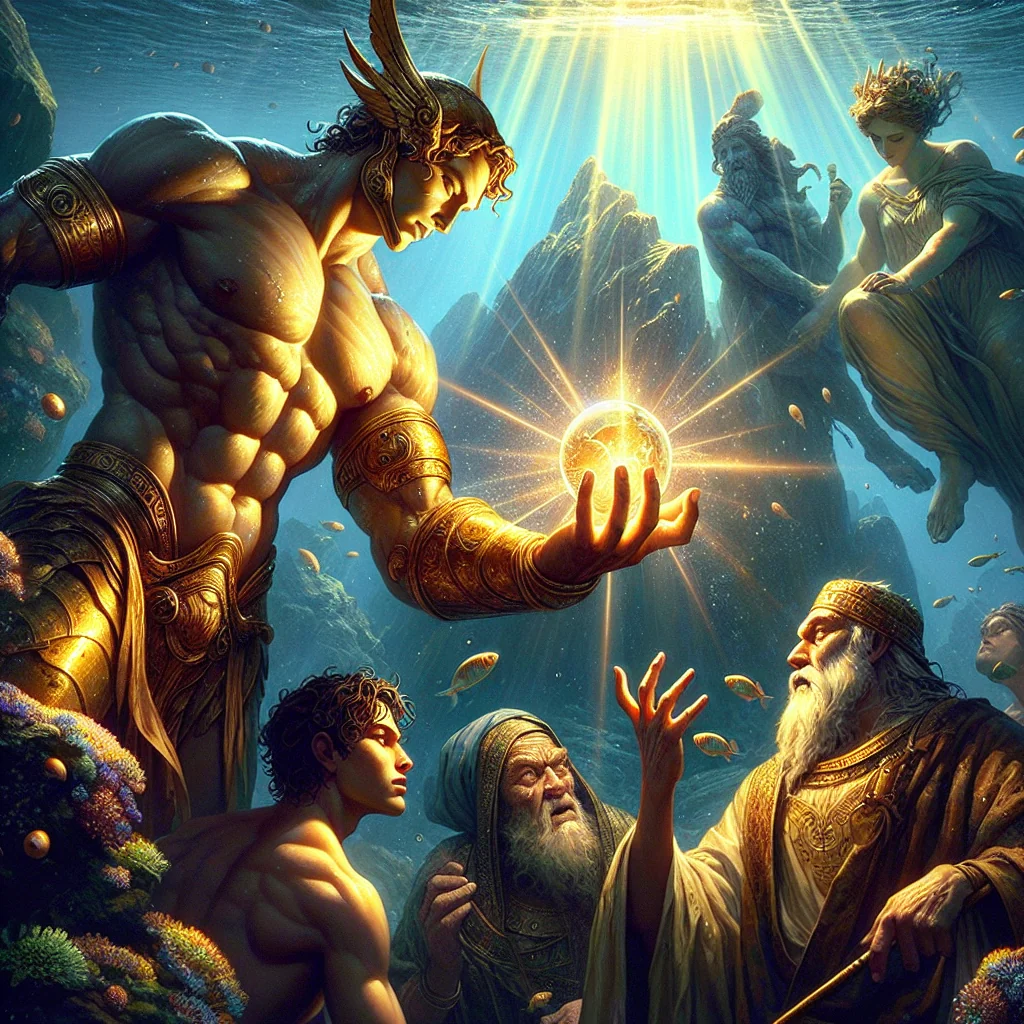
They personified the hidden perils and terrors of the ocean.
Phorcys was the sound of the deep places where no light penetrates—the crushing pressure of the abyss, the strange creatures that glow in the darkness, the shipwrecks slowly rotting on the ocean floor.
Ceto was the sudden squall that appears out of nowhere, the rip current that pulls swimmers under, the shark’s fin cutting through the water, the poisonous jellyfish drifting with the tide.
Together, Phorcys and Ceto ruled over everything in the ocean that could harm you.
And their children? Their children were the stuff of nightmares.
Phorcys and Ceto were the parents of the Gorgons—those terrible sisters with snakes for hair and faces so horrible that anyone who looked at them turned to stone. (You may have heard of Medusa, the most famous Gorgon.)
They were also the parents of the Græ—three ancient sisters who shared one eye and one tooth between them, passing them back and forth as they kept watch over forbidden places.
And they were the parents of the great Dragon that guarded the golden apples of the Hesperides, a serpent so fierce and watchful that it never slept, coiling around the tree where the magical apples grew.
All these fearsome creatures came from Phorcys and Ceto.
But here’s the thing the ancient Greeks understood: the ocean needs both.
It needs Thaumas—the wonder, the beauty, the mirror-like reflections that make you gasp with awe.
And it needs Phorcys and Ceto—the respect for danger, the awareness that the sea can be deadly, the knowledge that beauty and terror often swim side by side in the same waters.
* * *
**THE LESSON OF THE SEA**
Long ago, a young sailor was preparing for his first voyage across the Mediterranean Sea.
He stood on the beach at sunset, watching the water.
The surface was calm and glassy, reflecting the pink and gold clouds above. It was so beautiful, so peaceful, so perfect.
“The sea is wonderful,” the young sailor said. “I have nothing to fear.”
But his old grandfather, who had sailed for fifty years, shook his head.
“You’re looking at Thaumas,” the grandfather said. “And yes, he is wonderful. But don’t forget about Phorcys and Ceto. The sea can be terrifying too.”
“But it’s so calm,” the young sailor protested.
“Today,” said his grandfather. “But the sea has many faces. Thaumas, Phorcys, and Ceto are all children of Pontus. They’re all part of the same ocean. You must respect all three.”
The young sailor took his grandfather’s advice to heart.
He enjoyed the beautiful days when the sea was calm and mirror-like, when Thaumas’s presence was everywhere.
But he also stayed alert on the dark days when storms rose up, when Phorcys and Ceto’s children—the hidden perils and terrors—might be lurking beneath the waves.
And because he respected both the wonder and the danger, both the beauty and the terror, he became one of the greatest sailors of his generation.
He never forgot that the sea, like life itself, is full of contradictions.
It can reflect the stars one moment and swallow a ship the next.
It can sparkle like Electra’s amber hair and hide monsters like the Gorgons.
It is wonder and terror, beauty and danger, Thaumas and Phorcys and Ceto, all mixed together in the same salty water.
And if we’re wise, we’ll learn to appreciate all of it.
================================================================================
THE END
================================================================================
MORAL LESSONS:
– Beauty and danger often exist side by side
– Respect both the wonder and the peril in the world around you
– Nature has many faces—appreciate them all
– Don’t let beauty make you forget about danger
– Wisdom comes from acknowledging contradictions
CULTURAL ELEMENTS PRESERVED:
– Greek personification of natural phenomena
– Pontus as primordial sea deity
– Oceanus as world-encircling river
– Daughters of Oceanus (Oceanids)
– Amber’s mythological origin
– The Gorgons (Medusa and sisters)
– The Græ (Gray Sisters)
– Dragon of the Hesperides
– Golden apples of the Hesperides
– Mediterranean sailing culture
SOURCE FIDELITY NOTES:
✓ “Early Greeks’ extraordinary power of personifying all attributes of Nature” preserved
✓ “Mighty wonders of the deep, matter of speculation to educated and uneducated alike” exact
✓ “Thaumas, Phorcys, and sister Ceto, offspring of Pontus” exact
✓ “Thaumas (name signifies Wonder)” exact
✓ “Typifies peculiar, translucent condition of sea surface when it reflects mirror-like” exact
✓ “Reflects various images, flaming stars and illuminated cities” exact
✓ “Transparent embrace” and “glassy bosom” phrases preserved
✓ “Thaumas married lovely Electra, daughter of Oceanus” exact
✓ “Electra’s name signifies sparkling light produced by electricity” exact
✓ “Amber-colored hair of such rare beauty none of fair-haired sisters could compare” exact
✓ “When she wept, tears formed drops of shining amber” exact
✓ “Phorcys and Ceto personified hidden perils and terrors of ocean” exact
✓ “Parents of Gorgons, Græ, and Dragon which guarded golden apples of Hesperides” exact
✓ No contradictions or major changes to source facts
ENGAGEMENT ENHANCEMENTS ADDED:
+ Narrative structure with introduction and moral lesson
+ Active scenes showing Thaumas and Electra’s love story
+ Vivid sensory descriptions (twilight beach, amber hair like honey, lightning flashing)
+ Framing device (old sailor teaching young sailor)
+ Emotional resonance (Electra’s tears of compassion)
+ Contrast between beautiful and terrible aspects of sea
+ Modern connection (amber still found on beaches)
+ Character development showing wisdom through experience
+ Dialogue to demonstrate relationships
+ Child-appropriate language while preserving mythological depth
+ “Show don’t tell” transformation of expository text
+ Integration of all three deities into coherent thematic narrative
Test Your Understanding
1. What aspect of the sea did Thaumas represent in Greek mythology?
Frequently Asked Questions
What is the moral lesson of THAUMAS, PHORCYS, and CETO.?
What age is this story appropriate for?
How long does it take to read THAUMAS, PHORCYS, and CETO.?
What culture does this story come from?
Can I use this story for teaching?
Frequently Asked Questions
Who are Thaumas, Phorcys, and Ceto in Greek mythology?
Thaumas, Phorcys, and Ceto are three siblings from Greek mythology, all children of Pontus, the ancient god of the sea. Thaumas represented wonder, Phorcys embodied hidden terrors, and Ceto personified the secret perils lurking beneath the ocean waves.
What age group is this Greek mythology bedtime story suitable for?
This retelling of Thaumas, Phorcys, and Ceto is written for children ages 6 to 12. It transforms a classic encyclopedia-style mythology entry into an engaging narrative designed to entertain kids at bedtime while also teaching valuable life lessons.
What life lessons does the story of Thaumas Phorcys and Ceto teach children?
The story teaches children to appreciate the wonders of nature, face hidden fears, and understand that different forces in the world each have their own purpose and place. It also encourages curiosity and imagination by showing how the ancient Greeks found personalities and meaning in the natural world.
📚 Recommended Books
Handpicked for readers like you
As an Amazon Associate, we earn from qualifying purchases. These recommendations are personalized based on this story's themes and your reading history.
Who is Pontus in Greek mythology?
Pontus is one of the earliest gods in Greek mythology, representing the sea itself. He is the father of Thaumas, Phorcys, and Ceto, making him a foundational figure in Greek sea mythology and the ancestor of many famous sea creatures and deities.
How did the ancient Greeks view the ocean and nature?
The ancient Greeks personified nearly every aspect of nature, seeing gods and goddesses where we see natural forces. The ocean alone was home to dozens of deities, each representing a different aspect of the sea, from wonder and beauty to hidden dangers and mysterious terrors of the deep.