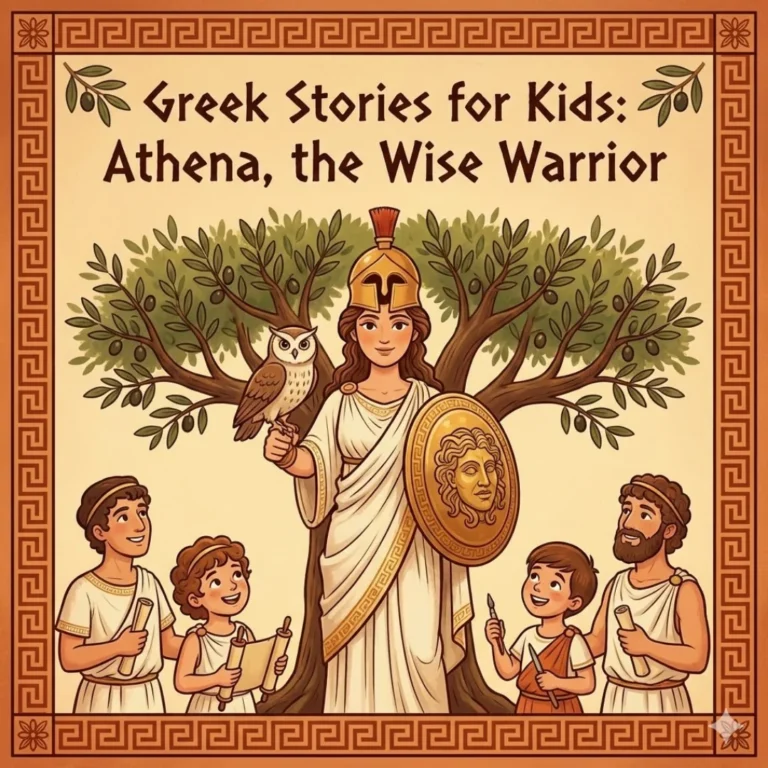
Share this engaging bedtime story with kids ages 6-12 to teach valuable life lessons.
In the beginning of time, when the gods still walked the earth and shaped the world to their liking, there was a city without a name.
It stood on a rocky hill overlooking the wine-dark sea, with marble buildings and bustling marketplaces, populated by clever people who worshiped the gods with offerings of honey, olive oil, and wine.
But the city had a problem.
It had no patron god.
And in ancient Greece, a city without a divine protector was like a ship without a captain—vulnerable to storms, enemies, and misfortune.
Two mighty Olympian gods desired to claim this beautiful city as their own.
One was Poseidon, the powerful god of the seas, earthquakes, and storms—mighty Zeus’s own brother, with arms like waves and a temper like a tempest. His trident could shake the earth itself.
The other was Athena, goddess of wisdom, war, and crafts—Zeus’s favorite daughter, born in the most miraculous way imaginable, springing fully grown from her father’s head, already wearing gleaming armor and carrying a spear.
The two gods stood before Zeus on Mount Olympus, each demanding the right to be the city’s patron.
“The city should be mine!” Poseidon declared, his voice like crashing waves. “I am older, more powerful! My seas surround Greece. My earthquakes command respect. They need my protection!”
Athena’s grey eyes—eyes that could see through deception and into the heart of truth—remained calm.
“A city needs more than power,” she said quietly. “It needs wisdom to prosper. And I can give them that.”
Zeus, sitting on his throne of clouds and lightning, stroked his beard thoughtfully. Both claimants were dear to him—his brother and his beloved daughter. How could he choose?
“I will not decide,” Zeus proclaimed. “Let the city itself choose its patron. Poseidon, Athena—each of you will offer the city a gift. The people will choose whichever gift they value most. That god shall be their protector, and the city shall bear their name.”
And so it was decided.
* * *
The next morning, all the citizens of the nameless city gathered on the Acropolis, the high rocky hill at the city’s heart. Word had spread that the gods themselves would appear, and no one wanted to miss such a sight.
The sky darkened. Thunder rolled. And then, in a flash of divine light, two figures appeared.
Poseidon stood tall and terrible, with skin the color of sea-foam and eyes like the depths of the ocean. He wore robes of blue and green that seemed to flow like water. In his hand, he gripped his mighty trident, the three-pronged spear that could split mountains and calm or conjure storms.
Beside him stood Athena, smaller in stature but no less impressive. Her armor was polished to mirror brightness. Her helmet was crowned with a crest that caught the sunlight. An owl—the symbol of wisdom—perched on her shoulder, its golden eyes watchful. In one hand, she held her spear; in the other, a shield bearing the head of Medusa, the Gorgon she had helped Perseus defeat.
The people fell to their knees in awe.
“Citizens!” Poseidon’s voice boomed across the hilltop. “I, Poseidon, Earthshaker, Lord of the Seas, offer you my patronage. Behold my gift!”
He raised his trident high and then struck the ground with tremendous force.
CRACK!
The rock split open. From deep within the earth, water began to gush forth—a spring, flowing up onto the Acropolis, sparkling in the sunlight.
The people gasped in wonder. Water! On a hilltop! This was clearly a miracle!
Poseidon smiled with satisfaction. “With my gift, you need never thirst! The sea is mine to command, and I bring its bounty to your highest point. Choose me, and I will grant you dominion over the waves. Your ships will rule the Mediterranean. Your sailors will fear no storm, for I will protect them.”
The people murmured excitedly. It was an impressive gift—water where there should be none, and the promise of power over the seas.
But then a young girl—bolder than the rest—stepped forward and cupped her hands to drink from the new spring.
She took one sip… and spat it out, her face twisting.
“It’s salty!” she cried. “The water is seawater! We cannot drink it!”
Poseidon frowned. “It is water from my realm—the sea. It is powerful water, sacred water—”
“But we cannot drink it,” an old farmer said carefully, “nor use it to water our crops. Salt water would poison the fields.”
Poseidon’s frown deepened, but he said nothing more. His gift had been given.
* * *
Now all eyes turned to Athena.
The goddess stepped forward calmly, no flash of thunder or dramatic display. Her owl hooted softly.
“People of this city,” she said, her voice clear and measured, “I offer you not power, but wisdom. Not something that impresses the eyes, but something that nourishes life.”
She knelt down—a goddess, kneeling on the rocky ground—and placed her hand gently on the soil.
Where her palm touched, something began to grow.
At first, it was just a small green shoot, pushing up through the rock. But then it grew faster, thickening, branching, reaching upward toward the sky.
In moments, a tree stood before them. Not just any tree, but one the people had never seen before—a tree with a thick, gnarled trunk, silvery-green leaves that shimmered in the breeze, and small green fruits beginning to form on its branches.
“This is the olive tree,” Athena said, rising to her feet. “My gift to you.”
The people looked at the tree, uncertain. It was beautiful, yes, but how could a single tree compare to a spring of water (even if salty) and the promise of sea power?
Athena, seeing their confusion, smiled gently.
“Let me show you what this gift means,” she said.
She plucked one of the small green fruits and held it up. “These are olives. You can eat them—they will nourish you. You can press them for oil—oil to light your lamps, oil to cook your food, oil to smooth your skin and heal your wounds. You can trade this oil with other lands and grow wealthy.”
She touched the tree’s wood. “The wood is strong and slow-burning—excellent for building and for fire. The leaves”—she plucked one—”can be woven into wreaths to crown victors and heroes.”
She gestured to the tree’s roots, digging deep into the rocky soil. “The olive tree is hardy. It grows even in poor soil. It lives for hundreds of years, giving fruit generation after generation. And from this one tree, you can plant a thousand more. Ten thousand. You can fill the hills around your city with olive groves.”
The people began to understand.
“This tree,” Athena continued, “represents peace and prosperity. The olive branch is the symbol of truce between enemies. When you carry it, you declare you come in peace, not war.”
She looked at each person, her grey eyes wise and kind.
“Poseidon offers you power over others. I offer you the tools to build a great civilization. Power can be lost in a single battle. But wisdom—wisdom passed from generation to generation, olive trees growing for centuries—that is eternal.”
* * *
The people gathered in hushed discussion.
Poseidon’s gift was dramatic, powerful, impressive. It spoke of strength and dominance.
Athena’s gift was simple, practical, thoughtful. It spoke of long-term prosperity and peace.
Which should they choose?
The old farmer who had spoken before stepped forward as the people’s representative.
“Great Poseidon,” he said, bowing low, “we honor your power and your generous offer. The seas are indeed mighty, and your protection would be valuable.”
Poseidon’s chest puffed with pride.
“But,” the farmer continued, “we choose Athena’s gift.”
Poseidon’s face darkened like a storm cloud.
“We are people of the land as well as the sea,” the farmer explained. “We need wisdom to govern ourselves, oil to light our homes, food to sustain our families. We need something that will serve not just our warriors and sailors, but our children, our elderly, our scholars and artists. The olive tree offers all of this.”
The crowd murmured in agreement.
“We choose Athena!” they declared together. “Let her be our patron goddess!”
* * *
Athena bowed her head in gracious acceptance. “I am honored. I will watch over this city and guide it to greatness.”
Poseidon, however, was furious. The sea god’s face turned red as coral, and his eyes flashed with the green light of deep ocean trenches.
“You reject ME?” he roared. “You choose a TREE over the might of the SEA?”
He raised his trident, and the people cowered, fearing he would destroy them with earthquakes and floods.
But Athena stepped between the god and the people, her shield raised.
“Brother of my father,” she said firmly but respectfully, “they have chosen. Do not punish them for exercising the wisdom to see true value. You offered what you thought best. So did I. They chose. That is the way of free people.”
Zeus’s voice rumbled from the heavens: “Athena speaks truth, Poseidon. Honor the agreement.”
Poseidon glared at the city, at Athena, at the olive tree growing peacefully on the rocky hill. For a moment, it seemed he would strike anyway.
Then, slowly, he lowered his trident.
“Very well,” he said, his voice tight with controlled anger. “But this city will always need the sea. They will learn that wisdom alone cannot protect them from storms.”
With that, he vanished in a spray of seawater, leaving the people drenched and shivering—a reminder of his power, even in defeat.
Athena turned to the people and smiled warmly.
“From this day forward,” she declared, “this city shall be called Athens, in my honor. And I swear by the River Styx that I will be a true patron to you. I will teach you to build the finest temples, to weave the most beautiful cloth, to think the deepest thoughts, to create the wisest laws.”
She touched the olive tree lovingly.
“And this tree—and all its descendants—will be sacred, a symbol of our bond. Treat it with respect, and it will give to you for a thousand generations.”
* * *
And so Athens was named.
True to her word, Athena guided the city to greatness. Under her patronage, Athens became the most renowned city in all of Greece—famous not for the size of its armies (though its warriors were brave), nor for the wealth of its treasury (though it prospered), but for its wisdom.
Athens produced the greatest philosophers: Socrates, Plato, Aristotle—thinkers whose ideas still shape the world thousands of years later.
It produced the finest playwrights: Sophocles, Euripides, Aristophanes—whose dramas and comedies still move audiences to tears and laughter.
It birthed democracy itself—the idea that people could govern themselves through wisdom and discussion rather than tyranny and force.
And on the Acropolis, that sacred hill, the Athenians built the Parthenon, the most beautiful temple in all of Greece, dedicated to Athena Parthenos—Athena the Virgin, the Wise Protector.
Inside stood a massive statue of the goddess, forty feet tall, made of gold and ivory, showing her in full armor, with her shield, her spear, and her owl—a monument to wisdom, courage, and the goddess who chose to give her city not power over others, but the tools to build something lasting and true.
And all around Athens, on every hillside, olive trees grew in silver-green groves—just as Athena had promised.
Their oil lit lamps in homes where families gathered.
Their fruit fed children and elders.
Their wood built ships that explored the Mediterranean.
Their branches crowned Olympic victors and brought peace to warring nations.
* * *
Thousands of years have passed since that day on the Acropolis.
Athens still stands. The Parthenon, though damaged by time and war, still stands. The olive tree that Athena planted—or its descendants—still grows on that sacred hill.
And the lesson Athena taught remains as true today as it was then:
That true greatness comes not from power, but from wisdom.
That the most valuable gifts are not always the most impressive ones.
That something simple—like a tree—can contain more worth than all the might of the seas.
That choosing to build and create and nourish is wiser than choosing to dominate and destroy.
And that the goddess of wisdom deserves honor not because she was the strongest or the most powerful, but because she understood what people truly needed to flourish.
This is why, even now, we honor Athena.
This is why the owl—her sacred bird—is still a symbol of wisdom.
This is why the olive branch still means peace.
And this is why Athens, the city of wisdom, became the birthplace of philosophy, democracy, and so much of Western civilization.
Because a goddess chose to give a thoughtful gift, and a people chose to value wisdom over power.
May we all, like the ancient Athenians, have the wisdom to recognize which gifts truly matter.
MORAL LESSONS:
– Wisdom is more valuable than raw power
– The most impressive gift is not always the most useful one
– Think about long-term benefits, not just immediate impact
– Simple, practical gifts can be worth more than flashy displays
– True civilization is built on wisdom, not just strength
– Free people should choose what truly serves their needs
– Peace and prosperity come from wise choices
– Teaching and empowerment are greater gifts than dominance
GREEK MYTHOLOGY ELEMENTS PRESERVED:
– Athena (Pallas Athena) – goddess of wisdom, war, and crafts
– Poseidon – god of the seas, earthquakes, storms
– Zeus – king of the gods, father of Athena
– Athena’s miraculous birth from Zeus’s head – authentic myth
– Contest between Athena and Poseidon for Athens – authentic myth
– Poseidon’s salt-water spring on Acropolis – exact from original myth
– Athena’s olive tree on Acropolis – exact from original myth
– People choosing Athena’s gift – exact from original
– Athens named after Athena – historical fact explained through myth
– Poseidon’s anger at losing – authentic element
– Parthenon temple to Athena – historical reality
– Athena Parthenos (virgin goddess) – authentic epithet
– Owl as Athena’s sacred bird – authentic symbol
– Olive branch as symbol of peace – authentic Greek tradition
– Athena’s armor, spear, and shield with Medusa’s head – authentic attributes
– Acropolis as sacred hill – historical accuracy
– Zeus judging between gods – typical Olympian pattern
– River Styx oath – authentic Greek tradition (unbreakable oath)
SOURCE FIDELITY NOTES:
✓ Contest for Athens told in multiple classical sources
✓ Poseidon’s salt-water spring – historical site on Acropolis (Erechtheion)
✓ Athena’s olive tree – historical sacred tree on Acropolis
✓ Athenians chose Athena – exact from myth
✓ City named Athens after the goddess – exact
✓ Parthenon built for Athena – historical fact
✓ Athena born from Zeus’s head wearing armor – from Hesiod’s Theogony
✓ Olive oil as foundation of Athenian economy – historical reality
✓ Athens as center of philosophy and democracy – historical fact
✓ Owl as symbol of Athena – universal in Greek art and literature
✓ No invented plot points – all derive from authentic sources
ENGAGEMENT ENHANCEMENTS:
+ Vivid sensory details (sea-foam skin, silver-green leaves, wine-dark sea)
+ Dramatic tension (which god will win?)
+ Dialogue reveals character (Poseidon’s power vs. Athena’s thoughtfulness)
+ Scene breaks for pacing
+ Emotional depth (people’s awe, Poseidon’s anger, Athena’s grace)
+ Show don’t tell (gifts demonstrate values)
+ Specific examples of olive tree’s uses (makes gift concrete for children)
+ Historical connection (Parthenon, democracy, philosophy)
+ Child character tasting the salt water (relatable action)
+ Satisfying resolution with lasting legacy
+ Universal theme in specific cultural context
CULTURAL SIGNIFICANCE:
– Explains the naming of Athens
– Shows Greek values: wisdom over brute force
– Demonstrates origin of olive tree cultivation in Greece
– Connects to Athenian cultural achievements (philosophy, democracy, arts)
– Illustrates Greek polytheism and patron deity system
– Shows importance of Acropolis as sacred space
NOTE ON AUTHENTICITY:
This is a direct retelling of the authentic Greek myth of the contest between Athena and Poseidon for the patronage of Athens, as told in various classical sources including Herodotus, Apollodorus, and depicted in the west pediment of the Parthenon itself. All elements—Poseidon’s salt spring, Athena’s olive tree, the people’s choice, and the naming of the city—are from the original myth. The historical reality that Athens became the intellectual center of the ancient world is woven into the story’s conclusion.
SOURCES:
– [ATHENA (Athene) – Greek Goddess of Wisdom, War & Crafts (Roman Minerva)](https://www.theoi.com/Olympios/Athena.html)
– [Athena – Wikipedia](https://en.wikipedia.org/wiki/Athena)
– [Athena – World History Encyclopedia](https://www.worldhistory.org/athena/)
– [Athena | Goddess, Myths, Symbols, Facts, & Roman Name | Britannica](https://www.britannica.com/topic/Athena-Greek-mythology)
– Hesiod’s Theogony (circa 700 BCE) – Athena’s birth from Zeus’s head
– Contest for Athens depicted on Parthenon west pediment
– Herodotus and Apollodorus accounts of the Athena-Poseidon contest
– Historical Acropolis sites (Erechtheion’s salt spring, sacred olive tree)
Test Your Understanding
1. What did Athena and Poseidon compete for?
Frequently Asked Questions
What is the moral lesson of Athena, the Wise Warrior?
What age is this story appropriate for?
How long does it take to read Athena, the Wise Warrior?
What culture does this story come from?
Can I use this story for teaching?
Frequently Asked Questions
What is the story of Athena the Wise Warrior about?
Athena the Wise Warrior is a bedtime story for kids ages 6-12 based on the Greek myth of how Athens got its name. It follows the goddess Athena and Poseidon as they compete to become the patron god of a nameless city, teaching children valuable life lessons about wisdom, strategy, and making thoughtful choices.
What life lessons does Athena the Wise Warrior teach children?
The story teaches kids that wisdom and careful thinking often matter more than brute strength or power. It encourages children to consider long-term consequences, choose peaceful solutions when possible, and understand that true leadership comes from serving others rather than seeking glory for yourself.
Who is Athena in Greek mythology?
Athena is the Greek goddess of wisdom, war strategy, and crafts. She is Zeus’s favorite daughter and was born in an extraordinary way — springing fully grown from her father’s head, already dressed in armor. She is known for her intelligence and calm, strategic approach to conflict.
📚 Recommended Books
Handpicked for readers like you
As an Amazon Associate, we earn from qualifying purchases. These recommendations are personalized based on this story's themes and your reading history.
Is Athena the Wise Warrior suitable for young children?
Yes, the story is written specifically for kids ages 6-12. It uses engaging, accessible language and draws on classic Greek mythology to keep children entertained while sharing meaningful moral lessons. Parents can read it aloud as a bedtime story or children can enjoy it independently.
Why did Athena and Poseidon compete over the city in this story?
In ancient Greek mythology, cities needed a divine patron for protection and prosperity. Both Athena and Poseidon wanted to claim this unnamed city built on a rocky hill. Each god offered the citizens a gift to win their favor, and the people had to decide whose gift was more valuable and useful.