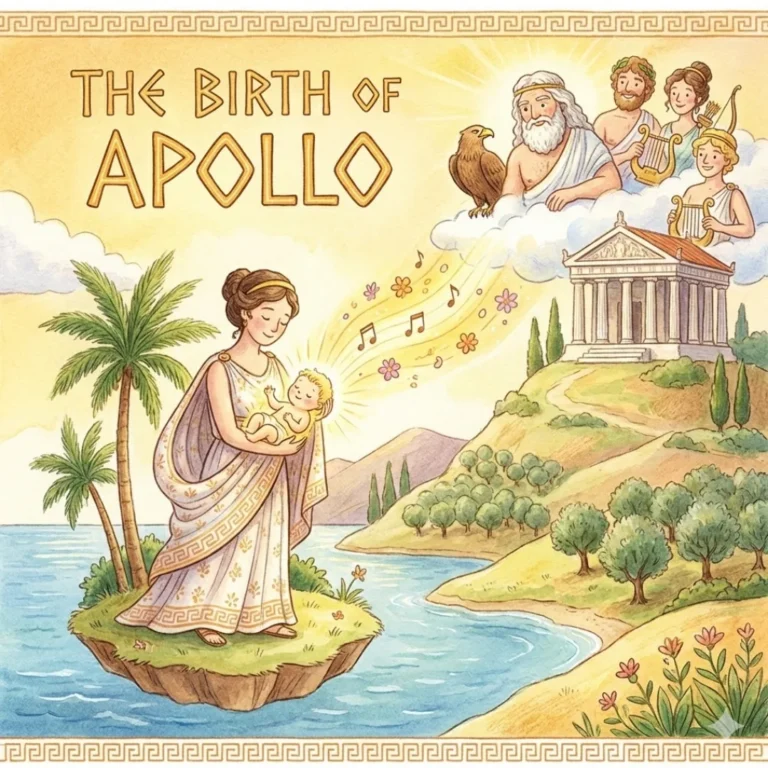
‘The Birth of Apollo’ is an educational moral story perfect for bedtime reading with children ages 6-12.
Long ago in ancient Greece, when the gods still walked among mortals and islands floated upon the wine-dark sea, a goddess named Leto found herself in desperate trouble. She carried within her two divine children, twins fathered by Zeus, the king of all gods. But Hera, Zeus’s jealous wife and queen of heaven, had learned of this and burned with rage.
“No land shall give you refuge!” Hera declared, her voice echoing across the earth. “No place shall welcome you to bear your children!” And such was Hera’s power that every land, every island, every mountain and valley trembled in fear of her wrath and turned Leto away.
Poor Leto wandered across the world, heavy with child and weary beyond measure. She traveled to the peaks of mountains and the shores of seas. She sought shelter in forests and meadows. But everywhere she went, the land itself refused her, shaking in terror of Hera’s anger.
“Please,” Leto begged, “I ask only for a place to rest, to bring my children into the world. These twins I carry will be great gods, and the place that shelters me will be honored forever.”
But still the lands turned her away. The mountains said, “Hera’s wrath would shake us to our foundations.” The fertile plains said, “Her anger would scorch our fields.” Even the richest lands feared to offer shelter.
At last, tired and desperate, Leto came to a small, rocky island floating in the Aegean Sea. This was Delos—a poor place with little soil, battered by winds and waves, with hardly a tree or blade of grass. It was so humble that it drifted upon the water, never still, never settled, anchored to nothing.
“Will you give me shelter?” Leto asked the little island. “Will you give my son a place to be born?”
Delos hesitated. Even this small island feared Hera’s rage. “Goddess,” said Delos, “I am but a poor, wandering rock. I have no great cities, no rich temples, no fertile fields. What could I offer to the son of Zeus? And if I help you, will not Hera’s fury destroy me utterly?”
“My son will be Apollo,” Leto promised, her voice filled with divine certainty. “He will be the god of light, of music, of prophecy and healing. If you give him a birthplace, he will make you famous forever. Your name will be sung in every land. Pilgrims will come from across the world to honor you. You will be sacred above all islands.”
Delos considered this. What did the island have to lose? Already it was poor and wandering. “Very well,” Delos agreed. “I will shelter you, goddess. But you must swear that Apollo will build his temple here and honor me always.”
“I swear it,” Leto vowed. “This I promise on the sacred river Styx, by which even the gods are bound.”
And so it was that Leto found refuge at last on the humble island of Delos. But even then, her trials were not over. For nine days and nine nights, she labored to bring forth her children. The greatest goddesses came to help her—Dione, Rhea, Themis, and others—all except Hera and her daughter Eileithyia, the goddess of childbirth, whom Hera kept imprisoned on Mount Olympus.
Without Eileithyia, no birth could be completed. Leto suffered in agony while Hera smiled in cruel satisfaction on distant Olympus. But the other goddesses would not abandon Leto. They sent Iris, the rainbow messenger, to Olympus with a magnificent bribe—a golden necklace nine cubits long, strung with amber beads as bright as the sun.
“Come quickly, Eileithyia,” Iris pleaded. “See what gifts await you! Only you can help the goddess Leto.”
The golden necklace was so beautiful that even loyal Eileithyia could not resist. Without telling Hera, she slipped away and flew swiftly to Delos. The moment she arrived and spoke the sacred words of childbirth, Leto’s pain transformed into joy.
Leto wrapped her arms around a sacred palm tree that grew beside a pool of clear water. She knelt upon the soft grass, and at that moment, the island of Delos ceased its wandering. Four great pillars rose from the sea floor and anchored the island firm and fast. Never again would Delos drift—it would remain fixed forever as the sacred birthplace of a god.
And then, as the sun reached its zenith in the sky, Apollo was born.
The moment the infant god emerged into the world, golden light blazed forth. The goddesses bathed him in pure water and wrapped him in white swaddling clothes bound with golden bands. But Apollo would not taste mortal food. Themis, goddess of divine law, gave him nectar and ambrosia—the food of immortality.
The instant this divine food touched his lips, something wondrous happened. The golden bands burst apart. Apollo sprang up from the goddesses’ arms, no longer an infant but a glorious youth with golden hair. His first words rang out across Delos like music: “The lyre and the curved bow shall be dear to me, and I will reveal to mortals the unfailing will of Zeus!”
The goddesses gasped in awe. Before their eyes, Apollo grew to his full divine power. Light streamed from him like rays of the sun. His beauty was so perfect that it hurt to look upon him directly, yet no one could turn away.
“Bring me a lyre,” Apollo commanded, “that I may make music. And bring me a bow, that I may defend the innocent and uphold truth.”
All Delos rejoiced. The palm tree that had sheltered Leto became sacred forever. The pool of water became holy. Flowers bloomed across the rocky soil—delicate white blossoms and golden daffodils. Swans, sacred to Apollo, circled the island seven times, singing with voices more beautiful than any earthly bird.
Apollo kept his mother’s promise. He made Delos the center of his worship. He commanded that a great temple be built there, and that festivals be held in his honor. From across the Greek world, people came to Delos—rich and poor, kings and commoners—all bringing offerings to the golden god who had been born on the humble island.
And so Delos, once the poorest and most scorned of places, became the most sacred and honored. Ships filled its harbor. Temples crowned its hills. Treasuries overflowed with gold and silver. All because it had shown kindness when no one else would.
Apollo went on to become one of the greatest of all gods. He established his oracle at Delphi, where priestesses would speak his prophecies to all who sought wisdom. He became the god of music and poetry, of healing and plague, of light and truth. His twin sister Artemis, born just before him on Delos, became the virgin huntress and protector of wild places.
But Apollo never forgot the little island that had sheltered his mother. He kept Delos sacred always, and it remained the center of his worship throughout all the ages of ancient Greece.
The story of Apollo’s birth teaches us many things. It reminds us that even the mighty may need help from the humble. It shows us that kindness given in desperate times is never forgotten. And it tells us that from small and difficult beginnings, greatness can emerge—like the golden god born on a rocky island in the midst of the sea.
Even today, the ruins of Apollo’s temple still stand on Delos, and visitors come from around the world to walk where the god of light first opened his eyes to the world and filled it with his radiance.
Moral Lessons
- Courage to help others in their time of need, even at great risk, brings lasting honor and blessing. From humble beginnings, greatness can emerge when compassion guides our actions.
Test Your Understanding
1. Why did no land want to give Leto a place to give birth?
Frequently Asked Questions
What is the moral lesson of The Birth of Apollo?
What age is this story appropriate for?
How long does it take to read The Birth of Apollo?
What culture does this story come from?
Can I use this story for teaching?
Frequently Asked Questions
Who is Apollo in Greek mythology and why is his birth story important?
Apollo is one of the most important gods in Greek mythology, known as the god of music, poetry, prophecy, and the sun. His birth story teaches children about perseverance and how even gods faced challenges. It’s a perfect introduction to ancient Greek culture for ages 6-12.
Why couldn’t Leto find a place to give birth to Apollo and his twin sister?
Hera, Zeus’s jealous wife, cursed Leto so no land would welcome her. Hera was angry because Zeus had an affair with Leto, and she used her power to make every place on earth refuse to give Leto shelter during her pregnancy.
Is this Greek mythology story appropriate for children at bedtime?
Yes, this story is specifically adapted for children ages 6-12. While it deals with Greek gods and their conflicts, it focuses on themes of perseverance, kindness, and hope rather than violence, making it perfect for bedtime reading.
📚 Recommended Books
Handpicked for readers like you
As an Amazon Associate, we earn from qualifying purchases. These recommendations are personalized based on this story's themes and your reading history.
Who are the parents of Apollo in this story?
Apollo’s father is Zeus, the king of all gods in Greek mythology, and his mother is Leto, a gentle goddess. The story focuses on Leto’s struggles during pregnancy and how she overcame Hera’s jealousy to bring Apollo into the world.
What lesson does this ancient Greek story teach children?
This story teaches children about persistence in the face of difficulties and how kindness can overcome cruelty. It shows that even when things seem impossible, help can come from unexpected places, and good things happen to those who don’t give up.