This moral story for children ages 6-12 combines entertainment with important values.
At the foot of a mountain so tall its peak disappeared into the clouds, there was a small village where people lived in harmony with nature.
The mountain was called Kamiyama—”Spirit Mountain”—and the villagers knew it was sacred. Every tree on its slopes, every stone on its paths, every stream that flowed from its heights was home to kami—the spirits that dwell in all natural things.
In this village lived a girl named Yuki. Her name meant “snow,” after the pure white snow that crowned the mountain peak even in summer.
Yuki was small for her twelve years, with gentle eyes and quiet ways. While other children ran and shouted, Yuki preferred to sit by the stream and watch dragonflies dance on the water. While others competed to see who was strongest or fastest, Yuki learned the old prayers from her grandmother.
The other children sometimes teased her for being different.
But Yuki’s grandmother would smile and say, “A quiet stream runs deep, little one. Never mistake stillness for weakness.”
* * *
Yuki’s grandmother, Obaasan, was the oldest person in the village. She remembered when her own grandmother had taught her the ancient Shinto ways—the ways that honored the kami and kept balance between humans and nature.
“The kami are everywhere, Yuki-chan,” Obaasan would say, using the affectionate diminutive. “In the great cedar trees that have stood for a thousand years. In the stones that mark the mountain path. In the waterfall that never stops singing. Even in the rice that grows in our paddies—each grain holds a tiny spirit.”
She taught Yuki how to bow properly at the torii gate that marked sacred space. How to clap twice and bow once when offering prayers. How to rinse hands and mouth at the purification fountain before approaching a shrine.
Most importantly, she taught Yuki the attitude of the heart that matters most.
“The kami do not care about expensive offerings,” Obaasan explained. “They care about sincerity. They care about gratitude. They care about respect. A simple bowl of rice offered with a pure heart pleases them more than a feast given with arrogance.”
Yuki absorbed these teachings like earth absorbs rain, quietly and completely.
* * *
Then came the Year of the Drought.
The rainy season—that time when the sky should open and pour blessings on the rice fields—never came. Day after day, the sun blazed down from a cloudless sky.
The rice paddies, usually flooded with water, cracked into patterns like broken pottery. The streams that flowed from the mountain slowed to thin trickles. The villagers’ wells dropped lower and lower.
By the middle of summer, fear had taken root in every heart.
“Without water, the rice will die,” the farmers said, staring at their withering crops.
“Without rice, we will starve through the winter,” the mothers whispered, looking at their children with worried eyes.
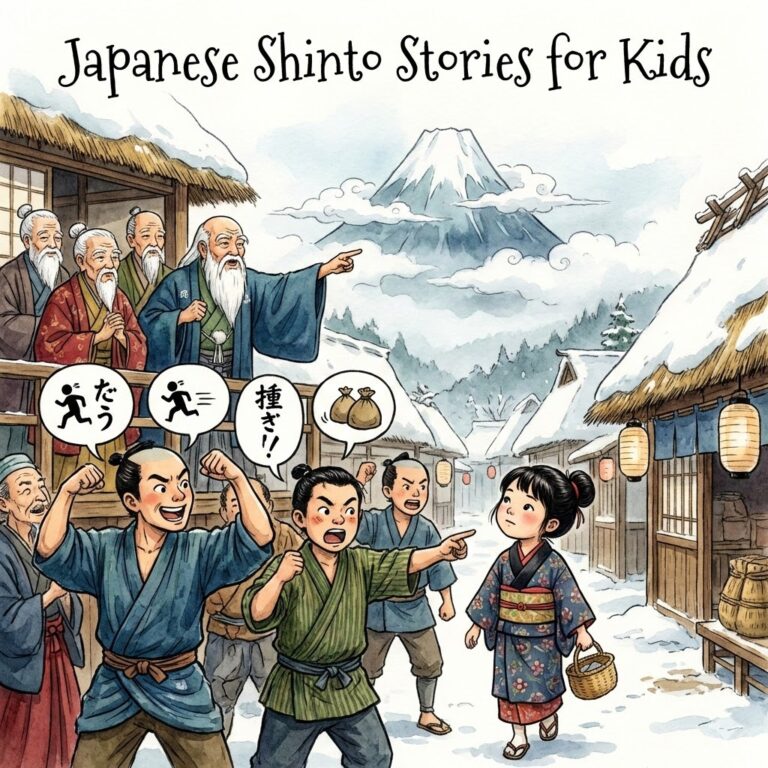
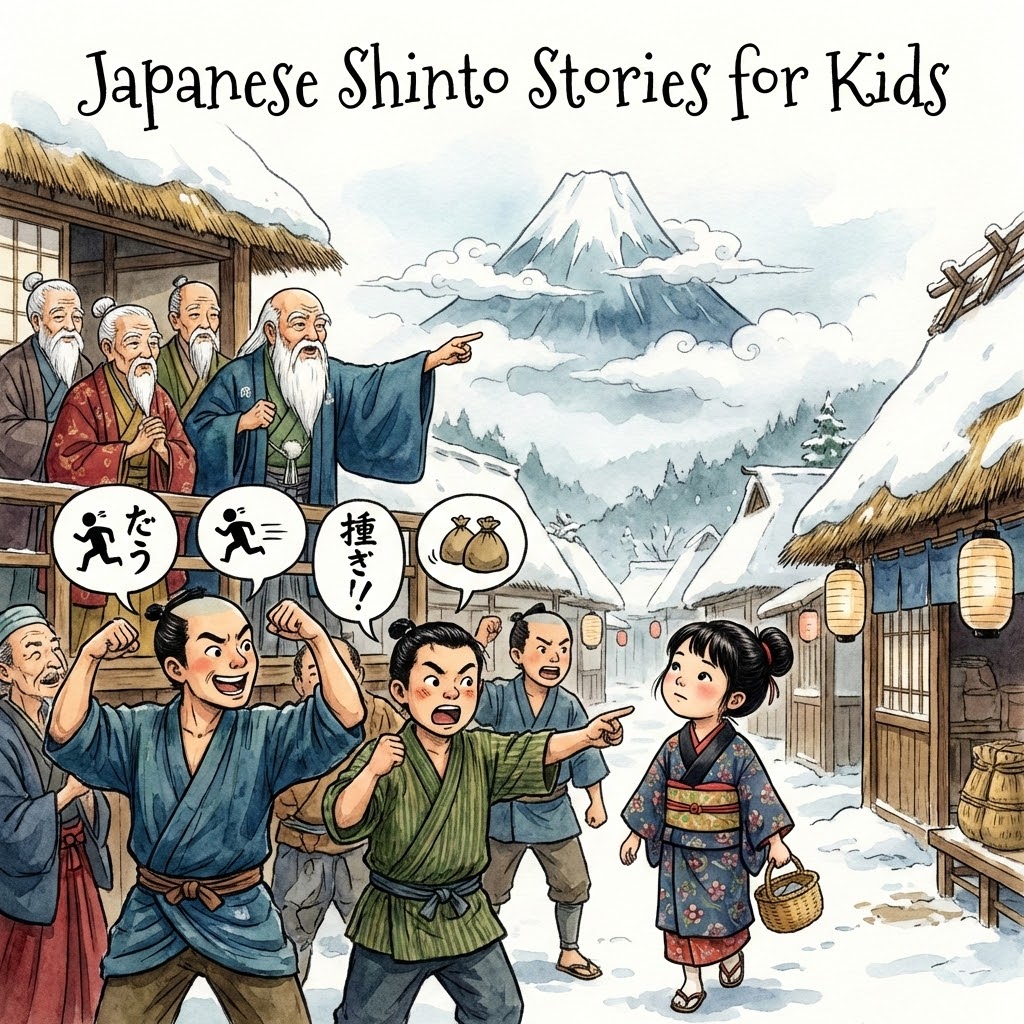
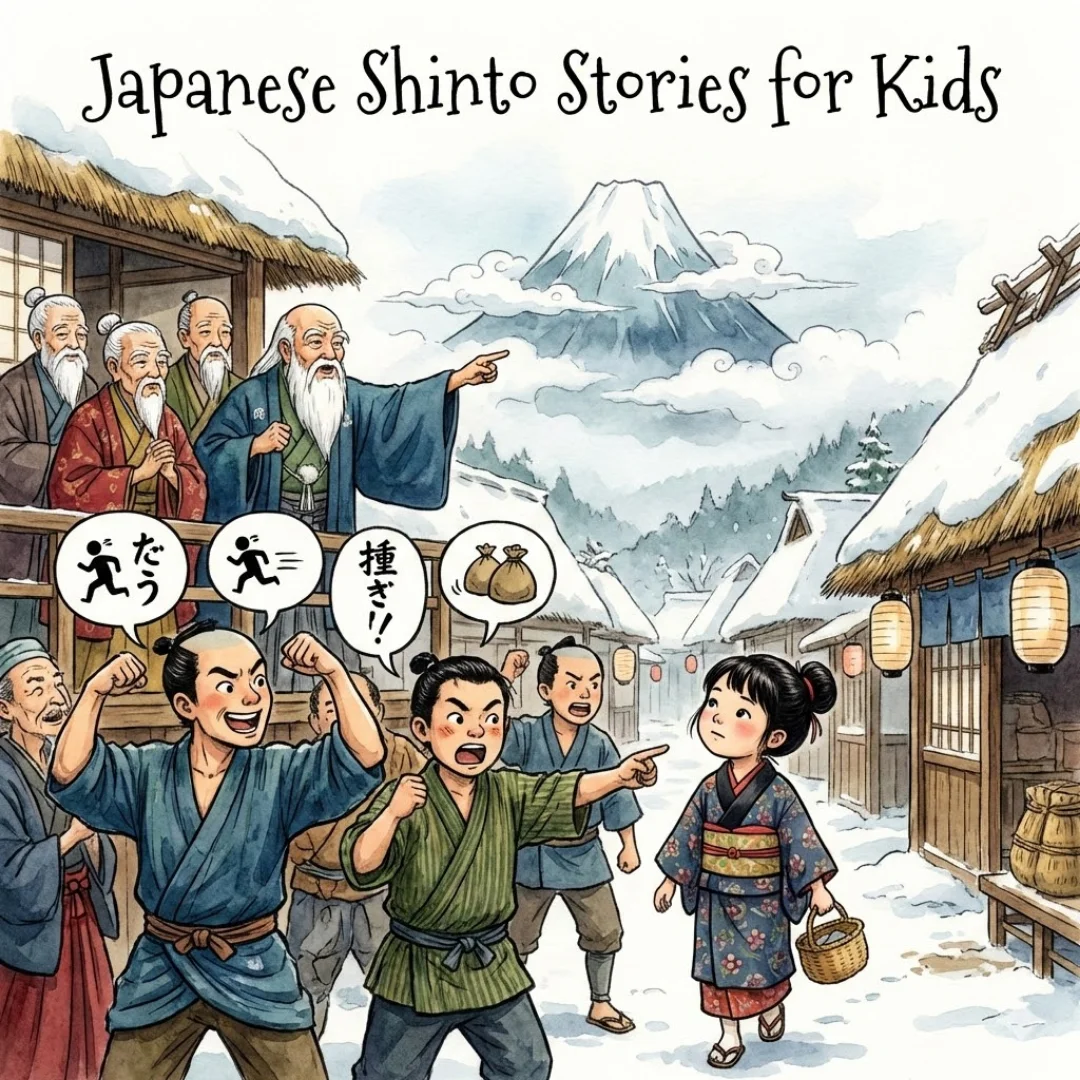
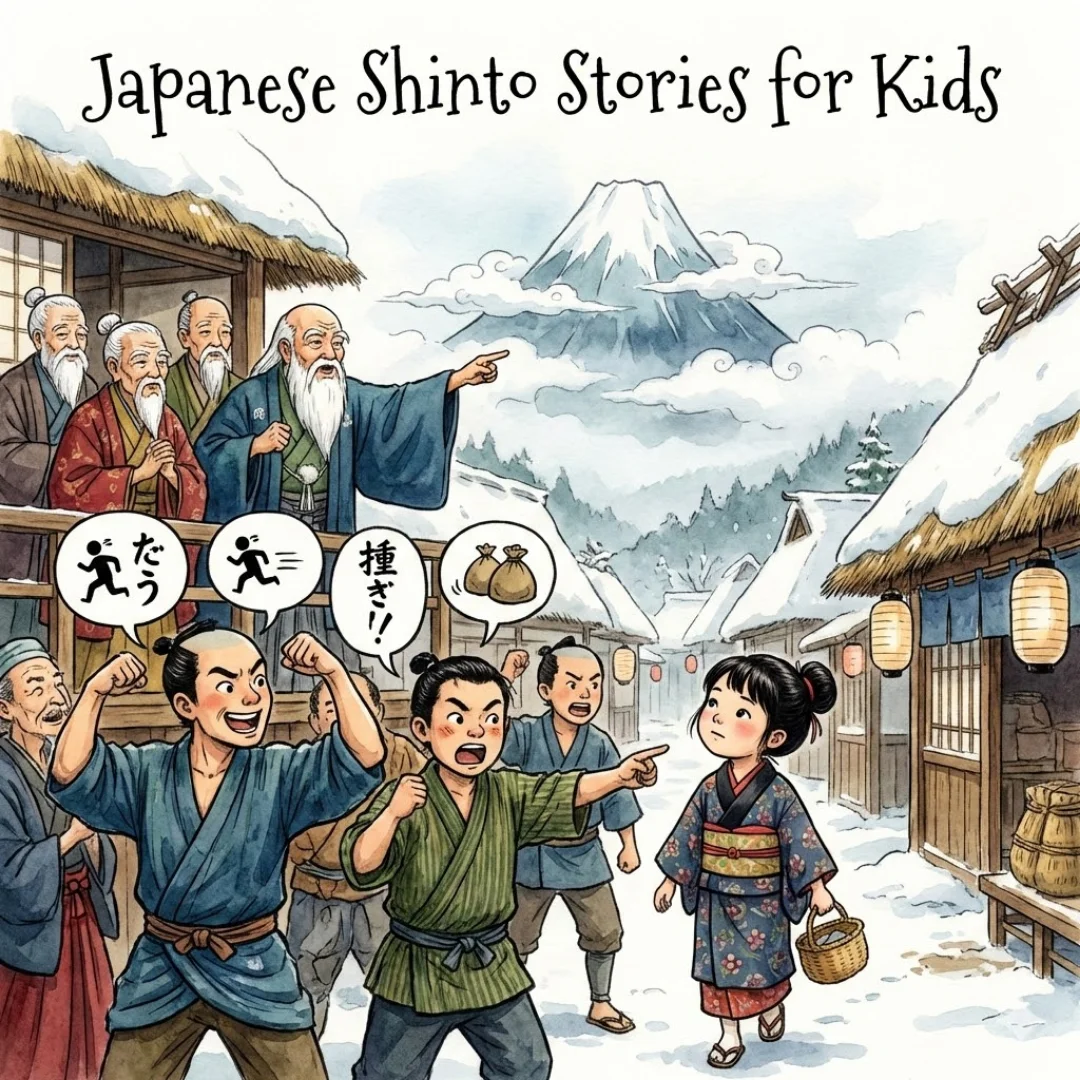
The village headman, Tanaka-san, called a meeting beneath the great camphor tree in the village square.
“We must ask the mountain kami for help,” he announced. “The drought is a sign that we have somehow displeased the spirits. We must send someone to the shrine at the mountain’s peak—the holiest place—to offer prayers and beg for rain.”
A murmur ran through the crowd. The shrine at the peak was a full day’s climb. The path was steep and dangerous. And no one had climbed to the summit in many years.
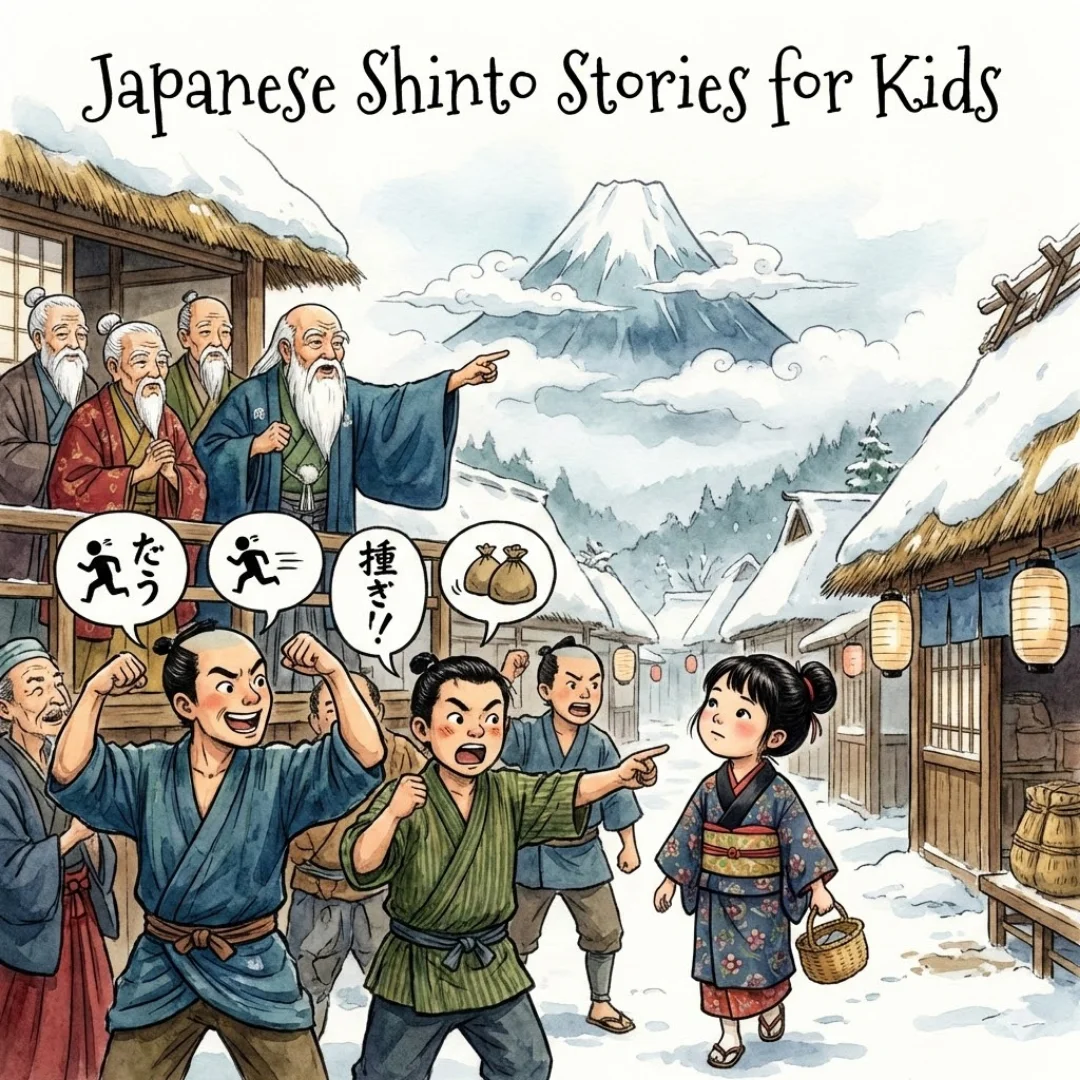
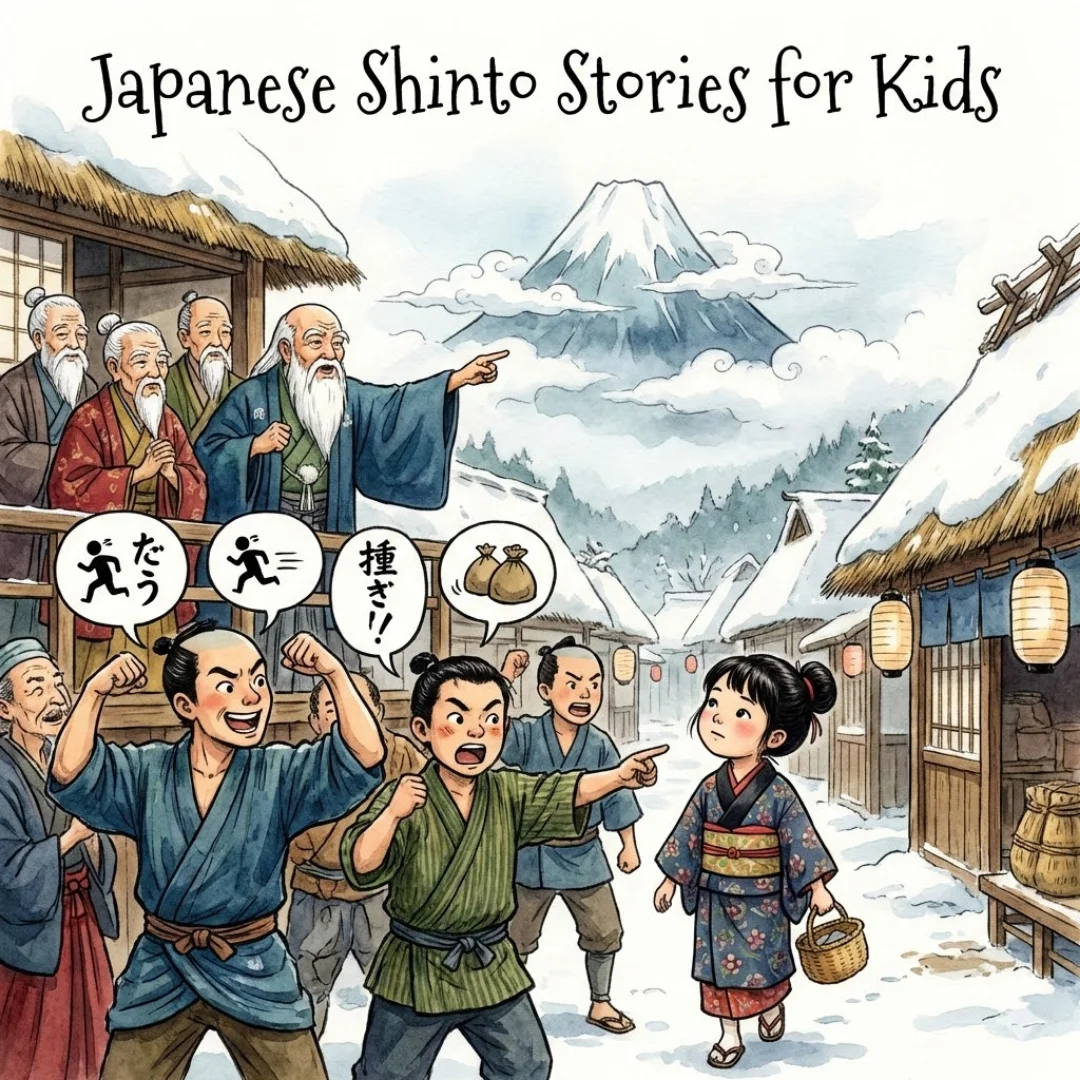
“I will go!” shouted Kenji, the blacksmith’s son, a young man proud of his strength. “I can carry the heaviest offering!”
“No, I should go!” called Takeshi, known as the fastest runner in the village. “I can reach the top quicker than anyone!”
“I have the loudest voice!” declared Hiroshi. “The kami will surely hear my prayers!”
The young men argued among themselves, each claiming to be the best choice.
Then a small voice spoke from the back of the crowd.
“Please… may I go?”
Everyone turned. Yuki stood there, her hands folded respectfully in front of her.
For a moment, there was stunned silence. Then several young men laughed outright.
“You?” Kenji scoffed. “A small girl who has never climbed higher than the berry bushes?”
“The path is too dangerous,” Takeshi said, shaking his head.
“The kami would be insulted by such a weak messenger!” Hiroshi added.
But a voice cut through the mockery—the voice of Obaasan, Yuki’s grandmother.
“The kami,” she said firmly, leaning on her walking stick, “do not measure strength in muscle or speed in feet. They measure what lies in the heart.”
She looked directly at the village headman.
“Tanaka-san, you remember my mother, who was a shrine maiden in her youth. She taught me, and I have taught my granddaughter, the proper ways to address the kami. Yuki knows the ancient prayers. She knows how to walk with respect. She knows how to offer gratitude rather than demands.”
The old woman’s eyes swept across the young men.
“Can any of you say the same?”
The young men fell silent, embarrassed.
Tanaka-san stroked his beard thoughtfully, then nodded. “Obaasan is right. Yuki shall go.”
* * *
Yuki prepared for her journey with care.
She did not pack heavy gifts or elaborate offerings. Instead, she took only what Obaasan told her: a small bowl of rice from their own meager store, a cup of the purest water they could find, and a branch of sakaki—the sacred evergreen tree used in Shinto rituals.
“These simple things, offered with a sincere heart, are all you need,” Obaasan said, embracing her granddaughter. “Remember, Yuki-chan: walk with humility. Observe with gratitude. Speak with respect. The kami see all.”
Before dawn the next morning, Yuki set out.
* * *
The path to the mountain’s peak began at a simple torii gate, painted red, marking the boundary between the ordinary world and sacred space.
Yuki paused before it. She bowed deeply, then stepped through, feeling the shift in the very air—a heightening, a deepening, as if she had crossed into a realm where spirits walked close to the earthly world.
The first part of the path wound through a forest of ancient cedars. These trees were so old, so massive, that five people holding hands could not encircle their trunks. Their tops disappeared into the canopy high above, where dappled sunlight filtered through in golden shafts.
Yuki walked slowly, not from exhaustion, but from reverence.
At each great tree, she paused and bowed. “Thank you, honorable kami, for your strength and your beauty. Thank you for the shade you give. Thank you for the clean air you breathe into the world.”
She did not rush. She noticed everything: the patterns of moss on stones, the way ferns uncurled like green prayers, the sound of a distant waterfall singing its eternal song.
The young men who had volunteered would have run past all this, seeing only obstacles to overcome. But Yuki understood what Obaasan had taught her: the journey itself was the prayer.
* * *
By midday, the path had grown steeper and rockier. Yuki’s legs ached. Her breath came harder. But when she reached a small stone shrine beside the path—just a simple shelter with a statue worn smooth by centuries of weather—she stopped.
The shrine was neglected. Fallen leaves covered the offering platform. Spider webs draped the corners.
Yuki could have hurried past. After all, her destination was the peak shrine, not this forgotten way-station.
But she remembered Obaasan’s words: “The kami notice how we treat even the smallest sacred spaces.”
So Yuki set down her pack. She carefully cleared away the leaves. She pulled the spider webs free (gently, so as not to harm the spiders—they too had their place in nature’s balance). She placed a small portion of her rice and a splash of her water on the offering platform.
Then she bowed and offered a prayer:
“Honorable kami of this place, please forgive our village for neglecting you. Accept this humble offering and know that you are remembered.”
The wind seemed to sigh through the trees, and for just a moment, Yuki felt a warmth in the air, as if something invisible had smiled.
* * *
The afternoon brought greater challenges. The path grew so steep that Yuki had to use her hands as well as her feet, climbing over boulders and up rocky steps carved by unknown hands hundreds of years ago.
Sweat soaked her clothes. Her hands became scraped and dirty. Twice she slipped and fell, bruising her knees.
But each time she fell, she noticed something: tiny alpine flowers growing in cracks in the rocks, their delicate petals brilliant against the grey stone. Lichens in shades of green and gold and rust, painting the boulders in intricate patterns. A salamander, orange-bright, watching her with jewel-like eyes from beneath a stone.
Even here, in this harsh and difficult place, life thrived. The kami were present.
Yuki felt her determination strengthen. If these tiny flowers could find a way to bloom on a mountainside, she could find a way to reach the top.
* * *
As the sun began to sink toward the horizon, Yuki finally emerged above the tree line.
The landscape changed dramatically. Here, near the peak, only tough grasses and stunted shrubs grew. The wind blew constantly, carrying with it the cold breath of high altitudes. Mist swirled around her, sometimes thick enough that she could barely see the path ahead.
This was the realm of the mountain itself—wild, powerful, ancient.
Yuki felt very small. But she also felt, paradoxically, deeply connected to something vast and eternal. The kami of this mountain was old beyond imagining, present since the stones first thrust up from the earth.
“I am here,” Yuki whispered into the wind. “I walk your paths with respect. Please guide me.”
The mist shifted, and for a moment, the path ahead became clear.
* * *
Twilight was falling when Yuki finally reached the peak shrine.
It was simple—just a small wooden building with a curved roof, weathered by countless seasons. But it sat at the very top of the world, with clouds drifting beneath it and the stars beginning to emerge in the darkening sky above.
Yuki approached slowly, her heart full of awe.
She purified herself at the stone basin fed by mountain springs. The water was so cold it made her gasp, but she rinsed her hands and mouth carefully, washing away the dust of the climb, preparing herself to stand before the sacred.
Then she approached the shrine’s offering platform.
She placed her rice, her water, and her sakaki branch with trembling hands. These offerings looked so small, so humble. Would the great kami of the mountain even notice them?
But then she remembered: sincerity matters more than size.
Yuki rang the bell that hung before the shrine—two clear notes that echoed into the vast evening sky.
She bowed twice, clapped twice, bowed once—the traditional Shinto salutation.
And then she spoke, not loudly or demandingly, but with the quiet honesty of a child addressing a beloved elder:
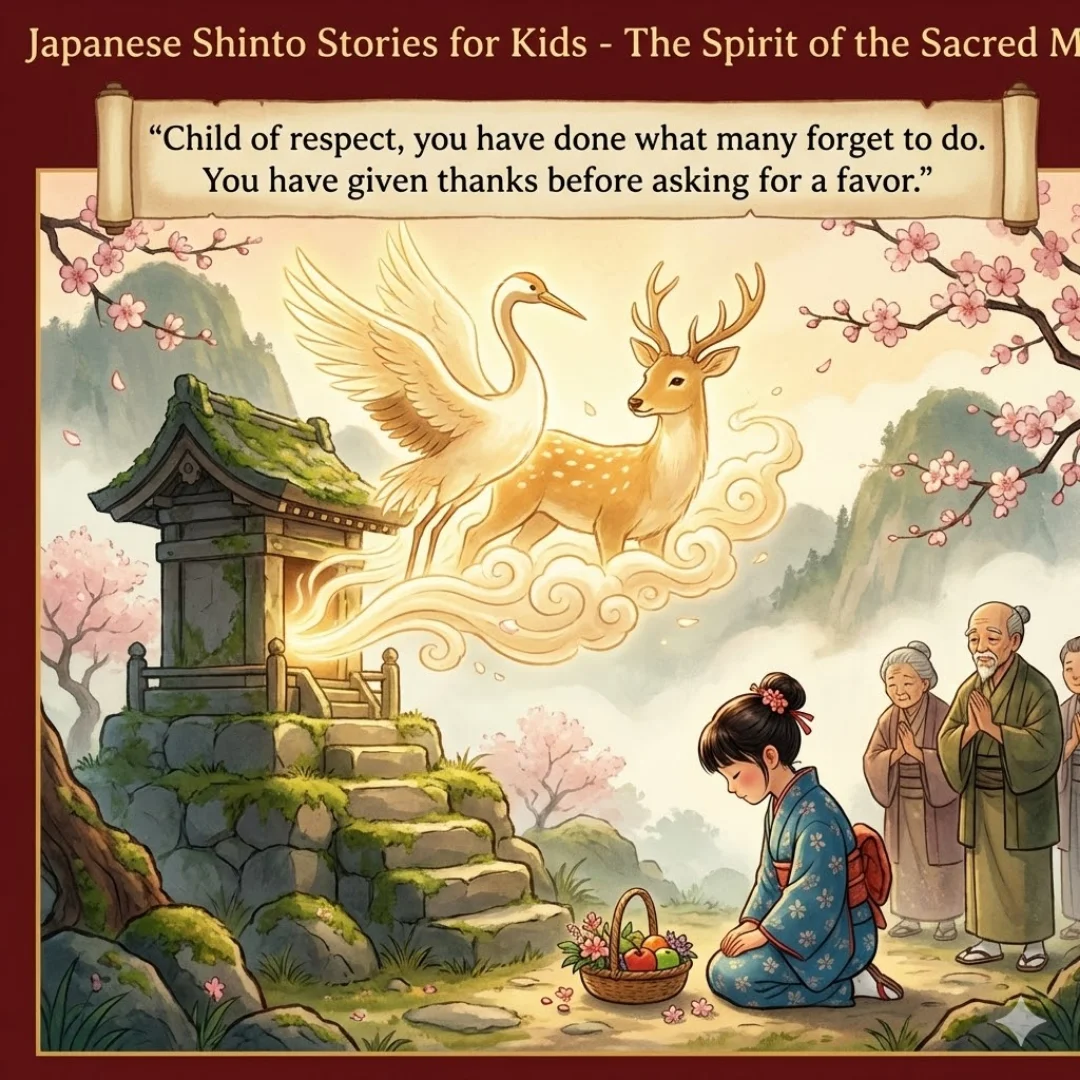
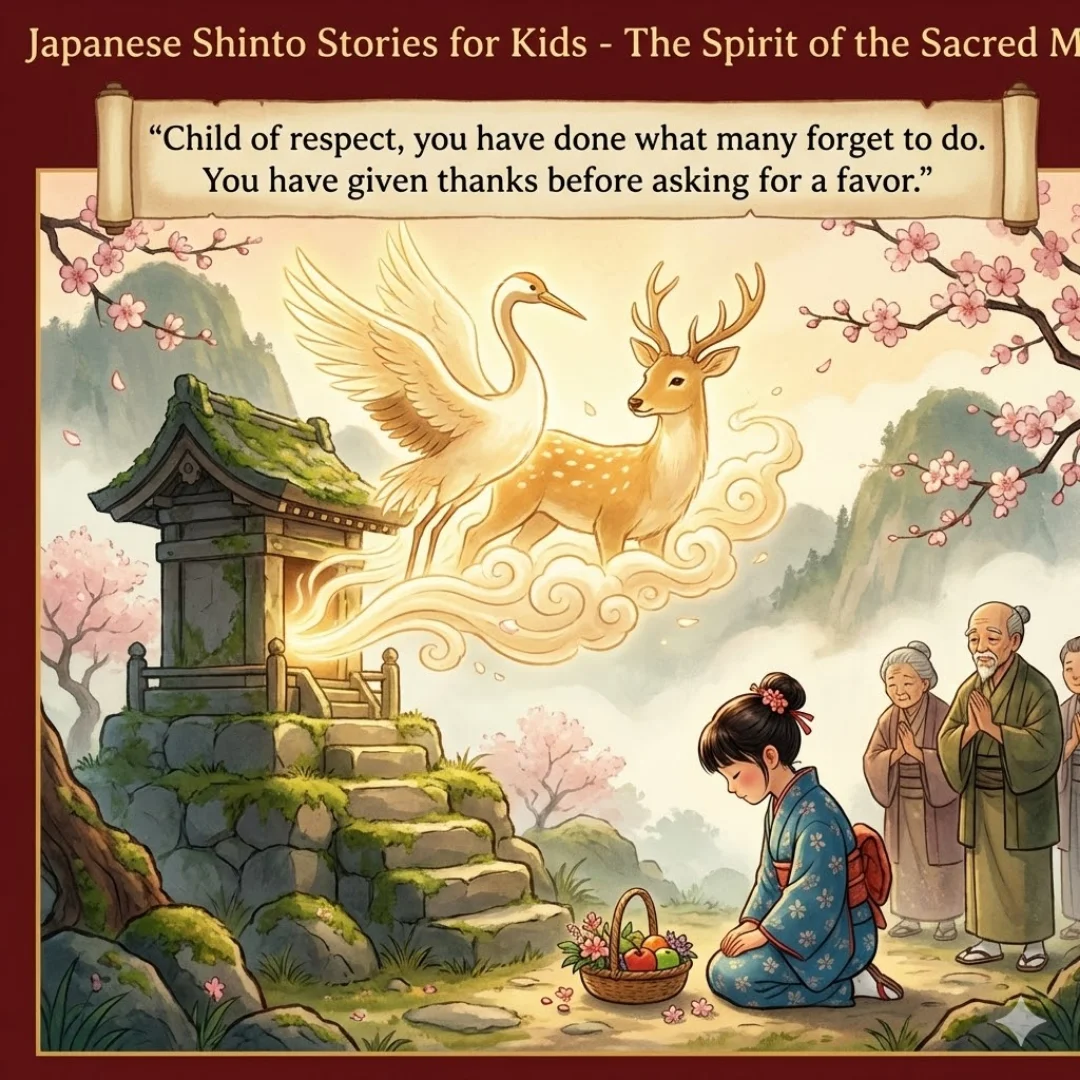
“Great Kami of the Sacred Mountain, I come from the village at your feet. We have been blessed by your presence for generations. We have drunk from your streams, farmed the soil enriched by your minerals, found peace in your forests.
“Now we face drought, and we are afraid. Our crops wither. Our wells run dry. We know that we are small and the forces of nature are vast. We do not presume to tell you what to do, or even to ask that you change the weather for our convenience.
“We ask only this: if we have offended you in some way—if we have taken without gratitude, used without respect, or forgotten to honor your presence—please forgive us. Help us understand how to live in better harmony with your gifts.
“And if it is within your will and the natural order of things… please send rain.”
Yuki’s voice broke on the last word. Tears, which she hadn’t known she was crying, ran down her cheeks.
“We are grateful,” she whispered. “For everything. For all that you are. For all that you give. Thank you. Thank you. Thank you.”
She bowed low, her forehead touching the cold stone of the offering platform, and remained there in the deepening darkness, her heart poured out like water.
* * *
Yuki stayed at the peak shrine that night, wrapped in the thin blanket she had brought, watching the stars wheel overhead.
She did not sleep. Instead, she sat in meditation, feeling the mountain’s presence all around her—solid, eternal, patient as stone, wild as wind.
And in that long night, something changed in Yuki. She felt herself becoming part of something larger than herself, part of the endless cycle of giving and receiving, growth and rest, rain and sun, life and death and life again.
This was what Obaasan had tried to teach her: that humans are not separate from nature, standing outside it and using it. Humans are part of nature, woven into its fabric, dependent on its gifts, responsible for its care.
As dawn approached, Yuki felt more than saw a presence near her—something vast and ancient, aware and watchful.
She did not look directly at it, for she knew some things are too sacred for mortal eyes. But she felt its attention on her, measuring, considering.
And then—she felt approval.
Like a warm hand on her shoulder. Like a grandmother’s smile. Like the first gentle touch of rain on thirsty earth.
* * *
When Yuki climbed back down the mountain the next day, she found the village in joyous chaos.
During the night—the very night she had prayed at the peak shrine—clouds had gathered. Thick, heavy clouds full of promise.
As Yuki walked through the torii gate and back into the ordinary world, the first drops began to fall.
Then more. Then more.
Within an hour, rain was pouring from the sky in great silvery sheets, drenching the earth, filling the streams, flooding the rice paddies with life-giving water.
The villagers danced and laughed and cried with relief. Children ran through the rain with their mouths open, catching drops on their tongues. Farmers embraced each other, watching the water soak into the cracked ground.
And when they saw Yuki, muddy and exhausted, walking slowly down the mountain path, they rushed to greet her.
“You did it!” Kenji shouted, no longer mocking but genuinely amazed.
“The kami heard you!” Takeshi said with wonder.
“What did you say to them?” Hiroshi asked. “What prayer was powerful enough to bring this rain?”
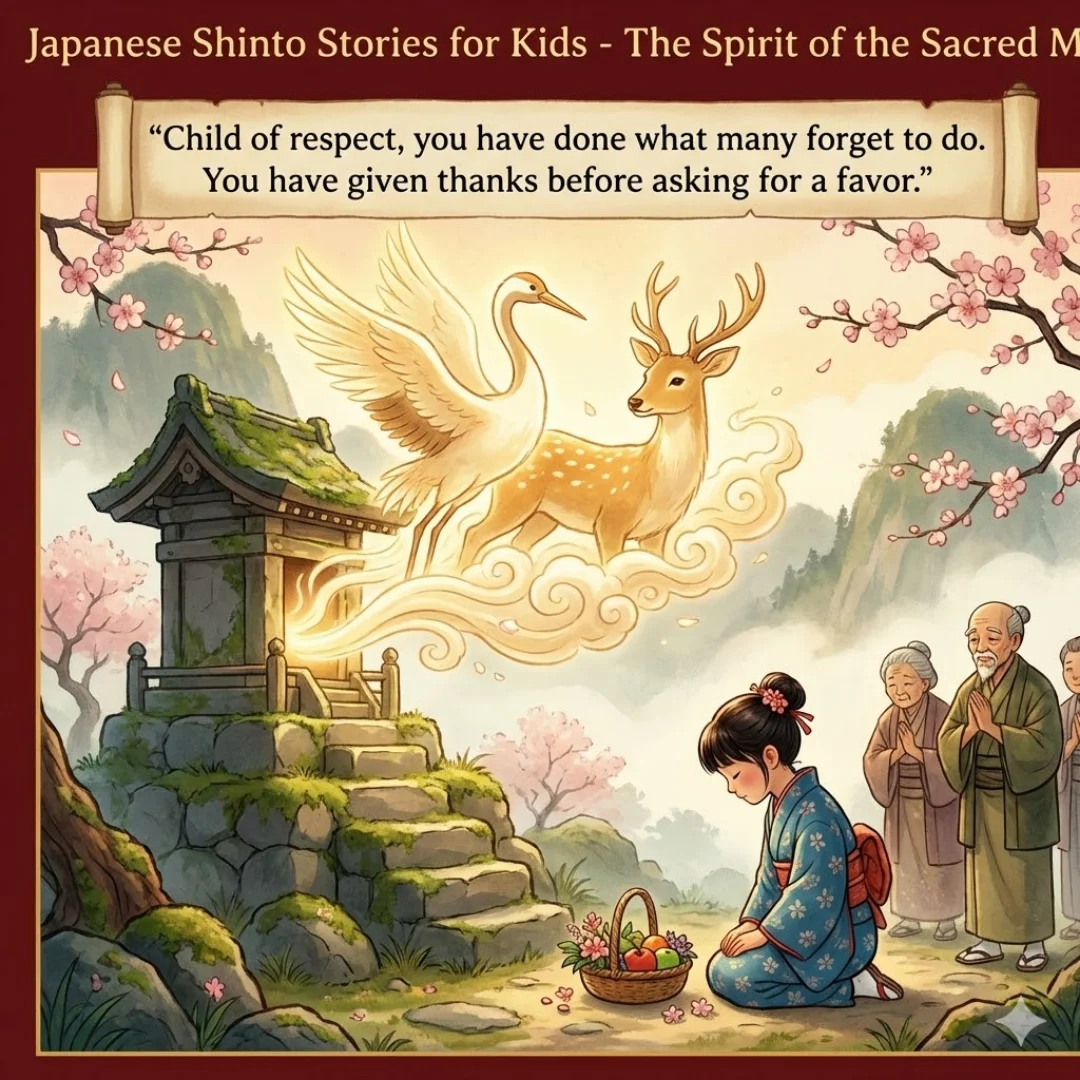
Yuki, who had barely spoken above a whisper since her return, simply shook her head.
“I said thank you,” she replied. “I just… said thank you.”
* * *
The rain continued for three days—exactly as long as needed to save the rice crop and refill the wells. Then it stopped, and the sun returned, and the balance was restored.
That autumn, the village harvest was abundant. The rice grew tall and golden. The crops yielded more than in any season anyone could remember.
And from that time forward, the villagers treated the mountain with even greater respect.
They rebuilt the small shrines along the path. They made sure never to take more from the forest than they truly needed. They taught their children to notice the kami in every tree and stone and stream.
And every year, when the planting season began, someone would climb to the peak shrine to offer rice and water and prayers of gratitude.
Sometimes it was the village headman. Sometimes it was a farmer whose crops had thrived. Sometimes it was a mother whose child had been healed.
But often—very often—it was Yuki.
She never grew tired of the climb. She never stopped noticing the small miracles along the path—the flowers, the salamanders, the patterns of moss on stones.
And when she reached the peak and stood before the ancient shrine, she would always say the same simple prayer:
“Thank you. Thank you. Thank you.”
For Yuki had learned what the kami had tried to teach her village all along:
That gratitude is the highest form of prayer.
That respect is worth more than any expensive offering.
That humans and nature are not separate things but parts of one sacred whole.
And that sometimes the smallest person, with the humblest gift, can touch the heart of the divine—if only their own heart is pure and their thanks are sincere.
This is the way of Shinto.
This is the wisdom of the kami.
And this is the path that Yuki walked for the rest of her life, teaching others to see the sacred in the ordinary and to offer gratitude for every blessing.
MORAL LESSONS:
– Sincere gratitude is more valuable than material wealth
– Respect for nature brings harmony and blessings
– Humility and purity of heart matter more than physical strength
– The journey itself can be as important as the destination
– Quiet observation often sees what loud action misses
– Honoring even small sacred spaces shows true devotion
– We are part of nature, not separate from it
SHINTO PRINCIPLES PRESERVED:
– Kami (spirits) dwelling in all natural things – authentic Shinto belief
– Torii gate marking sacred space – actual Shinto practice
– Purification ritual (rinsing hands and mouth) – exact practice
– Bow twice, clap twice, bow once – authentic prayer gesture
– Sakaki sacred evergreen – used in real Shinto rituals
– Mountain worship – authentic to Japanese Shinto tradition
– Shrine offerings of rice and water – traditional
– Gratitude as highest prayer – core Shinto value
– Respect for nature – fundamental Shinto principle
– Sacred and ordinary worlds connected – Shinto worldview
– No demands of gods, only requests and thanks – Shinto approach
– Balance between human and natural world – Shinto concept
CULTURAL ELEMENTS:
– Japanese honorifics (Obaasan, -san, -chan) – authentic
– Village elder structure – traditional
– Rice farming as central to life – cultural reality
– Monsoon/rainy season importance – geographic accuracy
– Grandmother teaching old ways – cultural transmission
– Sacred mountains in Japan (Kamiyama = generic sacred mountain name)
– Shrine maiden tradition referenced
– Community decision-making under camphor tree – traditional
ENGAGEMENT ENHANCEMENTS:
+ Vivid sensory details (dappled sunlight, orange salamander, cold mountain springs)
+ Character development (Yuki’s quiet strength vs. loud boys’ arrogance)
+ Internal journey mirrors external climb
+ Show don’t tell (Yuki’s reverence shown through actions)
+ Scene-by-scene progression up mountain
+ Emotional depth (fear, exhaustion, awe, gratitude)
+ Contrast between different approaches to sacred
+ Satisfying character arc (village learns from Yuki)
+ Universal themes in specific cultural context
NOTE ON AUTHENTICITY:
This is a modern story embodying authentic Shinto principles rather than ancient mythology. All Shinto practices, beliefs, and terminology are accurate to actual Shinto tradition.
SOURCES:
– [Mount Fuji: Japan’s Tallest and Most Sacred Mountain](https://www.worldhistory.org/Mount_Fuji/)
– [The Spirit of the Mountain: Shinto Beliefs and Sacred Peaks](https://japanese.mythologyworldwide.com/the-spirit-of-the-mountain-shinto-beliefs-and-sacred-peaks/)
– [Konohanasakuya-hime – Wikipedia](https://en.wikipedia.org/wiki/Konohanasakuya-hime)
– Shinto practices and beliefs about kami, nature worship, and mountain sanctity
Test Your Understanding
1. What are kami in Shinto belief?
Frequently Asked Questions
What is the moral lesson of Japanese Shinto Stories for Kids: The Spirit of the Sacred M?
What age is this story appropriate for?
How long does it take to read Japanese Shinto Stories for Kids: The Spirit of the Sacred M?
What culture does this story come from?
Can I use this story for teaching?
Frequently Asked Questions
What are Japanese Shinto stories for kids?
Japanese Shinto stories for kids are traditional tales that teach children about the spiritual beliefs of Japan’s indigenous religion. These stories feature kami (nature spirits) and show how people can live in harmony with nature, teaching important values like respect, mindfulness, and connection to the natural world.
What is this story about?
This story follows Yuki, a quiet 12-year-old girl who lives in a village at the foot of sacred Kamiyama mountain. While other children tease her for being different, Yuki has a special connection to nature and the kami spirits that dwell in all natural things.
What age group is this story appropriate for?
This moral story is designed for children ages 6-12. It combines entertainment with important values in an age-appropriate way, introducing young readers to Japanese culture and Shinto beliefs through engaging storytelling that’s both educational and enjoyable.
📚 Recommended Books
Handpicked for readers like you
As an Amazon Associate, we earn from qualifying purchases. These recommendations are personalized based on this story's themes and your reading history.
What are kami in Japanese Shinto stories?
Kami are spirits in Japanese Shinto belief that dwell in all natural things like trees, stones, streams, and mountains. In this story, the sacred mountain Kamiyama is home to many kami, teaching children to respect and appreciate the spiritual presence in nature.
What lesson does this story teach children?
This story teaches that being different is not a weakness, and that quiet, thoughtful people have their own special strengths. It shows the importance of respecting nature, learning from elders, and finding inner peace through spiritual connection with the world around us.