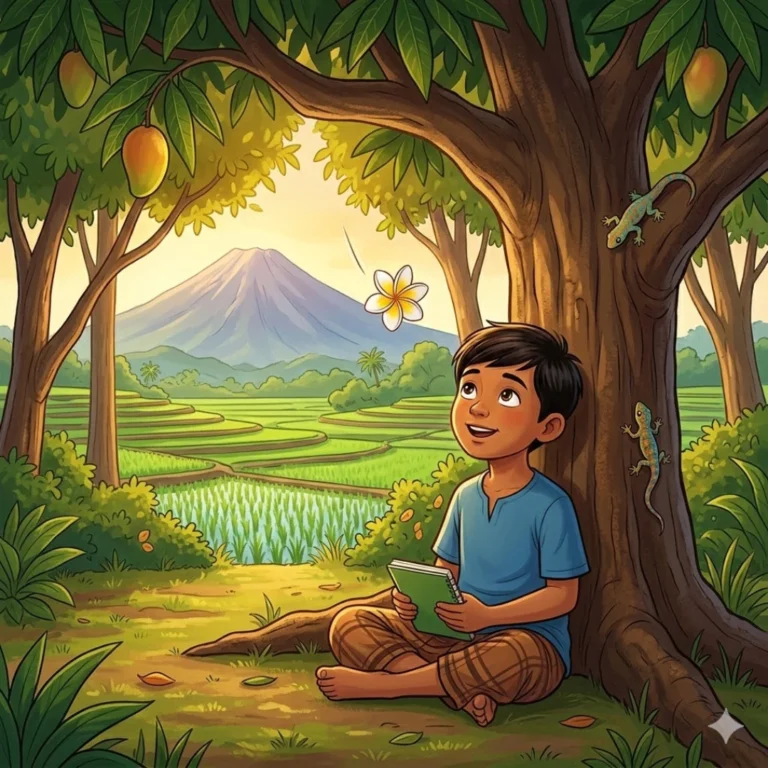
On the island of Java, where the volcanoes stand so high their heads are sometimes in the clouds and the rice terraces step down the hillsides like staircases built for very patient giants, there lived a boy called Bagas who had forgotten to be grateful.
This had not happened all at once. It never does. It had happened gradually, the way a pool grows cloudy – not from one thing but from many small things settling at the bottom, so slowly you don’t notice until the water is no longer clear.
Basgas was nine years old, and he lived with his grandmother in a small house at the edge of the terraces. He had a good life – warm rice every evening, a grandmother who told excellent stories, a view from his sleeping mat that included three volcanoes and, on very clear mornings, the sea. He also had a mango tree in the yard that produced, in season, more mangoes than a family of six could reasonably eat.
But Bagas had begun to think of these things as simply the way things were, rather than as gifts.
The village children in the school at the bottom of the hill had things he didn’t have: shoes with lights in the soles, lunchboxes with cartoon characters on them, tablets for playing games. Bagas noticed these things very much. He noticed them continuously. He noticed them so much that he had stopped noticing almost everything else.
His grandmother, whose name was Mbah Tini and who had noticed a great many things in her seventy-three years, noticed this.
One morning in the dry season, when the terraces were pale gold and the air smelled of ripening grain and the morning was soft and cool and entirely pleasant, she called Bagas to come and sit with her.
She did not lecture him. Mbah Tini had learned long ago that lecturing children produced excellent glazed eyes and very little else. Instead, she gave him a small notebook with a green cover and a pencil.
“What is this for?” he asked.
“I want you to count the rain,” she said.
He looked at the sky, which was blue and entirely rainless. “There is no rain.”
“I know,” said Mbah Tini. “That is the assignment. Count what is not here.”
Bagas did not understand this at all, but he was accustomed to not understanding his grandmother immediately, and to understanding her later. He tucked the notebook in his sarong pocket and went about his day.
That morning, drawing water from the well before school, he thought: what a considerable nuisance, carrying this heavy bucket. The bucket was heavy. The morning was hot already. He wrote in his notebook: No rain to collect the water for me.
At school, his friend Dimas shared his lunch with him because Bagas had forgotten his. He wrote: No rain to wash Dimas’s hands, but Dimas shared anyway.
On the way home, a frangipani tree dropped three flowers onto his head, which seemed almost deliberate. He looked up at the frangipani – white and yellow, smelling very much of themselves, which is to say wonderfully. He wrote: No rain falling right now, so the frangipani smell like this instead of like wet frangipani, which is a different smell, also good.
He sat under the mango tree to do his homework. The shade was generous. A small lizard ran up the trunk near his face, regarded him with its swiveling eye, and ran down again. He wrote: No rain, so I can sit here instead of inside. Lizard visited. Gecko on the roof was singing last night, which means rain is coming – I didn’t know I was listening but apparently I was.
By the end of the week, the notebook was half-full.
He had counted: seventeen specific varieties of bird he could hear from his sleeping mat in the morning. The way the terraces looked in late afternoon when the light came sideways across the stepped water and each level became a separate mirror. The smell of wood smoke from cooking fires in the evening, which smelled exactly like being home. The neighbor’s cat, who came to sit on his foot each morning as he ate breakfast, for reasons known only to the cat.
He had also counted the real absences: the days when the water supply was low and his grandmother went early and quietly to fetch more than usual. The week when the rice terrace above them needed repairing and everyone on the hillside came to help, including his grandmother despite her knees. The fact that mangoes did not last, and season ended, and you ate them as they came because there was no other way to have them.
“I don’t think I was counting what you meant,” Bagas told Mbah Tini at the end of the week.
“What do you think you were counting?”
He thought about this seriously. “Everything that’s here when the rain isn’t here. And also things that… I don’t have anymore but had. Or that might not last.” He paused. “Like the mangoes.”
“Exactly like the mangoes,” said Mbah Tini.
“The mangoes are here now,” said Bagas. “I’ve been eating them every day and just thinking they were ordinary.”
“What are they?”
He thought about a mango from this morning – warm from the tree, heavy in the hand, the specific give of it when it was perfectly ripe, the way the smell hit you before you even broke the skin.
“Not ordinary,” he said.
Mbah Tini took the notebook and looked through it. She ran her finger along a few entries. Her face did the thing it did when something pleased her: a small compression of the lips that was not quite a smile but was better than one.
“You counted forty-three things in five days,” she said. “Things that were here when you expected only rain.” She handed it back. “The ones who have tablet-lunchboxes. What are they not counting?”
Bagas sat with this.
All the things in the notebook: the frangipani, the gecko’s song, Dimas’s generosity, the lizard, the seventeen birds, the sideways light on the terraces, the neighbor’s cat’s mysterious loyalty, the particular quality of mango season on Java.
“These things,” he said at last.
“Everyone is missing something,” said Mbah Tini. “The question is whether you notice what you have, or only notice what you don’t.” She tapped the notebook. “Keep counting.”
Basgas kept the notebook all through the dry season, and into the rains when they came. He added: the way rain sounds on a tin roof at night, which is different from the way it sounds on banana leaves, which is different again from the way it sounds when it first hits dry red earth. He added the petrichor smell, which is the smell of rain landing on dry earth and releasing something ancient. He added the frogs that came alive only in wet season, whose voices filled the evening like an orchestra tuning up.
On a rainy evening near the end of the year, his friend Dimas came to visit and they sat on the porch and watched the rain come down the mountain in silver sheets.
“My tablet broke,” said Dimas gloomily.
“Look at that,” said Bagas, pointing to where the rain hit the terrace and each drop made a small perfect circle that spread and vanished. “We’ve been watching that happen for ten thousand years and no one made it yet and it doesn’t break.”
Dimas looked at him for a moment. Then he looked at the rain circles.
“Hm,” said Dimas. He stayed another hour.
The notebook eventually filled up. Bagas asked his grandmother for a new one.
She gave him one without comment, which was a kind of comment.
The Moral of This Story
When we truly see the gifts around us, we stop searching for what we think we lack
About This Story’s Culture
This story is set in Java, Indonesia, specifically in the rice terrace agricultural communities on volcanic hillsides, similar to the UNESCO World Heritage Subak irrigation system of Bali. The Javanese term Mbah is an authentic honorific for grandparents (Mbah Kakung for grandfather, Mbah Putri or Mbah Tini for grandmother). The sarong is authentic everyday dress in Java. Javanese culture has a deep tradition of philosophical reflection through small practices – the concept of rasa (feeling/taste) as a path to understanding is central to Javanese spiritual life. The story also reflects the agricultural cycle of wet and dry seasons that governs life throughout Java and Bali.
Key Story Elements
- Bagas – a nine-year-old Javanese boy in a rice terrace village who has stopped noticing his gifts
- Mbah Tini – the wise grandmother who teaches through assignment rather than lecture
- The green notebook – counting what’s present when rain is absent as a gratitude practice
- Forty-three things counted in five days: frangipani, gecko’s song, lizard, seventeen birds
- Potter-style close observation of nature: rain circles on terraces, petrichor smell, rain on tin vs leaves vs earth
- The mangoes as the symbol – eating them as ordinary when they are not
- Dimas’s broken tablet vs the rain circles that have never broken
Frequently Asked Questions
What is ‘The Boy Who Forgot the Rain’ about?
It’s an Indonesian children’s story set on the island of Java about a nine-year-old boy named Bagas who gradually loses his sense of gratitude. The story explores how we stop noticing the good things in our lives when we begin to take them for granted, and what it takes to truly appreciate them again.
What age group is ‘The Boy Who Forgot the Rain’ suitable for?
The story is recommended for children aged 6 to 12. It takes around 8 to 10 minutes to read aloud, making it a great choice for bedtime reading. The themes of gratitude and appreciation are presented gently enough for younger children while still engaging older readers.
What is the main lesson or moral of this gratitude story for kids?
The core lesson is about gratitude — specifically how easy it is to stop appreciating the good things in life when they become routine. The story gently reminds children that everyday blessings like food, family, and nature are gifts worth noticing, not simply background facts of life.
📚 Recommended Books
Handpicked for readers like you
As an Amazon Associate, we earn from qualifying purchases. These recommendations are personalized based on this story's themes and your reading history.
Where does ‘The Boy Who Forgot the Rain’ come from?
The story draws from Indonesian tradition and is set on the island of Java, featuring vivid local details like volcanic mountains, rice terraces, and mango trees. It reflects values common in Indonesian storytelling, particularly the importance of gratitude and staying connected to the world around you.
Are there other gratitude stories for kids like this one?
Yes — similar themed stories include ‘Urashima and the Sea Palace,’ a Japanese tale about gratitude, and ‘The Yak Herder’s Dream,’ which focuses on contentment. Both explore what happens when characters lose appreciation for what they have, making them great companion reads to this Indonesian story.