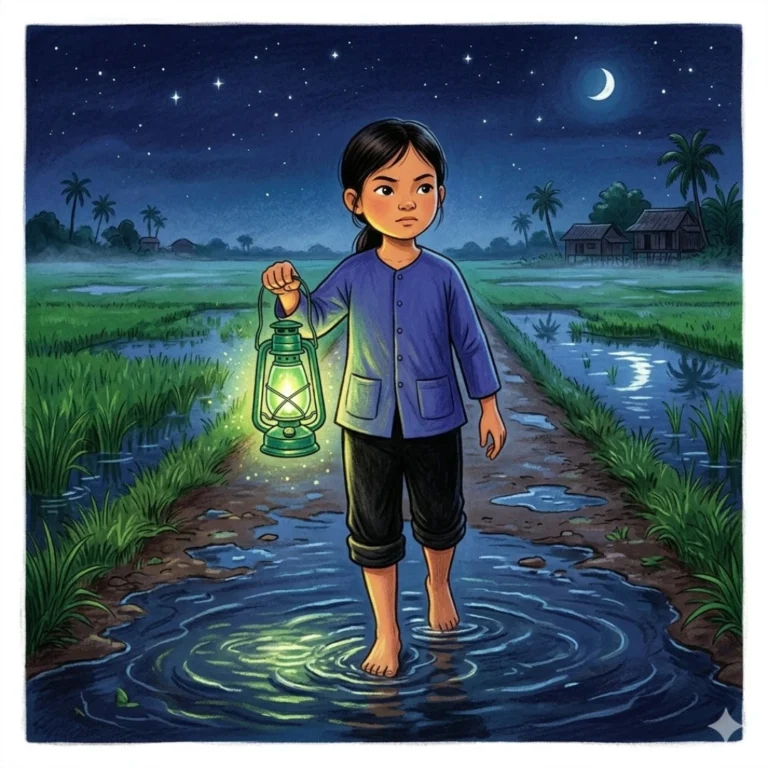
The river delta in the time before electric light was a different world at night – vast and dark and alive with sounds you couldn’t quite place, frogs and nightbirds and the slow lapping of water against mud banks, and somewhere in the middle of it all, a girl with a jade lantern.
Her name was Linh, which means spirit, which suited her better than she knew. She was ten years old, small for her age but quick, with river mud perpetually between her toes and a stubbornness that her mother called a gift and her teachers called something else entirely.
The jade lantern had belonged to her great-grandmother. It was carved from a single piece of pale green jade, hollowed to hold a candle, and it cast a light the color of shallow river water – green-gold and slightly mysterious. Her great-grandmother had carried it from the north during a very hard year, walking three weeks through forest and mountain to reach the south, and she had said: this lantern will light your path when all other lights go out. Keep walking toward morning.
Linh had kept this instruction carefully in the back of her mind, the way you keep emergency matches.
She needed it now.
Her younger brother Tuan had been sick for two weeks – the fever kind of sick that settled in and refused to leave, that made his eyes too bright and his breath too fast and their mother sit up all night pressing cool cloths to his forehead with the expression of someone who is praying and worrying at the same time.
The medicine the doctor needed came from the town pharmacy, half a day’s journey along the river road. The road flooded twice a week in rainy season. It was rainy season. The flood was up. The man with the boat was three villages away and wouldn’t return until tomorrow.
Linh’s father was working in the city. Her mother could not leave Tuan.
“I can go,” said Linh.
“You cannot,” said her mother, automatically.
“The road is high on the eastern side above the flood,” said Linh. “I know the path. I have walked it four times.”
“Not at night.”
“I have the lantern.”
Her mother looked at her for a long time – the specific look that means I know you are right and I am afraid anyway.
Linh went.
The first part of the path was familiar. Rice paddies on both sides, water reflecting stars, the familiar smell of mud and growing things. Her lantern made its green-gold circle and she walked steadily, not fast, not slow, the pace her great-grandmother had probably walked through the mountains: the pace that could be maintained all night if it had to be.
The flood started where she expected – a wide shallow sheet of brown water across the road, knee-deep at most. She waded. The cold of it surprised her even though she’d known it would be cold, and something slippery touched her ankle that was probably just a river root and not anything worth thinking about.
She walked out the other side.
Half an hour later, she wasn’t sure she was on the right path anymore.
This is the thing about walking in the dark with a small lantern: you can only see the circle immediately around you. The landmarks you use in daytime – the big banyan with the split trunk, the small shrine at the crossroads, the field where the buffalo were – are just shapes or nothing in the dark, and one rice paddy looks very much like another.
Linh stopped.
This was the sensible thing to do. Running when lost makes you more lost. She stood still and let her eyes adjust beyond the lantern’s circle and she listened.
She could hear the river. The Mekong always sounds the same – a particular deep, slow, continuous sound that is the voice of something very large and very old. It was to her left. The road to town was on the river’s eastern bank. She needed the river on her left.
She turned until the river sound was on her left and walked.
Twenty minutes later she found the split banyan.
The second hour was harder. The path climbed slightly here, away from the flood plain, and the ground was uneven. She slipped twice in the mud. The second time she caught herself on a bamboo stalk that sliced a shallow cut across her palm, and she sat for a moment and breathed and said several things under her breath that she did not say in front of adults.
Then she stood up and kept walking.
The lantern’s candle was getting short. She had brought two spares. She stopped at a dry patch under an overhanging palm and changed the candle without burning herself, which took longer than expected because her hands were muddy and shaking slightly from the cold.
New candle lit, green-gold light restored, she walked on.
The town appeared when she had almost convinced herself it wasn’t there: lights between trees, the smell of cooking fires and diesel, the sound of someone’s radio playing something cheerful about love.
Linh walked to the pharmacy. It was closed.
Of course it was closed. It was past midnight.
She stood on the step and looked at the darkness behind the glass door and felt the specific exhaustion that comes not from physical tiredness but from doing a hard thing and then finding the hard thing is not finished.
She knocked. No answer. She knocked harder.
A light came on upstairs.
The pharmacist was a small woman with reading glasses pushed up on her forehead who looked at Linh for a long moment – muddy, cut palm, jade lantern, river smell – and said, simply: “Who is sick?”
“My brother. He has fever for two weeks and needs -” Linh told her what the doctor had said.
The pharmacist came downstairs in her slippers, unlocked the pharmacy, and found the medicine.
“How did you get here?” she asked, while she counted the tablets.
“I walked the river road.”
Another long look. “How old are you?”
“Ten.”
The pharmacist packed the medicine carefully and added a jar of ointment for the cut on Linh’s palm. She refused payment – Linh’s mother had sent money and she pressed it back into Linh’s hand.
“My daughter is thirteen,” she said. “She would not have done what you did tonight.”
“She might,” said Linh honestly, “if her brother needed it.”
The pharmacist smiled. “Sit. Eat something. I’ll find you a way back.”
Her husband drove Linh home in his truck, which navigated the flooded road with headlights blazing. The truck made the journey in twenty minutes. Linh looked out the window at the dark paddies going past and tried to reconcile this speed with the four hours she had walked.
Her mother was awake at the door, saw the medicine, and made a sound that was not quite a word.
Tuan got the first dose that night. His fever broke before dawn – not because of the medicine alone, probably, but the medicine was part of it, and he was six years old and small, and every part mattered.
In the morning, Linh slept until noon, which she had never done in her life.
When she woke, her mother was sitting beside her bed. She didn’t say anything for a long moment. Then: “Your great-grandmother would have liked you very much.”
Linh looked at the jade lantern on the shelf, its pale green catching the afternoon light.
Keep walking toward morning, it said.
She intended to.
The Moral of This Story
Keep going even when the path is long and dark, because the dawn is always on the other side
About This Story’s Culture
This story is set in the Mekong Delta region of southern Vietnam, one of the most densely populated and flood-prone agricultural regions in the world. The jade lantern references Vietnam’s rich tradition of jade craftsmanship and the cultural value of family heirlooms passed across generations. The mass migration of Vietnamese people from north to south during the 20th century is evoked in the great-grandmother’s journey. The story reflects authentic Mekong Delta life: rice paddies, seasonal flooding, river navigation by sound, and the tight-knit community networks of rural Vietnamese villages. The name Linh (spirit/soul) and Tuan are common Vietnamese names.
Key Story Elements
- Linh – a ten-year-old river delta girl making a midnight journey for her sick brother’s medicine
- The jade lantern – family heirloom from great-grandmother who walked south through the mountains
- The Mekong River as both obstacle (flooding) and guide (sound used for navigation)
- Stevenson adventure realism: real physical danger, slipping in mud, cutting palm, not knowing the path
- The closed pharmacy and the pharmacist who opens it – kindness meeting perseverance
- The truck ride home in 20 minutes vs the four-hour walk: perseverance creates what speed cannot
- The great-grandmother’s instruction: keep walking toward morning
Frequently Asked Questions
What is The Jade Lantern Girl story about?
The Jade Lantern Girl is a Vietnamese folk-inspired children’s story about a ten-year-old girl named Linh who carries her great-grandmother’s jade lantern. The story explores themes of perseverance, family heritage, and finding your way through difficult challenges. It’s written for readers aged 6 to 12 and takes about 8 to 10 minutes to read.
What age group is The Jade Lantern Girl suitable for?
The Jade Lantern Girl is written for children aged 6 to 12. The language is rich and descriptive but accessible, making it great for independent readers around 8 and up, or as a read-aloud story for younger children aged 6 and 7 with a parent or caregiver.
What lesson does The Jade Lantern Girl teach kids?
The central theme of The Jade Lantern Girl is perseverance — pushing through hardship even when things feel dark or uncertain. Through Linh’s stubbornness and her great-grandmother’s legacy, the story shows children that determination and family strength can guide you when everything else feels overwhelming.
📚 Recommended Books
Handpicked for readers like you
As an Amazon Associate, we earn from qualifying purchases. These recommendations are personalized based on this story's themes and your reading history.
Is The Jade Lantern Girl based on a real Vietnamese tradition or folktale?
The story draws on Vietnamese cultural tradition and setting, particularly life in the river delta region of Vietnam. While it appears to be an original story rather than a retelling of one specific folktale, it incorporates authentic Vietnamese elements like the heritage of migration, family heirlooms, and the spiritual meaning behind names.
Why does the jade lantern matter so much in the story?
The jade lantern is a family heirloom carved from pale green jade that belonged to Linh’s great-grandmother, who carried it on a three-week journey through forest and mountain. It symbolises resilience and hope passed down through generations, with the promise that it will light your path when all other lights go out.