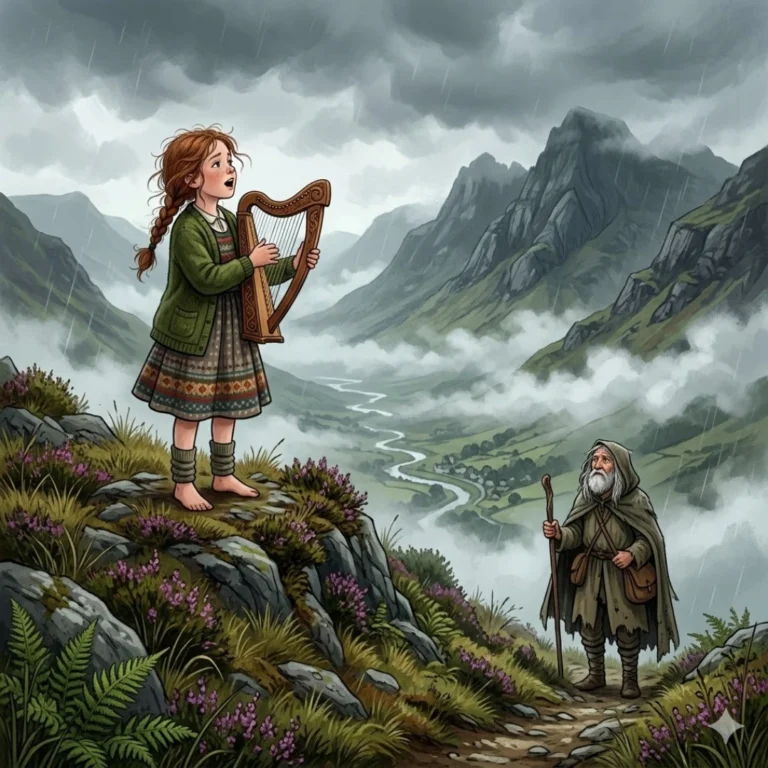
In the hills of Cymru, where the mountains hold their faces close to the clouds and the rain comes in sideways off the sea with what can only be described as great personal enthusiasm, there was once a girl who could not sing.
This was remarkable, because in that valley, in that time, everyone could sing. The old men sang while they mended nets. The women sang at the river. The children sang when they walked to school and coming home from school and, if they were particularly inclined, during school itself. Song was as natural as breathing in Cwm Hir, and about as necessary.
But Nest could not sing.
She could produce sounds. She was not entirely mute. But what came out when she tried to make music was something that made dogs tilt their heads uncertainly and caused her mother to say, “Never mind, cariad, you have many other gifts,” in the patient voice of someone who has looked carefully for a thing and not quite found it.
Nest was eleven years old. She had dark eyes and a serious mouth and she loved stories with the specific, hungry love of someone who needs them to make sense of the world. She had walked the same hills every day of her life and named every rock and stream and she could not, for all her love and all her trying, make music.
The bard who came to the valley was called Caradoc ap Rhys, and he was very old and very accomplished and he smelled of the long road. He had a harp with thirty strings and a voice that made the mountains listen. He had traveled, he said, every road in Cymru and several roads that were not strictly in Cymru by any sensible geography.
“I am looking,” he said, at the fire in Nest’s father’s hall, “for a student. Someone who will carry the songs forward after I am gone.”
The young men of the valley sang for him, one by one. They were good singers, most of them – clear-voiced and strong. Caradoc listened to each with courteous attention and said nothing for a long time after.
Nest did not sing. She sat in the shadows by the wall and listened to the bard listen, and she thought about what it must be like to be a carrier of songs.
“None of them,” said the old bard at last.
There was a murmur through the hall.
“Good voices,” he said. “Good technique. But I am not looking for someone who already has the song. I am looking for someone who is still searching for it.”
Nest stepped out of the shadows before she knew she was going to.
“I am searching,” she said.
The hall went very quiet. Everyone knew that Nest could not sing.
Caradoc looked at her for a long time with eyes the grey-blue of mountain water. “Sing for me,” he said.
“I will disappoint you,” she said honestly.
“Sing anyway.”
So she sang. Or tried. What came out was the shape of a song without the music inside it – recognizable as an attempt, kind to nothing, the sound of someone reaching for a thing that wasn’t quite there.
When she finished, the hall waited.
“Come back tomorrow,” said Caradoc. “At dawn.”
He did not take her as his student immediately, or even soon. He made her walk with him through the hills, and he taught her to listen first – to the way wind moved through different valleys, to the intervals between one bird’s calls and the next, to the natural rhythms in water over stone. He taught her that music lives in the world before it lives in a voice, and that you can only give out what you have first taken in.
Nest walked and listened and tried, every morning, to sing what she heard.
The trying was not comfortable. There were mornings when her voice went wrong in new and interesting ways, and the sheep on the hillside moved away, and she felt like crying and sometimes did, quietly, where only the clouds could see.
There were other mornings when something nearly worked – a phrase, a bar, something that felt from the inside like the thing she was reaching for. These were fewer than the bad mornings but they mattered more.
Caradoc never praised too much and never dismissed too quickly. He said: “Again.” He said: “Listen to where the river changes speed – that is the rhythm you are looking for.” He said: “You are trying to sing the word. Sing what the word feels like.”
One morning in spring, six months after she had first stepped out of the shadows in her father’s hall, Nest stood on the hillside above Cwm Hir and looked out over the valley, all green and silver and moving in the morning wind, and she opened her mouth.
What came out was not perfect. It was not the voice of someone who has always known how to sing. It was rougher than that, and more personal – the specific voice of someone who has listened very hard and tried for a very long time and has begun, slowly, to find the note that was always theirs.
But it was true.
Caradoc was standing below her on the path. He had not moved for the length of the song. When it was done, he was quiet for a moment that stretched out long and wide.
“That,” he said, “is a voice.”
“It is still rough,” said Nest.
“All the best voices are rough when they are young,” said the old bard. “Smooth voices are only interesting in glass. In a person they indicate either that they have never struggled, or that they have learned to hide the struggle, which is not the same as overcoming it.”
He handed her the harp.
Not his own harp – a smaller one, her own size, that she had not seen before. She had not even asked for a harp. She was still thinking about voice.
“The songs of Cymru have been waiting a very long time,” said Caradoc. “They don’t want the person who could already sing them. They want the person who had to fight their way to the music. That is you, Nest.”
She held the harp. The wood was warm, slightly, already, as though it had been waiting to be held.
Below them, the valley of Cwm Hir went about its morning in the Welsh way – rain arriving, then leaving, then thinking about arriving again, the streams loud over stone, the grass green as something that intends to remain. Somewhere below, someone was singing while they worked, the old easy habit of a valley that had always known how.
Nest added her voice to it, small and rough and searching and very much her own.
The mountains listened.
It was enough. It was more than enough. It was, in fact, everything.
The Moral of This Story
The song that matters most is the one you finish, not the one you were born knowing
About This Story’s Culture
This story draws on the rich Welsh bardic tradition – one of the oldest continuous poetic and musical traditions in Europe. The bard (bardd) in Welsh culture was not merely a singer but a keeper of historical memory, genealogy, and wisdom, holding an important social position. The name Taliesin in the title references the most famous figure in Welsh bardic tradition – a 6th century poet whose legendary origin story involves drinking from Ceridwen’s cauldron of inspiration. Cwm Hir is a real valley in mid-Wales (famous for Cwm Hir Abbey). The name Nest is an authentic Welsh female name (historically borne by a famous 12th-century Welsh princess). Caradoc (Caradog) is an authentic Welsh/Brythonic name. The story honors the Welsh tradition of communal singing (corawl) and the cultural centrality of music to Welsh identity, including the Eisteddfod tradition of bardic competition.
Key Story Elements
- Nest – a Welsh girl who cannot sing in a valley where everyone sings, searching for her voice
- Caradoc ap Rhys – the ancient bard seeking not the best singer but the one still searching
- The hills of Cwm Hir as a living landscape that teaches music through its natural rhythms
- Six months of daily practice: walking, listening, failing, and slowly finding the note
- The bard choosing Nest precisely because her voice has had to be fought for
- Lagerlöf journey style: the pilgrim’s path, persistence through seasons, earned arrival
- The gifted harp as the symbol of being chosen by the tradition, not for natural talent but earned devotion
Frequently Asked Questions
What is The Last Song of Taliesin’s Student about?
It’s a Welsh folklore-inspired children’s story about Nest, an eleven-year-old girl who cannot sing in a valley where everyone can. The story follows her journey of hope and perseverance as she discovers her own unique gifts, drawing on the rich tradition of Taliesin, the legendary Welsh bard.
What age group is this Welsh story suitable for?
The Last Song of Taliesin’s Student is written for children aged 6 to 12. It takes around 8 to 10 minutes to read aloud, making it a great bedtime story or classroom read. The themes of perseverance and self-belief resonate with kids who feel different or struggle to fit in.
Who was Taliesin and why does he appear in children’s stories?
Taliesin was a legendary sixth-century Welsh bard celebrated for his magical, inspiring songs. He appears in Welsh mythology as a master poet gifted with wisdom and vision. His story makes him a perfect figure in children’s tales about finding your voice, creativity, and the power of perseverance.
📚 Recommended Books
Handpicked for readers like you
As an Amazon Associate, we earn from qualifying purchases. These recommendations are personalized based on this story's themes and your reading history.
What moral lesson does this story teach kids?
The story’s central themes are hope and perseverance. It gently shows children that not fitting in doesn’t mean failing — it often means you’re finding a different, equally valuable path. Nest’s journey encourages kids to keep trying even when they feel left out or fall short of expectations.
Is this story based on real Welsh folklore?
The story is rooted in Welsh tradition, drawing on the culture of Cymru, communal song, and the legendary figure of Taliesin. While Nest is a fictional character, the setting and spirit feel authentically Welsh, making it a lovely introduction to Celtic storytelling for young readers.