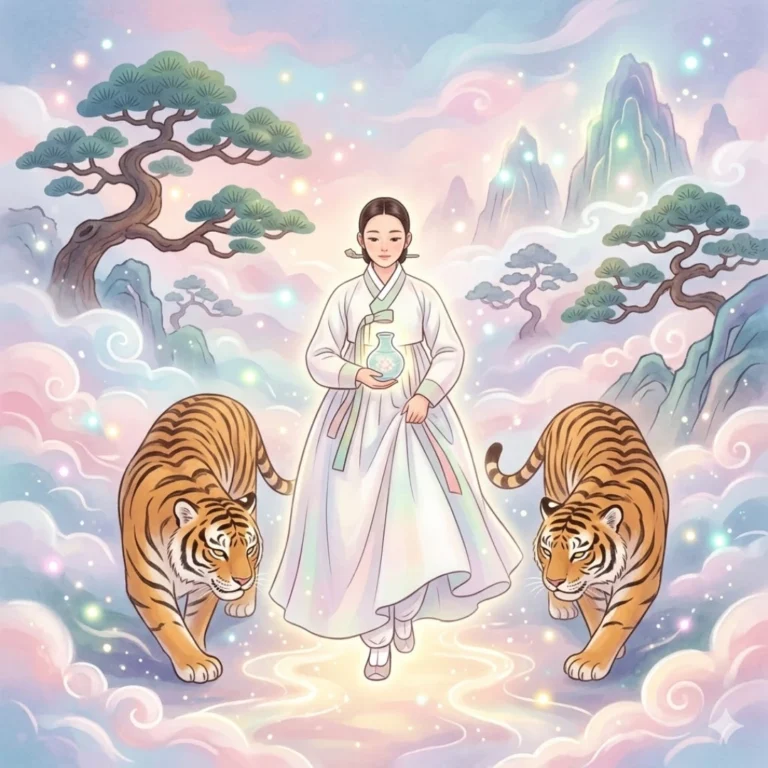
Abandoned as a baby for being a girl, Princess Bari grows up to make an impossible journey—and saves her parents who abandoned her.
The king and queen of an old Korean kingdom already had six daughters. When the seventh was born, the king’s disappointment was so great that he had the tiny girl put in a box and floated away on the river. She was given no name—just “Bari,” which means “discarded.”
Spirits guided the box to the shore of a kind old couple who raised the child with love. Bari grew up gentle, patient, and unusually brave.
Years later, the king and queen fell gravely ill. No medicine could cure them. A shaman delivered the news: only the water of life, hidden at the far edge of the spirit world, could save them. No ordinary person could make such a journey.
Six daughters refused. The spirit world was full of monsters and trials.
Then word reached the old couple’s cottage. Bari heard, and without hesitation, she began to walk.
She crossed mountains where tigers blocked her path. She spoke gently to the tigers, and they stepped aside. She crossed rivers of fire. She held her breath and leaped. She reached the spirit world’s keeper, a great warrior-god who set her three impossible tasks. She completed each one with steady patience.
Finally she asked for the water of life. The keeper looked at her for a long moment.
“Who do you carry this for?”
“For my mother and father,” she said simply, “who threw me away.”
Silence. Then the keeper bowed his head and gave her the water.
Bari walked back. Every step of the way, she helped others she met—a lost child, a hungry spirit, a grieving family. She arrived home just as the king and queen breathed their last breaths.
She poured the water of life on their lips. Their eyes opened.
The king looked at his seventh daughter—the one he had discarded—and understood what he had thrown away.
Bari became the first shaman, the guide between the living and the dead, who forever helps lost souls find their way home.
Moral of the Story
Compassion means helping even those who have hurt you. Bari’s greatest strength was her ability to love without conditions.
Learn These Words
- abandoned
- left behind and uncared for
- shaman
- a spiritual healer or guide in many cultures
- grieving
- feeling very sad because of a loss
- patience
- the ability to wait calmly and keep going despite difficulty
- compassion
- caring deeply about others’ suffering and wanting to help
Test Your Understanding
1Why was Princess Bari abandoned?
2What could cure the king and queen?
3Which daughters went to fetch the water?
4What did Bari do on the way home?
5What lesson does this story teach?
Frequently Asked Questions
Who is Princess Bari in Korean mythology?
Princess Bari is a figure from a traditional Korean shamanistic myth. She is the seventh daughter of a king who abandons her at birth for being a girl. Her name means ‘discarded.’ Despite being rejected, she later undertakes a dangerous journey to the spirit world to find the water of life and save her parents, becoming a symbol of compassion and resilience.
Why was Princess Bari abandoned by her parents?
The king and queen already had six daughters and desperately wanted a son. When their seventh child was also a girl, the king was so disappointed that he placed the baby in a box and set her adrift on a river. She was given only the name ‘Bari,’ meaning ‘discarded,’ reflecting her parents’ rejection based solely on her gender.
What is the water of life in the Princess Bari story?
The water of life is a magical cure hidden at the far edge of the spirit world. When the king and queen fall gravely ill and no medicine can heal them, a shaman reveals that only this water can save them. Reaching it requires crossing dangerous terrain filled with monsters and trials—a journey so perilous that six sisters refuse to attempt it.
📚 Recommended Books
Handpicked for readers like you
As an Amazon Associate, we earn from qualifying purchases. These recommendations are personalized based on this story's themes and your reading history.
What moral lesson does Princess Bari’s Long Walk teach children?
The story teaches forgiveness, courage, and compassion. Despite being abandoned by her parents, Bari chooses to help them without hesitation. It shows children that kindness and bravery can overcome even the deepest hurt, and that a person’s worth is never determined by how others treat them. It also challenges outdated ideas about gender.
Is the Princess Bari myth still important in Korean culture today?
Yes, Princess Bari remains deeply significant in Korean culture. She is considered the original ancestor of Korean shamans and is central to traditional funeral rites, where she guides souls to the afterlife. The myth has also inspired modern Korean novels, poetry, and films, making it one of the most enduring and widely retold stories in Korean folklore.