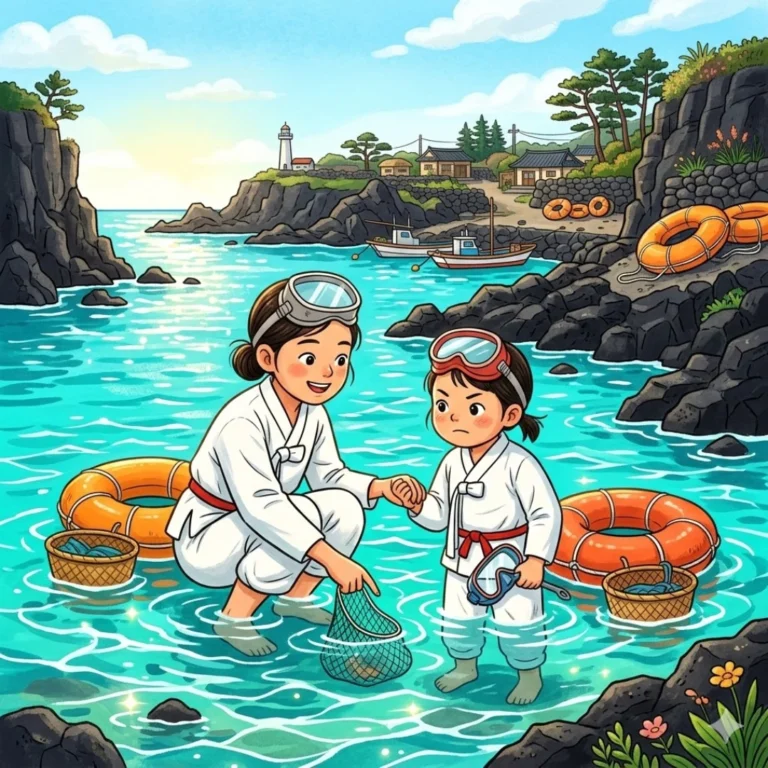
Now, here is a thing you may not know, and it is worth knowing: on the island of Jeju, off the southern coast of Korea, there are women who dive into the sea without any air tanks or machines or clever inventions – just their own breath, held very carefully – and they have been doing this for two thousand years. They are called haenyeo, which means sea women, and they are some of the most remarkable people in the world, though they tend not to boast about it.
This story is about a girl who wanted to be one, and what it cost her.
Miyeon was eleven years old, and her grandmother was the most famous haenyeo in their village. Not famous because she boasted – haenyeo don’t boast, as a rule – but famous because she could hold her breath for three minutes and forty seconds, which is enough time to do a great many useful things underwater. Her name was Halmoni, which means grandmother, though this was not the name she was born with. Her diving name was the one that had followed her for sixty years, and nobody remembered the other one anymore.
“Will you teach me?” Miyeon had asked, every year since she was eight.
“Come back when you can swim to the black rock and back without stopping,” Halmoni had said, every year.
This year, Miyeon could. She had practiced every morning for six months in the cold harbor water, and she had done it: to the black rock, one breath, turn, one breath, back. Her grandmother had watched from the shore with an expression that gave nothing away, which with Halmoni was exactly the same as being very pleased.
“Come tomorrow,” she said.
The training was harder than Miyeon had imagined, and she had imagined it quite difficult. Breath control: inhaling in a specific pattern, not gasping, never gasping. The water temperature in the winter months was cold enough to make your face hurt. The other girls in the training group were older, twelve and thirteen, and they did not make it easier for her because haenyeo tradition held that you earned your place or you didn’t.
But Miyeon had a gift for stillness underwater. When she dove, the noise of the world above dropped away like something she had set down, and there was only the green-blue silence and the current moving her hair and the shapes of sea life below – abalone fixed to the rock, a school of yellow damselfish going past, the strange slow ballet of a jellyfish.
She found the stillness easy. It was the surface that was hard.
The hard part was this: her friend Sora was having difficulties.
Sora was in the training group too, and Sora was struggling. She had the strength, she had the courage/” title=”More stories about courage”>courage, but she could not find the stillness. She panicked underwater – a tiny, controlled panic, the kind you can hide if you try very hard, but Miyeon recognized it because she knew Sora’s face as well as her own.
The older girls noticed. They whispered.
The old way of the haenyeo was also this: the sea chose who stayed and who didn’t. To help someone who couldn’t find the stillness was to help them do something the sea didn’t want them to do. Better for her to find another path.
Miyeon could have said nothing. It was easy to say nothing. Everyone was saying nothing.
She pulled Sora aside after practice.
“You’re panicking at the five-meter mark,” she said.
Sora’s jaw went tight. “I know.”
“It’s not the cold. You’re tensing before you need to. Your air is getting used up faster because of it.”
Sora looked at her. “You noticed.”
“I always notice you.”
They practiced in the mornings before the group training, Miyeon and Sora alone in the cold harbor. Miyeon told her what she had figured out about stillness – that it wasn’t about thinking less, it was about letting the thinking float to the top of your mind and staying still below it, like the sea floor while the surface moves above.
This was hard to explain and harder to teach, but Sora was patient, and Miyeon was persistent, and slowly – over two weeks, then three – Sora’s five-meter wall moved to six meters, then seven.
The other older girls noticed this too. They said nothing, but their silence had a different quality.
Halmoni noticed everything.
She said nothing until the evening she and Miyeon were mending dive suits by lamplight, and then she said, without looking up from her work: “The sea-dragon’s test is not the diving.”
Miyeon waited, because her grandmother’s sentences often came in two parts.
“The diving is easy for some people. The sea-dragon’s test is what you do when the easy path is to leave someone else behind.”
“Is that from the old stories?” Miyeon asked.
“Some of it,” said Halmoni. “Some of it I made up just now, but it’s the same thing either way.”
Sora passed the first assessment three weeks later. Not brilliantly – she was at the bottom of the group scores. But she passed.
Miyeon was second from the top.
Afterward, in the locker room, one of the older girls – Kim Jihye, who was thirteen and had been diving for a year – said to Miyeon: “You slowed yourself down, practicing with her instead of alone.”
Miyeon thought about this. She wasn’t sure it was true. She thought you might get better by teaching, sometimes – that explaining something made you understand it more fully. But she wasn’t sure enough to argue.
“Probably,” she said.
“You might have scored higher.”
“Probably,” she said again.
Kim Jihye looked at her for a moment. “My mother says the haenyeo who dive longest are the ones who look out for the ones beside them. Because the sea is less dangerous when you know someone is watching for you.”
She went back to her locker.
Miyeon sat for a moment with this – the gift of someone else’s mother’s wisdom, offered in the sideways way that things are often offered in Korea, which is not directly but so clearly you cannot miss it.
Then she went outside to where Sora was waiting in the morning air, grinning the wide grin of someone who has done the hard thing and knows it, and they walked down to the harbor together to watch the haenyeo go out with the tide.
The sea was there, and patient, as it always is. The women rose and dove, and rose again.
The Moral of This Story
True loyalty means staying when staying is hard, not just when it is easy
About This Story’s Culture
The haenyeo (sea women) of Jeju Island are one of Korea’s most distinctive cultural traditions, recognized by UNESCO as Intangible Cultural Heritage in 2016. These women free-dive to depths of up to 20 meters to harvest abalone, sea cucumber, and other marine life, working without oxygen equipment. The tradition has existed for at least 1,500 years and represents a rare example of a female-dominated profession in traditional Korean society. The haenyeo community has its own social structure, code of ethics, and folk beliefs. Jeju Island itself is Korea’s southernmost island, known for its volcanic landscape, warm climate, and distinct culture. The term halmoni (grandmother) is the authentic Korean honorific.
Key Story Elements
- Miyeon – an eleven-year-old girl in training to become a Jeju haenyeo sea-diver
- Halmoni – the grandmother, legendary haenyeo who teaches through indirection
- Sora – Miyeon’s struggling friend, the test of what loyalty costs
- The five-meter wall – Sora’s panic point that Miyeon alone notices and addresses
- Milne warm narrator voice: ‘Here is a thing worth knowing’ opening, gentle humor
- Kim Jihye’s wisdom from her mother – the haenyeo who look out for others dive longest
- Stillness as a teachable skill – Miyeon’s insight that explaining deepens her own understanding
Frequently Asked Questions
What is a haenyeo and why are they special?
Haenyeo means ‘sea women’ in Korean — they are female divers from Jeju Island, South Korea, who dive into the ocean using only their held breath, with no air tanks or equipment. They have been practicing this tradition for around two thousand years, making them one of the world’s most remarkable examples of human skill and endurance.
What age group is The Haenyeo Girl and the Sea Dragon’s Test suitable for?
This story is written for children aged 6 to 12 and takes about 8 to 10 minutes to read. It blends Korean cultural tradition with themes of loyalty and courage, making it a great choice for bedtime reading, classroom storytelling, or any young reader curious about the sea.
What lesson does The Haenyeo Girl story teach children?
The central theme is loyalty — to family, to tradition, and to yourself. Through Miyeon’s journey to become a haenyeo like her grandmother, the story explores what it truly costs to earn trust and honour a legacy, while showing young readers that courage often means putting others before yourself.
📚 Recommended Books
Handpicked for readers like you
As an Amazon Associate, we earn from qualifying purchases. These recommendations are personalized based on this story's themes and your reading history.
Where is Jeju Island and what makes it famous for haenyeo diving?
Jeju Island lies off the southern coast of Korea. It is world-famous for its haenyeo culture, where generations of women have dived to harvest seafood from the ocean floor using only their breath. UNESCO recognises haenyeo culture as an Intangible Cultural Heritage, and some experienced divers can hold their breath for over three minutes.
Is The Haenyeo Girl and the Sea Dragon’s Test based on a real Korean story?
The story draws on the real cultural tradition of haenyeo divers from Jeju Island, South Korea, but the specific tale of Miyeon and the sea dragon’s test is a fictional narrative inspired by that tradition. It blends factual cultural detail with folklore-style storytelling to bring Korean heritage to life for young readers.