Hear the story of the well at Amritsar, where the water runs clear and the langar fires burn day and night and no one who comes hungry is ever turned away – and hear the story of a boy called Ranjit who learned, one afternoon among the dishes, what strength really means.
Amritsar is the holy city of the Sikhs, and at its heart floats the Harmandir Sahib – the Golden Temple – on a lake called the Sarovar, which means pool of nectar. The temple is covered in gold that reflects in the water so that there seem to be two temples: the real one and the one below, shimmering. Pilgrims come from every corner of the world to stand on the marble causeway and feel the presence of something very large and very peaceful.
They also come for the langar.
The langar is the community kitchen, and it is one of the most remarkable things on earth. It serves one hundred thousand meals every day – every single day, without exception, without charge. Rich and poor eat together on the floor on equal terms, because the first Guru established three hundred years ago that all people are equal at the table. There are no reservations, no preferences, no better seats. There is only food, and there is enough.
Ranjit was ten years old and he had come to the Golden Temple for Vaisakhi with his parents and his younger sisters, who were seven and five and had opinions about everything. It was his first visit to Amritsar and he had spent two days in a state of amazed overload – the crowds, the music of the granthi singing scripture, the marble warm under his bare feet, the gold, the gold, always the gold reflecting in the water.
On the third day, his father went with an uncle to conduct some business in the city. His mother was resting with a headache. His sisters were asleep. And Ranjit, who was not someone who sat still comfortably, found himself at the langar.
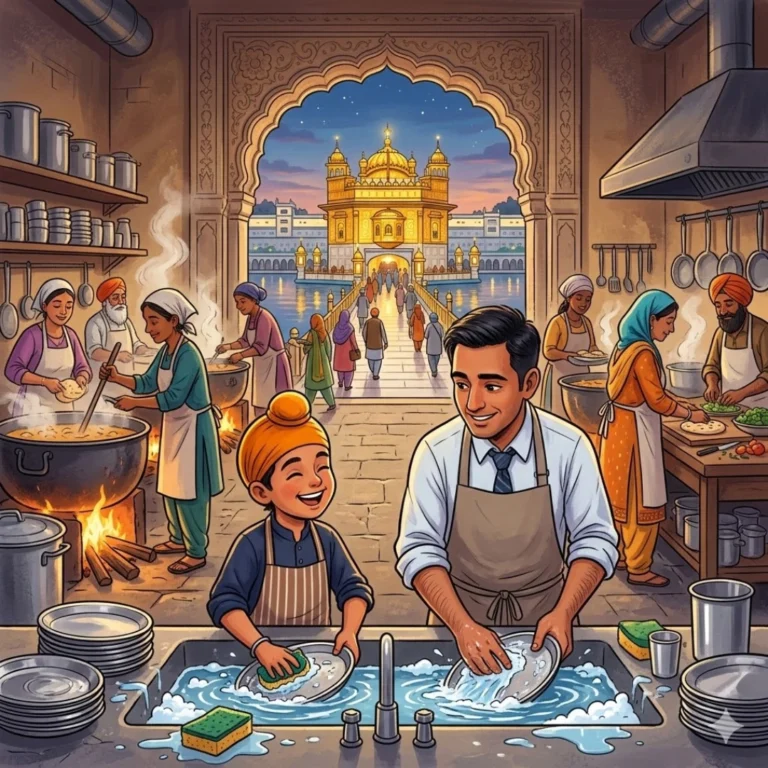
The langar was vast and busy and smelled of dal and ghee and warm chapati, and people were doing everything at once with the practiced efficiency of a place that has been running for centuries. Men and women and children were rolling chapati. Others were stirring enormous pots. Others were washing dishes in long troughs – hundreds of metal thalis at a time, stacked and rinsed and stacked again.
Ranjit watched from the doorway.
A man with a gray beard and flour on his hands noticed him and said: “Sat Sri Akal. Are you here to help or to watch?”
“Help,” said Ranjit, because this was clearly the correct answer.
He was given an apron and put on dishes.
The dishes were, to put it plainly, a very large job. For every hundred people who ate, a hundred thalis needed washing. For every hundred thalis washed, a hundred more arrived. The line of dirty dishes was, as far as Ranjit could tell, infinite.
He washed dishes for an hour. The man beside him – a businessman from Delhi in an expensive suit with his sleeves rolled up – washed beside him without speaking for twenty minutes, then said: “My first time doing this.”
“Mine also,” said Ranjit.
“In my office I have forty people who work for me,” the man said, not boastfully, just as a fact. “And here I am washing dishes beside a ten-year-old.”
“At home my mother washes all the dishes,” said Ranjit. “I never thought about it much.”
The man laughed. It was a surprised laugh, the kind that comes out before you’ve decided whether to laugh. “Yes,” he said. “That is exactly it.”
They washed together. The dishes kept coming.
Ranjit’s arms ached after an hour. After two hours, they had moved past aching into something else – not pain, exactly, but a deep physical awareness of what his arms were doing. He found he liked it, strangely. There was no thinking required. There was only the dish, the water, the cloth, the stack.
A girl a little older than him was on his other side. She had come, she said, every Saturday for three years. She knew the names of four of the other volunteers and the rotation schedule and how much dal the kitchen went through in a week.
“Why do you keep coming?” Ranjit asked her.
She thought about it. “Seva feels like something,” she said. “Like – when you do something that nobody will ever know you did, and you know you did it, and that’s enough. There’s something about that.” She rinsed a stack of thalis and set them to drain. “Also my nani says it’s good for the soul.”
Seva. Selfless service. The third pillar of Sikhism – naam japo, kirat karo, vand chhako – meditate, work honestly, share with others.
Ranjit had heard this all his life in the way you hear things that are always there: in the background, familiar, not yet felt.
Here, with his arms aching and an infinite line of dishes and the langar fires burning and one hundred thousand people fed today and one hundred thousand more tomorrow, he felt it.
After three hours he went back to find his mother, who was feeling better and had been looking for him.
“Where were you?”
“Washing dishes,” he said.
She looked at him. His arms were tired. His clothes were slightly damp. He had a smear of dal on his chin that he hadn’t noticed.
“Was it good?”
Ranjit thought about the businessman from Delhi with his sleeves rolled up. He thought about the girl who came every Saturday and knew the rotation schedule. He thought about the infinite dishes, and how they were not infinite, because they ended each night, because enough people came to do the work.
“Yes,” he said. “I think I’d like to come back.”
His mother smiled – the particular smile of someone whose child has learned something she had been hoping they would learn and could not have taught directly.
At the Golden Temple, the kirtan plays on. The langar fires burn. Somewhere in the vast kitchen, dishes are being washed by a hundred hands, famous and ordinary and everything between, kneeling together on the same marble floor.
This is seva. This is strength. This is what no one sees, and everyone benefits from, and the Gurus knew three hundred years ago would hold the world together, one clean dish at a time.
The Moral of This Story
Serving others without reward or recognition is the purest form of strength
About This Story’s Culture
The Harmandir Sahib (Golden Temple) in Amritsar, Punjab, is the holiest shrine of Sikhism, built in the 16th century and covered in gold leaf donated by Maharaja Ranjit Singh in the 19th century. The langar (community kitchen) is a central institution of all Gurdwaras (Sikh temples) and serves free meals to all visitors regardless of religion, caste, gender, or social status. The Golden Temple langar serves approximately 100,000 people on regular days and up to 200,000 on festivals. The three pillars of Sikhism – Naam Japo (meditate on God’s name), Kirat Karo (work honestly), Vand Chhako (share with others) – were established by Guru Nanak Dev Ji, the first Sikh Guru. Vaisakhi (April 13-14) is one of the most important Sikh festivals, marking the founding of the Khalsa brotherhood in 1699. Seva (selfless service) is a foundational Sikh practice.
Key Story Elements
- Ranjit – a ten-year-old Sikh boy at the Golden Temple for Vaisakhi, restless and curious
- The langar – 100,000 meals daily, free to all, the world’s largest free kitchen
- The businessman from Delhi washing dishes in an expensive suit – equality at the langar
- The girl who comes every Saturday – seva as a practice, not an event
- Kipling’s bardic narrator: ‘Hear the story’ opening, rhythmic moral proclamations at close
- The infinite dishes that are not infinite because enough people come
- Ranjit’s shift from hearing seva to feeling seva – the difference between knowing and experiencing
Frequently Asked Questions
What is the story of the well at the Golden Temple about?
The Well at the Golden Temple is a short story for kids aged 6-12 set in Amritsar’s famous Harmandir Sahib. It follows a boy named Ranjit who discovers the true meaning of strength while helping in the langar, the Sikh community kitchen that serves 100,000 free meals every day.
What is the Golden Temple and why is it important?
The Golden Temple, or Harmandir Sahib, is the holiest site in the Sikh faith, located in Amritsar, India. It sits on a sacred lake called the Sarovar and is covered in real gold. It’s famous not only as a place of worship but also for its langar, a free community kitchen open to everyone regardless of religion or background.
What is the langar at the Golden Temple?
The langar is a free community kitchen run by Sikh volunteers at the Golden Temple. It serves around 100,000 meals every single day to anyone who comes, rich or poor, all eating together as equals. It’s one of the largest free kitchens in the world and reflects the Sikh value of selfless service, known as seva.
📚 Recommended Books
Handpicked for readers like you
As an Amazon Associate, we earn from qualifying purchases. These recommendations are personalized based on this story's themes and your reading history.
What age group is this Golden Temple story suitable for?
This story is written for children aged 6 to 12 and takes around 8 to 10 minutes to read. It draws on Sikh tradition and explores the theme of service in a gentle, engaging way that younger readers can easily understand and connect with.
What lesson does a child learn from reading this story?
The story teaches children that real strength isn’t about physical power — it’s about humility, kindness, and serving others without expecting anything in return. Through Ranjit’s experience helping in the Golden Temple kitchen, young readers discover that the Sikh value of selfless service, or seva, is a powerful and meaningful way to live.