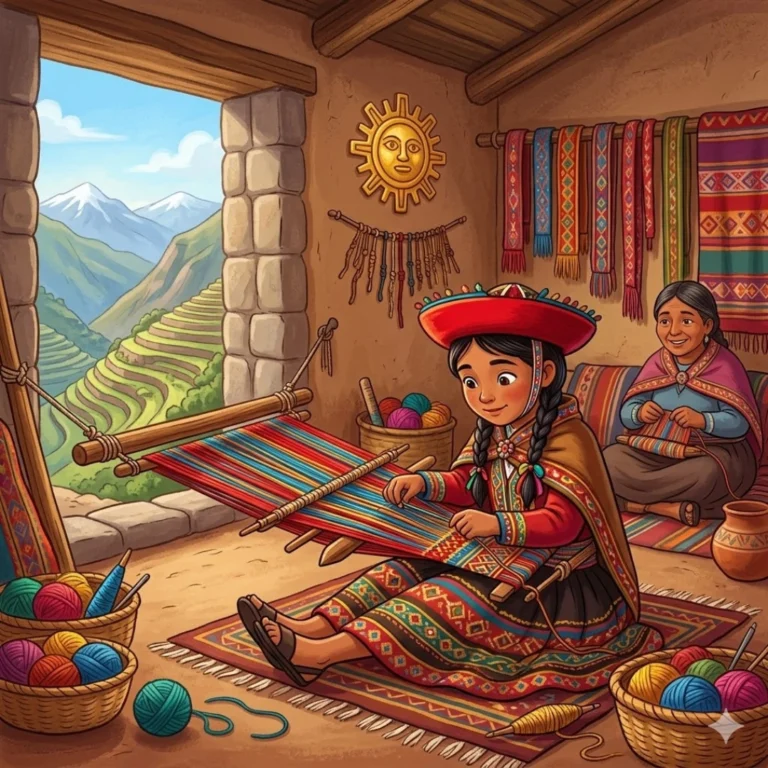
High in the Andes Mountains, where the clouds rest on the shoulders of the peaks like sleeping llamas and the sun god Inti blazes golden across the sky, there lived a girl named Kusi.
Kusi was nine years old and full of fire. She could run the steep stone paths of her village faster than any child her age, she could count the family’s alpacas before her father finished tying his sandals, and she could recite every knot on her grandmother’s quipu — the knotted cord that kept the family’s records — without missing a single loop. But there was one thing Kusi could not do, no matter how hard she tried.
She could not weave.
In the Inca world, weaving was not merely a craft. It was a language the fingers spoke to thread, a conversation between a weaver’s heart and the great Pachamama herself. The most sacred cloth — the tocapu — carried patterns that told stories, marked seasons, and honored the gods. To weave well was to speak clearly to the universe.
Every morning, Kusi sat at the loom her father had carved from dark queñoa wood, and every morning, the threads became a snarled, unhappy mess.
“Again?” her older sister Sisa said one afternoon, peering over Kusi’s shoulder with the particular superiority that only older sisters can manage. “You have been at this for three weeks, Kusi. The Festival of Inti Raymi is only one moon away. Every girl our age will present a woven panel to the temple of the Sun. What will you offer?”
“I will offer a fine panel,” Kusi said firmly, though her stomach felt like a quipu tied in all the wrong places. “I just haven’t made it yet.”
Sisa raised one eyebrow and walked away without another word, which was somehow worse than laughing.
That evening, as the peaks of the mountains turned the color of embers and Inti began his descent, an old woman appeared at the edge of the village. She walked slowly, leaning on a carved staff, and her mantle was woven in colors so rich and deep they seemed to hold the whole sky inside them — the blue of high-altitude lakes, the gold of ripened maize, the red of the mountain flowers that bloomed only after frost.
The village elder welcomed her and offered shelter, as was the custom of the Inca people — hospitality on the great Qhapaq Ñan road was sacred duty.
Kusi watched the old woman from a distance and felt a strange pull in her chest, like a thread being gently tugged.
The next morning, Kusi found the old woman sitting beside the communal weaving area, watching the other women work.
“Grandmother,” Kusi said respectfully, using the honorific for elder women, “I could not help but notice your mantle. I have never seen weaving so beautiful.”
The old woman’s eyes, sharp and warm as a hawk’s in sunlight, turned to Kusi. “And yet your own loom sits idle this morning,” she said. It was not an accusation. It was simply an observation, the way one notes that a field lies unplanted.
Kusi felt heat rise in her cheeks. “I am not… I cannot…” She stopped and began again, honestly. “I try and try, but the threads will not listen to me.”
The old woman smiled slowly. “Sit with me,” she said. “Show me what you do.”
Kusi fetched her loom and her bundle of alpaca wool thread — soft cream and deep brown spun by her mother — and she began. Her fingers moved too quickly, tangling the weft thread. The tension pulled wrong. Within ten minutes, the threads crossed and knotted, and Kusi let out a sound of pure frustration.
“There,” she said miserably. “You see? Impossible.”
“I see something different,” the old woman said. “I see a girl who rushes. Tell me, Kusi — when you count your family’s alpacas, do you count all of them at once, in one great glance?”
“No,” Kusi said, puzzled. “I count one, then the next, then the next.”
“And when you read your grandmother’s quipu?”
“One knot, then the next knot, then the next string.”
“Then,” the old woman said gently, “why do you weave as though you must finish the entire cloth in a single breath?”
Kusi opened her mouth, then closed it. She had no answer.
“Begin again,” the old woman said. “One thread. Just one. Make it true.”
Kusi untangled her work, took a breath that tasted of cold mountain air and distant snow, and placed her first thread with care. Then the second. Then the third. She worked slowly — so slowly it felt wrong — but when she looked down after a while, she saw three clean rows sitting straight and even, like well-built andenes on a mountainside.
“I did it,” she whispered.
“You began,” the old woman corrected kindly. “That is the first lesson of weaving. It is also the first lesson of all things worth doing.”
Kusi came back the next day and the day after that. She learned that patience was not the same as slowness — it was the art of giving each moment its proper attention. But learning is never a straight road, and Kusi’s path had many steep steps yet to climb.
On the fourth day, she tried to add a second color — the red of mountain flowers — and the entire pattern collapsed into confusion. She stared at it, and this time she did not make a sound. She simply sat very still, the way the mountains sit still during a storm.
“What do you see?” the old woman asked.
“I see that I changed too many things at once,” Kusi said slowly. “I changed the color and the pattern at the same time. I should have learned one first, then the other.”
The old woman nodded, and in her dark eyes there was something that looked like satisfaction. “The second lesson. When you fail, ask what it teaches you. A mistake you understand is a step forward. A mistake you ignore is a wall you will hit again and again.”
Kusi unpicked her work — patiently, carefully — and started the red thread again, keeping the simple pattern until she understood it. Then, only then, she tried a more complex design.
This time the threads crossed properly. The red flowed through the cream like a river through snow.
“Oh,” Kusi breathed, surprised by the beauty of it.
“Yes,” said the old woman softly. “That sound — that small oh of wonder — is what keeps a weaver at the loom through every difficulty.”
But there was one more great difficulty to come.
With six days remaining before Inti Raymi, Kusi worked on her panel with fierce concentration. She had chosen to weave a tocapu pattern — the small geometric squares that carried meaning — honoring Inti, the great sun. The design required she hold the count of eight threads in her head at all times while her fingers moved. It was the hardest thing she had attempted.
She made it almost to the end. And then, with three rows remaining, she miscounted. The pattern broke. One thread over, everything shifted, and the careful, beautiful sequence that had taken her days of work became — wrong.
Kusi felt tears prick at her eyes. Not the quick tears of frustration from weeks ago, but something deeper and more painful: the tears of someone who has worked truly hard and still fallen short.
“It is ruined,” she said quietly. “I cannot fix it. I cannot finish it in time. Sisa was right. I have nothing to offer at the festival.”
The old woman was silent for a long moment, and when she spoke, her voice was like the wind that moves through the high mountain grasses — steady, unhurried, and older than the stones.
“Kusi,” she said, “who told you that giving up was an option?”
Kusi looked up.
“Inti rises every morning,” the old woman continued, “even after the darkest, coldest night. Pachamama brings forth green shoots every spring, even after the killing frost. The great Qhapaq Ñan road was built step by step across the highest mountains in the world — one stone laid at a time, by hands that refused to stop. Do you think the builders never dropped a stone? Do you think Inti never struggled through the clouds?”
She reached over and placed her weathered hand over Kusi’s young one.
“Unpick only what is wrong. Keep what is true. Finish the last three rows. You have the skill. You have the patience. You have earned them.”
Kusi looked at her loom. She looked at the days of careful work that still held — the rows below the mistake, clean and true as mountain water. She took a breath.
And she began again — not from the start, but from where she still stood.
Row by row, thread by thread, one careful count at a time, she repaired the break in the pattern. The sun crossed the sky above her. The llamas browsed on the terraced slopes. The distant peaks stood in silent witness.
When the last thread was passed and Kusi tied the final knot, she held up her panel in the light of late afternoon and the tocapu gleamed — eight-count pattern perfect, sun symbol complete, the colors of Inti bright against the cream of alpaca wool.
She turned to show the old woman.
But the old woman was gone, as quietly as she had arrived, leaving only a single crimson thread lying on the stone where she had sat — the color of mountain flowers, the color that Kusi had first learned to weave.
The village elder, walking past, stopped and stared at the panel in Kusi’s hands.
“Child,” the elder said, “who taught you to make a true tocapu? That is the weaving of an aqlla — one of the chosen.”
“An old woman,” Kusi said, looking toward the road. “She came on the Qhapaq Ñan.”
The elder was quiet for a moment, then smiled in a way that made the fine lines of her face deepen like carved stone. “Some say that when a child is ready to learn an important lesson, Mama Ocllo herself walks the royal road to teach it.”
Kusi looked down at the crimson thread on the stone. She picked it up and wound it carefully around her finger.
At the Festival of Inti Raymi, when Inti blazed in his full glory and the great celebrations filled the stone plazas with song and color, Kusi presented her woven panel at the temple of the Sun. The priest unfolded it, and those who saw it grew quiet.
It was not the largest panel. It was not the most elaborate. But in every thread, in every carefully counted cross and turn of the pattern, you could see something that no shortcut could ever produce: the mark of a hand that had failed, and learned, and tried again — and refused, at the last, to stop.
And that is the gift that Mama Ocllo gave to Kusi, and through Kusi, gives to all of us still: not an easy task made simple, but a hard task made possible — one thread, one step, one morning at a time.
For this is the truest lesson the mountains have always known, and the loom has always sung, and every child who has ever tried and failed and tried again has always, always understood in their heart: Never give up. Even when things seem impossible, keep placing the next thread. The cloth you make will be more beautiful for every difficulty it contains.
The Moral of This Story
Never give up, even when things seem impossible
About This Story’s Culture
This story draws on authentic Incan traditions: tocapu are the sacred geometric symbols woven into fine Inca cloth, carried by aqlla (chosen women weavers) and used as both records and religious offerings. Inti Raymi, the Festival of the Sun, was the most important celebration in the Inca calendar, held at the June solstice, and woven offerings to Inti were a central part of the ceremony. Mama Ocllo and Manco Capac are the legendary founding couple of Inca civilization — credited by tradition with teaching humanity the arts of weaving, farming, and organized society — making Mama Ocllo the perfect embodiment of the weaving teacher who appears when a student is truly ready.
Key Story Elements
- Andes Mountains high-altitude village setting with alpacas and terraced slopes (andenes)
- Authentic tocapu weaving — sacred geometric patterns carried on Inca cloth to honor the gods
- Quipu (knotted cord record-keeping) used as a metaphor for patience and careful attention
- Mama Ocllo, the divine founding mother of Inca civilization, appearing as a mysterious traveling elder
- Inti Raymi (Festival of the Sun) as the meaningful deadline driving the protagonist’s determination
- Three distinct failures each teaching a separate lesson: rushing, changing too much at once, and despair
- Qhapaq Ñan (the royal Inca road) as the symbolic path of perseverance and civilizing wisdom
Frequently Asked Questions
What is the story of Mama Ocllo’s Gift of Weaving about?
Mama Ocllo’s Gift of Weaving is an Incan folktale for kids aged 6-12 about a determined girl named Kusi who struggles to learn weaving despite excelling at everything else. The story explores themes of perseverance and determination, set high in the Andes Mountains within the rich cultural world of the Inca civilization.
Who was Mama Ocllo in Incan mythology?
Mama Ocllo was a revered goddess and queen in Incan mythology, believed to be a daughter of the sun god Inti. She is celebrated as a divine teacher who gifted humanity with the sacred art of weaving, making her a powerful symbol of craftsmanship, wisdom, and feminine strength in Andean culture.
Why was weaving so important in the Inca world?
In the Inca world, weaving was far more than a craft — it was considered a sacred language. Weavers used thread and patterns to express spiritual meaning, communicate cultural identity, and connect with Pachamama, the earth goddess. Woven textiles held deep social and religious significance throughout Incan society.
📚 Recommended Books
Handpicked for readers like you
As an Amazon Associate, we earn from qualifying purchases. These recommendations are personalized based on this story's themes and your reading history.
What lesson does Mama Ocllo’s Gift of Weaving teach children?
The story teaches children that perseverance and determination matter more than natural talent. Kusi is gifted in many ways but must struggle and keep trying before she masters weaving. The key moral is that facing difficulty with courage and patience, rather than giving up, is how we grow and truly earn our achievements.
Is Mama Ocllo’s Gift of Weaving suitable for young children to read alone?
Yes, the story is written for children aged 6-12 and takes about 8-10 minutes to read. Younger children around age 6-7 may enjoy it best with a parent or caregiver, while children aged 8 and up can likely read it independently. The language is engaging and conversational, making it accessible and enjoyable for most primary school readers.