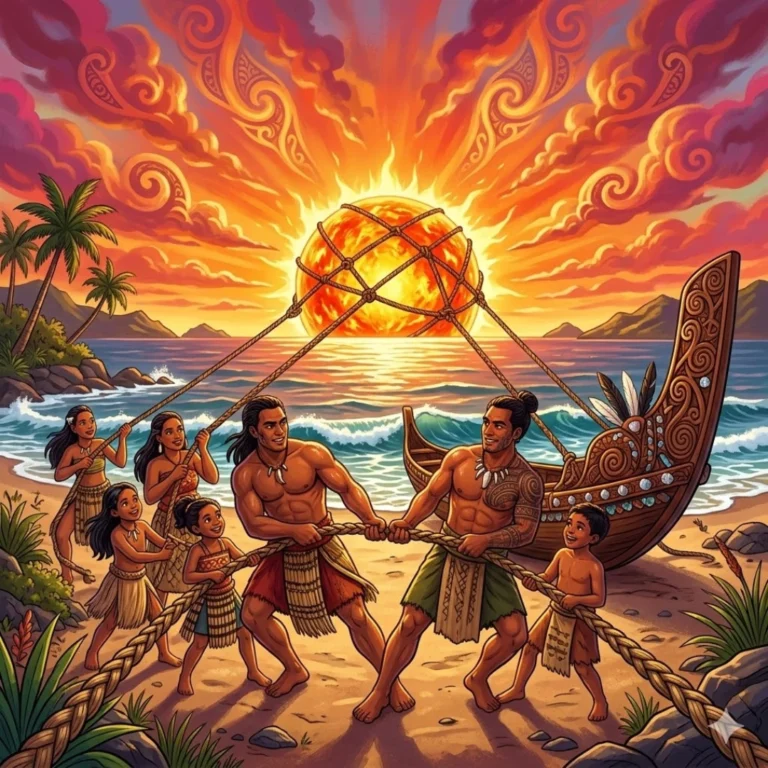
In the time before your grandfather’s grandfather was born, when Aotearoa was young and the mountains still remembered their first morning, the sun was a wild and reckless thing.
He roared across the sky like a waka in a storm — blazing, burning, rushing. He sprang from the eastern horizon before the birds had finished their first song, and he plunged below the western hills before the fishermen had even hauled in their nets. The days were so short, so terribly short, that the kumara would not ripen in the garden, the flax would not dry by the river, and the children would barely finish their games before the darkness swallowed the land again.
The people of Aotearoa shook their heads and wrapped their cloaks tighter and said: “There is nothing to be done. The sun is the sun. Who can argue with the sky?”
But one young man said otherwise.
His name was Maui-tikitiki-a-Taranga — Maui the clever, Maui the restless, Maui who had fished up this very island from the bottom of the sea with nothing but a fishhook and a song. He sat on the black volcanic shore near his whanau’s fire, watching the sun race and tumble toward the west, and a thought curled inside him like a koru fern, green and tightly wound, slowly unfurling.
“We will catch him,” said Maui.
His four brothers looked up from where they sat mending nets. The eldest, Maui-taha, narrowed his eyes. “Catch who?”
“The sun,” said Maui simply.
For a long moment, the only sound was the sea breathing on the rocks.
Then Maui-roto burst out laughing. “The sun!” He slapped his knee. “Our little brother wants to catch the SUN. Next he will tell us he can lasso the moon!”
“I have done stranger things,” said Maui mildly.
“He’s not wrong,” muttered Maui-pae under his breath, for he remembered the island rising up from the deep. Still, he shook his head. “Even if it were possible — and I do not say it is — we have no rope that could hold such a thing. The sun would burn through anything we wove in a heartbeat.”
“Then we weave ropes that do not burn,” said Maui. “We weave them from the sacred muka flax, stripped by the old method, treated with karakia at each stage. Strong ropes. Many ropes. Ropes like the roots of the great totara tree — that nothing in the sky or sea could break.”
Maui-waho, the quietest brother, had been listening. He looked up now, and there was something thoughtful behind his dark eyes. “And then what?” he asked. “Even if we reach the place where the sun is born — even if we snare him — what then? One man cannot hold the sun. Not even you, little brother, with all your tricks.”
And here Maui paused. Here the clever one, the demigod who had answered every challenge with a sharp word and a sharper plan, went quiet.
“That,” he said at last, “is why I need you.”
The brothers looked at one another.
“I am the one who knows the words,” Maui said, and his voice was serious now, all the boasting drained away. “I know the karakia to keep the ropes from burning. I know the place where the sun sleeps before he rises. I know how to read the stars and the wind and the lay of the land. But I am one pair of hands. One voice. To hold a sun — to truly hold him and make him listen — we need four more. We need whanau.”
The fire popped and sent a spray of sparks into the darkening air. The brothers were quiet for a long time.
It was Maui-taha, the eldest, the proudest, who spoke first.
“Tell us,” he said, “what we must do.”
And so began the great preparation.
For many days and many nights, the brothers worked together at the river’s edge, where the harakeke flax grew tall and green and thick as a warrior’s arm. They pulled the long flat leaves and beat them on the stones to soften them. They stripped away the outer layers to find the muka — the finest inner fibres, white and strong as the sinew of something ancient.
Maui walked among them, chanting the karakia at each step — the words that had been given to his ancestors by Tane, the god of the forests. Words of binding, words of strengthening, words that told the fibres: you will not burn, you will not break, you will hold what must be held.
Maui-roto, who had laughed loudest, now worked hardest. His hands moved in a quick, sure rhythm as he twisted the strands together — three, six, twelve, twenty-four — until the rope grew thick as his wrist and then thick as his arm.
“Is this strong enough?” he asked.
“More,” said Maui.
Maui-pae braided the individual lengths together with a technique passed down from their grandmother, each loop locking into the next so that the more tension was applied, the tighter it held. He worked through the night, his fingers flying by firelight.
“Is this strong enough?” he asked.
“More,” said Maui.
Maui-waho soaked the finished sections in the water of a sacred spring and stretched them on posts to dry in what little sun they had, testing each length by throwing his whole weight against it, hanging, swinging, yanking until he was satisfied it would not give.
“Is THIS strong enough?” he asked.
“Almost,” said Maui, and allowed himself a small smile.
And Maui-taha, the eldest, organized everything — dividing the work, keeping the count of ropes, making sure each brother ate and rested in turns so that no one’s hands grew too tired, no one’s eyes too heavy. Without him, the work would have tangled into chaos. With him, it moved like a river finding the sea.
At last, they had ropes enough to fill a waka. At last, they were ready.
They journeyed east, further east than fishermen go, further east than the sea-birds fly, to the great dark pit called Te Rua-o-te-Ra — the Pit of the Sun — where Te Ra, the great sun himself, slept each night before his morning run.
The land there was strange and ancient. Steam rose from cracks in the black earth. The trees were twisted into odd shapes by the constant heat. Nothing grew very tall, and the light, even at night, had a reddish tinge, as though the earth itself were smouldering.
“I don’t like this place,” muttered Maui-roto.
“Hush,” said Maui-taha.
“I don’t like it either,” admitted Maui-waho. “But we are here.”
They spread out along the edge of the great pit, each brother taking hold of a coil of rope, crouching low behind the rocks so the sun would not see them when he first stirred. Maui moved between them, adjusting their grip, whispering the plan one final time.
“When he rises, we wait for his head to come clear of the pit. Then we throw — all of us, together, not one before the other, not one holding back. If even one of us throws too early or too late, the ropes will tangle and the sun will be free before we have him. Together. Understand?”
Four heads nodded.
“And when you feel him pull — and he will pull, brothers, he will pull like every current in the sea — you do not let go. No matter what. You hold. Even when it burns. Even when it seems impossible. You hold, and we hold together, and together we are stronger than anything that flies through the sky.”
Then the dark began to thin at the east.
A light, deep orange and then blazing gold, began to pulse from the pit. The heat struck their faces like the opening of an oven. The stones around them cracked and hissed.
“Ready,” breathed Maui.
Te Ra’s great head crested the edge of the pit, all fire and fury and terrible speed, already lunging for the sky —
“NOW!”
Five ropes sang through the air at once — a sound like a haka, like five warriors’ voices joined in one great shout. The loops fell over the sun’s blazing shoulders, his arms of light, his roaring neck, and the brothers pulled — pulled with everything in them, all their strength, all their weight, every muscle and sinew and bone, feet braced against the cracking black rocks, hands wrapped three times in the sacred muka.
Te Ra screamed. He was not used to being stopped. He thrashed and bucked and the sky turned red and purple and the earth shook beneath them, and one by one the brothers might have been flung away — if they had been alone.
But they were not alone.
When Maui-roto’s grip began to slip, Maui-taha was there, adding his weight. When Maui-pae’s feet skidded on the hot stone, Maui-waho braced against him, a wall of flesh and bone and will. When the rope bit into Maui’s hands until they bled, he did not shout in pain — he shouted the karakia, louder and louder, the sacred words binding the ropes to their purpose, binding the brothers to their task.
Slowly — oh, so slowly — Te Ra slowed.
He could not break the ropes. He could not throw five brothers from the earth. He could not outrun five hearts beating as one.
“Enough!” the sun bellowed at last, and his voice was like a thousand fires. “Enough, Maui! I yield! I yield! I will move more slowly across your sky — I will give your people their long days. Only release me!”
Maui looked at his brothers. Their chests heaved. Their hands were scorched and shaking. Their eyes shone.
“Release him,” said Maui-taha.
And they did — together, at the same moment, as they had done everything.
Te Ra crossed the sky that day more slowly than he had ever moved before. The light lingered long over the green hills and the silver rivers and the deep harbours of Aotearoa. The kumara grew fat in the warmth. The flax dried on its poles. Children played until their mothers called them home three times over.
The people stood in the long golden evening and looked up in wonder.
“What happened?” they asked.
And five brothers walked back into the village — scorched, tired, grinning — and the eldest said: “We asked the sun to slow down.”
“And it listened?” someone asked.
Maui laughed and looked at his brothers. “We gave it no choice.”
That night, the whanau made a great fire on the shore and they danced the haka together, their feet stamping the rhythm into the earth, their voices rising over the sea. Not Maui’s voice alone — all five, together.
Because Maui had the cleverness and the karakia and the plan. But without his brothers’ hands on the ropes, the sun would have run away laughing.
And that is the lesson the stars remember, and the lesson the long Aotearoa days still tell:
One clever person can dream a great dream. But it takes whanau — it takes your people, standing beside you, holding on — to make that dream hold.
Together, we are stronger than alone.
The Moral of This Story
Together we are stronger than alone
About This Story’s Culture
This story draws on the genuine Maori legend of Maui snaring Te Ra (the sun) to slow its movement across the sky, one of the most beloved tales in the oral tradition of Aotearoa New Zealand. Authentic cultural elements include muka (the fine inner fibre of harakeke flax used for weaving strong cordage), karakia (sacred incantations), the concept of whanau (family and community as the foundation of strength), and the haka as a communal expression of victory and solidarity. The koru fern spiral — a symbol of new life and growth — appears as a metaphor for Maui’s unfolding idea, honouring its significance in Maori art and worldview.
Key Story Elements
- Maui as the clever demigod protagonist who cannot succeed without his brothers
- Four named brothers – Maui-taha, Maui-roto, Maui-pae, Maui-waho – each contributing unique strengths
- The weaving of sacred muka (flax fibre) ropes as extended teamwork preparation sequence
- Karakia (sacred prayer/incantation) used by Maui to protect and strengthen the ropes
- The dramatic confrontation at Te Rua-o-te-Ra (Pit of the Sun) where brothers act as one
- Te Ra (the sun) as a wild force tamed only by unified effort, not by one hero alone
- Kipling-style rhythmic cadence with vivid Aotearoa landscape and a haka celebration ending
Frequently Asked Questions
What is the story of how Maui slowed the sun about?
The story of how Maui slowed the sun is a Maori legend from Aotearoa (New Zealand) about a clever young hero who challenges the reckless sun racing too quickly across the sky. The days were so short that crops couldn’t ripen and people suffered, so Maui gathers his community to take action and slow the sun down.
What age group is the Maui slowed the sun story suitable for?
This retelling of how Maui slowed the sun is written for children aged 6 to 12 and takes about 8 to 10 minutes to read aloud. It’s a great choice for bedtime reading, classroom storytelling, or introducing kids to Maori mythology in an engaging, accessible way.
What lesson or moral does the Maui and the sun story teach children?
The story teaches unity and cooperation — that big problems can be solved when people work together instead of giving up. Maui refuses to accept that nothing can be done, inspiring his community to act. It encourages children to be brave, think creatively, and believe in collective effort.
📚 Recommended Books
Handpicked for readers like you
As an Amazon Associate, we earn from qualifying purchases. These recommendations are personalized based on this story's themes and your reading history.
Is the story of Maui slowing the sun based on real mythology?
Yes, it comes from traditional Maori mythology of Aotearoa, New Zealand. Maui is one of the most famous figures in Polynesian legend, known for remarkable feats like fishing up islands and harnessing fire. The tale of slowing the sun is one of his most celebrated stories across many Polynesian cultures.
Why did Maui want to slow the sun in the first place?
Maui wanted to slow the sun because it raced across the sky so fast that the days were dangerously short. Crops like kumara couldn’t ripen, flax couldn’t dry, and children barely had time to play before darkness fell. Slowing the sun was a practical act of survival for the people of Aotearoa.