

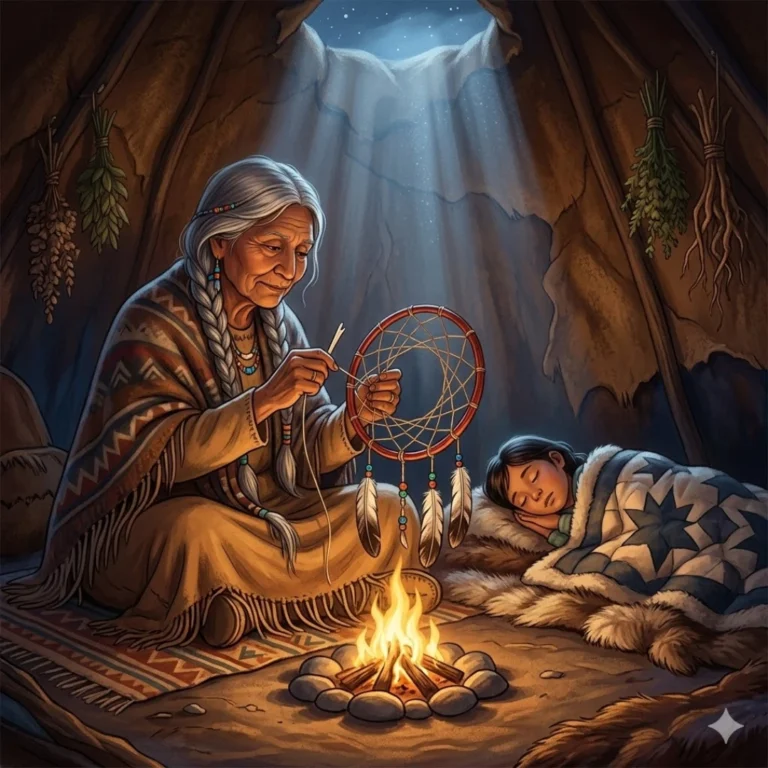
Long, long ago, when the Great Lakes were still young and the northern forests stood so tall their crowns could brush the belly of the sky, there lived a grandmother named Nokomis and her granddaughter, a girl called Waabi — which in the tongue of the Anishinaabe people means She Who Sees.
They lived beside a lake so wide that on still mornings the far shore disappeared into silver mist, and the birch trees around their home wore their white bark like the robes of quiet spirits. Each autumn, Nokomis and Waabi paddled their birch bark canoe through the tall grasses to harvest manoomin — the wild rice that the Great Spirit, Gitchi Manitou, had placed upon the water as a gift for the people. Each winter, they sat beside the fire and listened to the wind carry stories down from the north. Each spring, they gave thanks. And each summer evening, Waabi would fall asleep to the sound of the lake breathing against the shore.
But as Waabi grew older, the nights grew troubled.
“Nokomis,” she whispered one morning, her small face pale as birch bark, “the bad dreams came again. Dark shapes with long fingers. They reached for me through the dark, and I could not run.”
Nokomis drew the girl close. She could feel the rapid beating of Waabi’s heart, like a frightened bird cupped in two hands. The grandmother’s own heart ached with a love so deep it had no bottom, like the lake in winter. She kissed the top of Waabi’s head and said, “You are safe, little one. The day is here. The dark shapes have no power in the light.”
“But they will come back tonight,” said Waabi. “They always come back.”
Nokomis could not argue with this truth. So she rose that morning with a quiet, burning resolve in her chest. She knew the stories of Asibikaashi — the Spider Woman — who had once protected all the children of the Anishinaabe from the cruel spirits that prowled the space between sleeping and waking. But the world had grown so wide, the stories said, that Asibikaashi could no longer travel to every cradle, every sleeping mat, every child in every birch bark lodge from one end of the great land to the other. The people had always believed she was still out there, still watching — but where?
Nokomis decided she would find her.
She told no one but Waabi. “I am going to seek counsel from the old ones,” she said, braiding her silver hair and tying her moccasins with careful hands. “You will stay with your aunt. You will eat well. And when I return, I will bring you something that will guard your sleep.”
Waabi grabbed her grandmother’s sleeve. “What if you do not return?”
Nokomis knelt until their eyes were level. She touched the girl’s face with both hands, the way one cradles something irreplaceable. “Then I will have given everything so that you may sleep in peace,” she said softly. “That is what love does, my heart. It protects, even at great cost.”
She set out at dawn, walking west along the lakeshore, then north into the deep forest where the cedar trees grew so ancient their roots had heard the first songs of creation. She walked for two days, through fern and shadow, over moss-covered stones, past streams where brook trout flickered like living flames. She walked until her legs ached and the stars above the tree canopy were the only map she had.
On the third night, she stopped at the edge of a clearing where a great spider’s web hung between two old birches, each thread catching the silver light of a full moon so that the whole web blazed like a gift. Nokomis sat down before it and waited. She did not speak. She had been raised to understand that some silences are prayers, and that the most important things in the world arrive only when you are still enough to receive them.
Just before the moon reached the top of the sky, a voice came — not with sound exactly, but the way certain truths arrive: felt before they are heard.
“You have walked far, grandmother.”
Nokomis looked up. There at the center of the blazing web sat a figure small and ancient and shimmering — Asibikaashi, the Spider Woman, whose eight patient eyes held in them the memory of every child who had ever been frightened in the dark.
“I have,” said Nokomis. “My granddaughter cannot sleep for the bad dreams that come. I have come to ask for your help.”
“Why do you not ask the medicine man? Why do you not offer tobacco and wait for an answer to come to you in ceremony?”
“I have done these things,” said Nokomis. “The medicine is strong, but the dreams are stronger. I believe that some problems require a grandmother to walk into the dark herself.”
There was a pause that felt like the forest breathing. Then Asibikaashi made a sound that might have been laughter, or might have been the wind moving through the highest branches.
“You speak with zaagi’idiwin — with love,” said the Spider Woman. “And with aakode’ewin — with bravery. These are two of the Seven Grandfather Teachings. When love and bravery walk together, they are very hard to refuse.”
“I ask nothing for myself,” Nokomis said. “Only for the child.”
“I know,” said Asibikaashi. “It has always been this way. The ones who ask for others receive more than the ones who ask for themselves.” She descended from the center of the web on a single thread of moonlight. “Sit with me. I will teach you what I know. I will show you how to make a piece of me — a piece of my web — that you can carry home and hang above your granddaughter’s sleeping place. It will remember everything I know about catching fear.”
All that night, Nokomis sat beside Asibikaashi and learned. The Spider Woman showed her how to bend a young willow branch — supple and living — into a circle, the shape of the sun and the moon and the sacred hoop of life. She showed her how to weave sinew cord in the pattern of a web, round and round, lacing each thread with intention, leaving a small hole at the center — an opening just large enough for a good dream to slip through, but with a web so fine that nightmares would tangle in it and hang there until the morning light burned them to nothing.
“You must weave it with love,” Asibikaashi said. “The love is not separate from the craft. It is the craft. Every loop of sinew is a prayer. Every knot is an act of protection. When you tie the last knot, say your granddaughter’s name — say it clearly, into the web — so that it knows who it is made for.”
“And the feathers?” asked Nokomis, for she had seen feathers hanging from the dreamcatchers in the oldest stories.
“The feathers are a ladder,” said Asibikaashi. “They hang below so that the good dreams, once they pass through the hole, may drift down on soft wings to reach the sleeping child. A dream needs a gentle path to travel. Give it one.”
Nokomis worked through the rest of the night, her old fingers moving with a sureness she had not felt in years. It was as though the love she carried for Waabi flowed down through her hands into the willow and the sinew, making the whole small thing luminous with purpose. When dawn began to show itself in thin grey lines between the trees, she tied the last knot and said her granddaughter’s name aloud — “Waabi” — and in the quiet of the clearing, the name seemed to hum in the web for a moment before it settled into stillness.
She looked up to thank Asibikaashi, but the Spider Woman was already gone. Only the great web remained between the two birches, and it seemed to Nokomis that it was even more beautiful than before — as if something had been added to it, as if a grandmother’s love and an ancient guardian’s wisdom had become, together, a single thing.
Nokomis walked home.
She walked for three days this time, for the journey home always takes longer than the journey away — it is weighted with what you carry. But she did not feel tired. The dreamcatcher she held was light in her hands and yet full of something weightless and enormous, the way a seed is light but contains an entire forest.
When she stepped through the door of the lodge, Waabi ran to her and held her so tightly that Nokomis laughed.
“I was afraid!” Waabi said into her grandmother’s chest. “I had bad dreams every night you were gone.”
“I know, my heart,” said Nokomis, stroking the girl’s hair. “But look.” She held up the dreamcatcher, and in the firelight its sinew web gleamed like a small captured moon, and the feathers below it stirred in the warmth rising from the flames.
Waabi’s eyes went wide. “What is it?”
“It is a piece of the Spider Woman’s wisdom, woven with my love for you,” said Nokomis. “We will hang it above your sleeping place. It will catch the bad dreams before they reach you. The good dreams will find their way through the center and drift down on the feathers to your heart. You will sleep safely now.”
“Will it work forever?” Waabi asked.
“If it is made with love,” said Nokomis, “and if it is remembered with love, then yes. For as long as love holds the knots tight, it will hold.”
That night, they hung the dreamcatcher above Waabi’s sleeping mat. The fire burned low. The northern lights — the waabanang, the lights that the old people say are the torches of ancestors dancing — rippled green and violet above the lake. And Waabi slept through until morning, deeply and peacefully, chased by no darkness at all.
In the years that followed, Nokomis taught the making of dreamcatchers to her daughters and to their daughters after them, and to any mother or grandmother or grandfather who came to her asking how to protect a sleeping child. She taught them always what Asibikaashi had taught her: that the love is not separate from the craft. That every knot is a prayer. That the name of the child must be spoken into the web, clearly and with warmth, so that the dreamcatcher knows who it is made for.
And she taught them the lesson that she had carried home from the dark forest like a seed: that true love does not stand at a distance and wish for safety. True love walks into the night. True love learns what it must learn. True love weaves itself into a web of protection so that the ones it cherishes may dream in peace.
And this is why, to this day, a dreamcatcher hangs above the place where a child sleeps — because somewhere, long ago, a grandmother loved a little girl so much that she walked into the dark and brought back the light.
The Moral of This Story
True love means protecting others even at cost to yourself
About This Story’s Culture
The dreamcatcher originates in Ojibwe/Anishinaabe tradition, where Spider Woman (Asibikaashi) was believed to protect sleeping children from harmful spirits by weaving a web above their resting place; as the nation grew and spread across the Great Lakes, mothers and grandmothers began crafting dreamcatchers to carry on her protective role. The willow hoop represents the circle of life, the sinew web traps bad dreams that are destroyed by morning light while the center hole allows good dreams to pass through, and the hanging feathers provide a gentle path for those good dreams to reach the sleeper. The Seven Grandfather Teachings — including zaagi’idiwin (love) and aakode’ewin (bravery) — are authentic ethical teachings of the Anishinaabe people and are treated here with the reverence they deserve.
Key Story Elements
- Ojibwe/Anishinaabe cultural tradition and the origin of the dreamcatcher
- Spider Woman (Asibikaashi) as the original protector of children
- Grandmother Nokomis and granddaughter Waabi — love across generations
- Epic spiritual journey into the forest to seek ancient wisdom
- Willow hoop, sinew web, and feathers as sacred protective craft
- Seven Grandfather Teachings (zaagi’idiwin/love, aakode’ewin/bravery)
- Northern lights, wild rice, birch bark canoes — authentic Great Lakes landscape
Frequently Asked Questions
What is the story of the first dreamcatcher?
The first dreamcatcher is a Native American origin story from the Anishinaabe tradition. It tells how a grandmother named Nokomis and her granddaughter Waabi, meaning ‘She Who Sees,’ lived beside a great lake. The story explores themes of love and sacrifice and explains how the dreamcatcher came to be created to protect loved ones during sleep.
Where does the dreamcatcher come from in Native American tradition?
The dreamcatcher originates from the Anishinaabe people of the Great Lakes region in North America. According to tradition, it was crafted to catch bad dreams and let good ones pass through. This story brings that origin to life through the bond between a grandmother and granddaughter living beside the northern lakes.
What age group is this dreamcatcher story suitable for?
This story is written for children aged 6 to 12 and takes around 8 to 10 minutes to read aloud. It uses gentle, imaginative language that works well for bedtime reading or classroom storytelling, making Native American traditions accessible and engaging for young readers.
📚 Recommended Books
Handpicked for readers like you
As an Amazon Associate, we earn from qualifying purchases. These recommendations are personalized based on this story's themes and your reading history.
What is the moral or theme of The First Dreamcatcher story?
The central themes are love and sacrifice. The story shows how deep family bonds — especially between a grandmother and grandchild — can inspire acts of great care and creativity. It also gently introduces children to Anishinaabe values like gratitude, living in harmony with nature, and honouring the gifts of the Great Spirit.
Who are Nokomis and Waabi in the dreamcatcher legend?
Nokomis is a wise grandmother, and Waabi is her young granddaughter whose name means ‘She Who Sees’ in the Anishinaabe language. They live together beside a vast Great Lakes shoreline, harvesting wild rice and listening to the wind. Their close relationship forms the heart of this dreamcatcher origin story.
