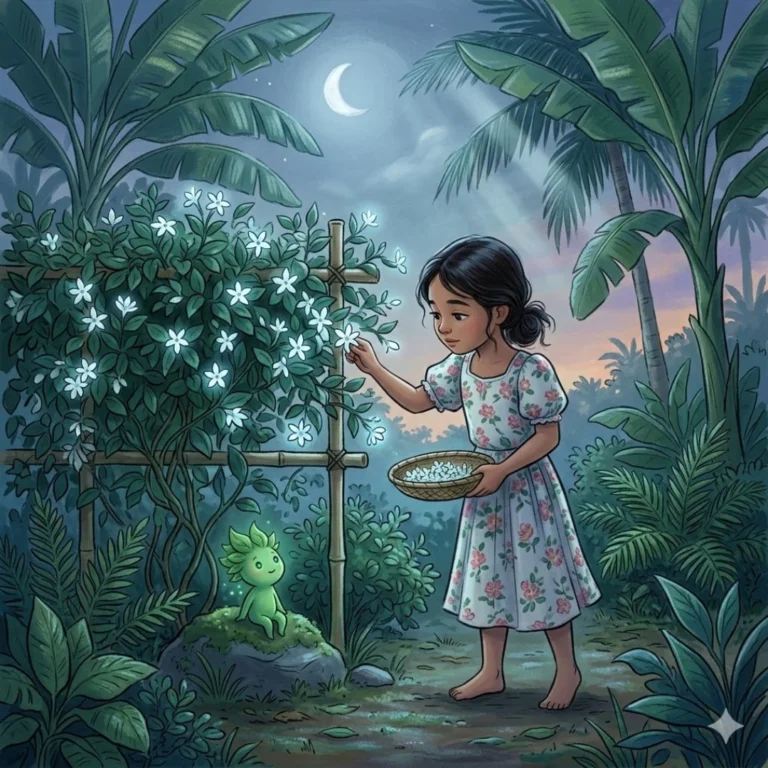
At the edge of the village of Luntiang Bayan, where the rice paddies turned to forest and the forest turned to something older and quieter still, there lived a girl named Amara.
Amara was nine years old, with quick brown eyes and bare feet that knew every root and stone of the path between her family’s bahay kubo and the great acacia tree at the forest’s border. Each morning she would press her forehead to her Lola’s hand — mano po — before slipping outside into the thick, green-smelling air of the Philippine morning. The world before breakfast was her favorite world: dew-heavy banana leaves bowing like bowed heads, roosters announcing the pink sky, and the forest breathing out a breath that smelled of earth and rain and things with no names.
It was in this early-morning world that Amara first found the sampaguita vine.
It grew along the old stone wall at the forest’s edge, a place where no vine had grown before. Amara noticed it the way you notice something that has always been waiting to be seen. The vine twisted gently upward, its dark leaves shaped like small green hearts. And at its tip, barely open, was a single white blossom — star-shaped and smaller than her thumbnail, trembling in the morning air.
Amara crouched low and breathed it in. The scent rose into her like a song, sweet and clear and a little like moonlight, if moonlight had a smell. She had strung thousands of sampaguita blooms into garlands with her Lola for the fiesta, had threaded them onto coconut-leaf needles while they talked and laughed. But this flower smelled different. This flower smelled like a secret.
“You found me,” said a voice.
Amara did not startle, which surprised her. She looked toward the sound and saw, sitting on a mossy stone just inside the tree line, a creature no taller than her knee. It looked something like a child, but its skin was the pale green of new fern fronds, its hair was made of trailing roots, and its eyes were the deep black of forest pools in the rainy season.
“You are an engkanto,” Amara said quietly.
The small spirit tilted its head. “Some call us that. I am called Diwata-si-Luntian — the green one. But you may call me Luntian, if it pleases you.” It gestured toward the vine. “That flower found you, really. It blooms only for those with a kapwa heart — one who feels that others are not separate from themselves.”
Amara sat down cross-legged in the damp grass, because this seemed like a conversation that deserved sitting. “What does the flower do?” she asked.
“It listens,” said Luntian simply. “And sometimes, when the one who tends it makes a true sacrifice — gives something they truly treasure for the sake of another — it answers.”
“What does it answer with?”
The green spirit looked at her with those deep pool eyes. “With exactly what is needed most. No more, no less.”
From that morning on, Amara tended the vine. She watered it before school, cleared away the climbing weeds that tried to crowd it, and sometimes simply sat beside it and talked — about her Lola, about the bayanihan last harvest when thirty neighbors came to lift old Mang Crispin’s bahay kubo and carry it down the hill so he would not have to climb so many steps with his tired knees. She talked about the way ylang-ylang bloomed yellow along the path to the church, and how bougainvillea threw magenta confetti on windy days, and how the rice terraces her uncle had shown her in the mountains looked like a staircase built for giants who had been very, very patient.
Luntian came sometimes to listen, perched on the mossy stone, and sometimes not. But the vine grew. New buds formed — dozens of small white stars waiting to open.
Then Amara’s Lola grew sick.
It happened the way illness happens in small places — quietly at first, and then everyone knew. Lola Caring had a cough that would not leave. The hilot, the village healer, came with her warm hands and her oils. Neighbors brought soup and prayers. Amara’s mother lit a candle before the statue of Santo Niño and said the words she always said when something felt too large and frightening to hold alone.
But Lola Caring’s breathing grew thin as paper.
Amara sat beside her grandmother’s bed that night and held her small, dry hand. Lola Caring’s eyes were closed, but she was not asleep — Amara could tell by the slight furrow between her brows, the way her mouth pressed together against some discomfort she would not speak aloud.
“Lola,” Amara whispered. “I am here.”
Lola Caring’s lips curved the smallest amount. “I know, anak. I can feel you.”
Amara stayed until her mother made her go to sleep. But she could not sleep. She lay on her woven mat and stared at the dark ceiling and thought about Luntian’s words. A true sacrifice. Something you truly treasure. For the sake of another.
She knew, then, what she had to do. And she knew it would hurt.
In the hour before dawn, Amara rose and padded barefoot through the bahay kubo and down the wooden steps. The night air was thick and velvet-warm, full of cricket song and the faraway call of a nightjar. She walked the familiar path to the stone wall without a lamp, because her feet knew the way.
The sampaguita vine was silver in the moonlight. Every bud had opened in the night — the whole vine heavy with white blossoms, their scent washing over her in great soft waves that made her chest ache with something she had no word for. It was the most beautiful thing she had ever grown. It was hers in the way that only things you have cared for can be yours.
Luntian was already there, sitting on the stone, watching her with those forest-pool eyes.
“You know why I have come,” Amara said.
“I know,” said the green spirit gently.
“If I give it — all of it — will my Lola be well?”
Luntian was quiet for a moment. An owl called from somewhere deep in the trees. Then the spirit spoke. “The flower does not make bargains, Amara. It is not that kind of magic. But true sacrifice — love made into action — opens something in the world. A door. What comes through is what is needed most.”
“I don’t understand completely,” Amara said honestly.
“I know,” said Luntian, and there was something like kindness in its strange face. “But your loob — your inner heart — understands. That is enough.”
Amara looked at the vine for a long moment. She thought about all the mornings she had crouched here, breathing in that first blossom. She thought about the garlands she would never string from these flowers, the quiet conversations she would no longer have beside this living, growing, fragrant thing.
Then she thought about her Lola’s dry hand in hers.
She began to pick the blossoms. Not roughly — she was not rough with growing things — but deliberately, one by one, placing each small white star in the fold of her skirt. Her eyes went blurry once, and she blinked it clear. The scent was almost overwhelming now, as though the vine was offering everything it had all at once, holding nothing back.
When every blossom had been picked, she left the bare vine with its dark, heart-shaped leaves and walked home through the pre-dawn stillness.
She laid all the blossoms on the wooden floor beside her Lola’s mat, in a circle — the way she had seen her mother arrange offerings. Then she lay down beside her grandmother and placed one small blossom, the very last one, in Lola Caring’s palm and curled the thin fingers gently closed around it.
“I love you, Lola,” she whispered. “More than the most beautiful thing I ever made.”
She slept.
In the morning, sunlight came through the bamboo slats in long bright blades, and something was different. Amara felt it before she opened her eyes — the air had changed, lighter and easier, the way air feels after rain has finished and the sky has remembered what blue is.
Lola Caring was sitting up.
Not just sitting — sitting up with color in her cheeks and her hair neatly braided and a look on her face like someone who has slept deeply and dreamed good things.
“Anak,” said Lola Caring, and her voice was clear. “I had the strangest dream. I was in a garden full of white flowers, and they smelled — oh, Amara — they smelled like everything good in the world at once.”
Amara felt something in her chest open like a blossom. She pressed her forehead to her grandmother’s hand. “Mano po, Lola.”
Lola Caring laughed — a real laugh, round and warm. “Hay nako, you funny child. Come here.” She gathered Amara against her and held her with the strength that had always been there, that had only been resting.
Later, when the house was full of relieved neighbors and her mother’s happy tears and someone had already put a pot of arroz caldo on for breakfast, Amara slipped away to the stone wall.
The vine was there, its bare stems quiet in the morning light. But at the very tip of the longest stem — where she had picked the first blossom, so many weeks ago — a single new bud was forming. Tiny. Tight. The pale green of new beginnings.
Luntian was not on the stone, but Amara heard something — or felt it, which is nearly the same — a small warm presence just inside the tree line, like a smile that had no face.
“Thank you,” she said, to the forest, to the vine, to the invisible green spirit and whatever it was that moved through the world answering quiet acts of love.
The bud trembled in the morning breeze.
And somewhere in the village, her Lola laughed again — that round, warm sound that carried all the way to the forest’s edge, where the old things listened, and were glad.
The sampaguita does not bloom for everyone. But those who tend it gently, who love without counting the cost, who give their most treasured things freely for the ones they love — for them, it always blooms again.
The Moral of This Story
True love means giving what you treasure most for others
About This Story’s Culture
This story draws on several authentic Filipino cultural traditions: the sampaguita (Jasminum sambac), the national flower of the Philippines, is deeply associated with purity, devotion, and offerings at religious shrines. The engkanto are spirits from Philippine folk belief who inhabit natural places. Cultural practices including mano po (pressing the forehead to an elder’s hand as a sign of respect), the hilot (traditional healer), bayanihan (the communal spirit of cooperative helping), and the concepts of kapwa (shared identity with others) and loob (the inner self or heart) are all woven authentically into the narrative to reflect the deep Filipino values of community, respect, and selfless love.
Key Story Elements
- Sampaguita vine as a living symbol of pure and selfless love
- Engkanto nature spirit Luntian who explains the flower’s magic
- Protagonist Amara’s tender care of the vine over many mornings
- Lola Caring’s illness as the crisis that demands sacrifice
- Amara picking every last blossom — her most treasured creation — for her grandmother
- Authentic Filipino cultural practices: mano po, bahay kubo, bayanihan, hilot, Santo Niño devotion
- The new bud forming after sacrifice, showing love always renews itself
Frequently Asked Questions
What is the Magic Sampaguita story about?
The Magic Sampaguita is a Filipino children’s story about a nine-year-old girl named Amara who discovers a mysterious sampaguita vine growing at the edge of an ancient forest. The story explores themes of love and sacrifice through her journey, drawing on traditional Filipino culture and values.
What is a sampaguita and why is it special in Filipino culture?
The sampaguita is a small, white, intensely fragrant flower that serves as the national flower of the Philippines. It holds deep cultural and spiritual significance, often used in garlands, religious offerings, and as a symbol of purity, love, and devotion. Its appearance in Filipino folklore often signals something magical or meaningful is about to unfold.
What age group is the Magic Sampaguita story suitable for?
This story is written for children aged 6 to 12 and takes around 8 to 10 minutes to read aloud. Its gentle language, vivid nature descriptions, and heartfelt themes make it ideal for bedtime reading, classroom storytelling, or sharing with young children interested in world folklore.
📚 Recommended Books
Handpicked for readers like you
As an Amazon Associate, we earn from qualifying purchases. These recommendations are personalized based on this story's themes and your reading history.
What Filipino traditions and customs are mentioned in this story?
The story features mano po, a traditional Filipino gesture of respect where a child presses their forehead to an elder’s hand. It also references the bahay kubo, a traditional bamboo stilt house, and everyday rural Philippine life including rice paddies, banana leaves, and the sounds of morning roosters.
What moral lesson does the Magic Sampaguita teach children?
The Magic Sampaguita centers on the themes of love and sacrifice, teaching children that true care for others often requires giving something meaningful of yourself. Rooted in Filipino tradition, the story gently shows young readers that selfless love — especially within family — carries a quiet but powerful magic of its own.