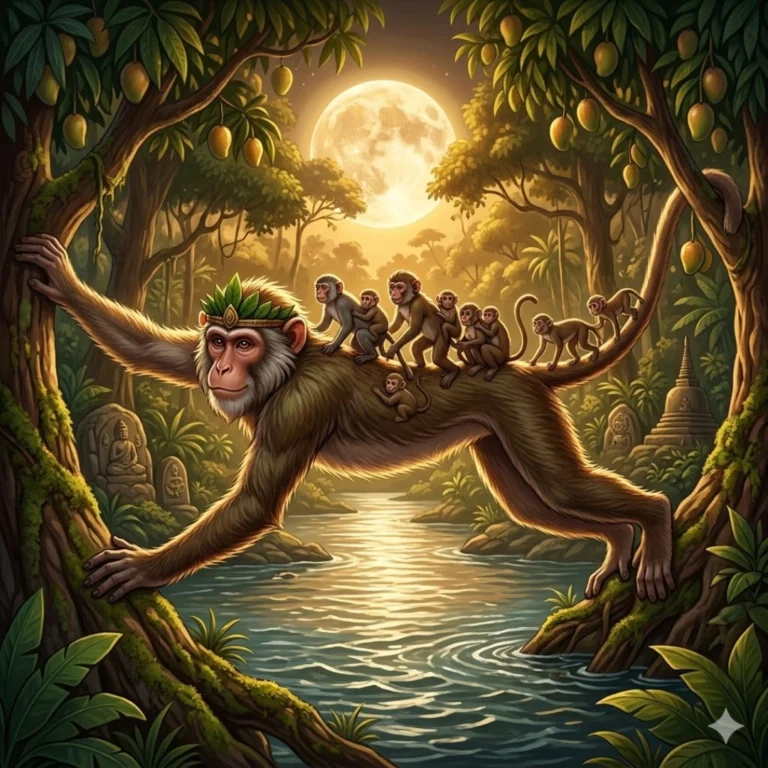
A king of monkeys uses his own body as a bridge so his subjects can escape—the oldest story of leading by serving.
High in a great mango tree above a river in ancient India, there lived a troop of eighty thousand monkeys. Their king was the largest and wisest among them, and he loved his subjects as a father loves his children.
The tree hung out over the river, and the monkeys feasted on its sweet fruit. Every year the King reminded them: “Pick all the fruit before it falls into the river. If the humans downstream taste it, they will come for us.”
One year, a single mango was missed—hidden under a leaf. It fell into the river and floated downstream, where the Raja of Varanasi plucked it from the water. He had never tasted anything so sweet.
“Find where this fruit comes from,” he commanded his soldiers.
The soldiers found the tree. They surrounded it at night with bows drawn, ready to capture the monkeys at dawn.
The Monkey King saw the soldiers. There was no escape—except the far riverbank, too far to jump.
He thought quickly.
He climbed to the tallest branch, tied a long vine to his waist, and stretched himself across the river. His front hands gripped the far shore’s branch. His body became a living bridge.
“Cross!” he called. “Every one of you—over my back, now!”
One by one, eighty thousand monkeys crossed over their king’s back to safety. The last to cross was a jealous monkey named Devadatta, who had always resented the king. He jumped on the king’s spine with both feet before crossing.
The king’s back broke. He fell, barely catching a branch, hanging over the river in terrible pain.
The human king, who had watched all of this, was moved beyond words. He had his men lower the Monkey King gently to shore. He gave him water and shade.
“Why?” the Raja asked. “Why did you give yourself for them?”
“Because they are mine to care for,” said the Monkey King. “A king does not own his people. He serves them.”
He died there on the shore, and the Raja gave him a funeral worthy of a great king—because that is exactly what he was.
Moral of the Story
True leadership means serving others, even at great personal cost. The greatest among us are those who become a bridge for others to cross.
Learn These Words
- selflessness
- caring more about others than about yourself
- troop
- a group of monkeys (or soldiers)
- resent
- to feel bitterly angry or jealous about something
- spine
- the backbone
- funeral
- a ceremony held after someone dies
Test Your Understanding
1Why did the soldiers come to the mango tree?
2How did the Monkey King help his troop escape?
3Who hurt the Monkey King while crossing?
4What did the Monkey King say was a king’s true duty?
5What lesson does this story teach?
Frequently Asked Questions
What is The Monkey King’s Bridge story about?
The Monkey King’s Bridge is an ancient Indian tale about a wise monkey king who uses his own body as a bridge so his eighty thousand subjects can escape capture by human soldiers. It’s one of the oldest stories illustrating servant leadership—the idea that a true leader sacrifices personal comfort and safety for the well-being of those they lead.
Where does The Monkey King’s Bridge story originally come from?
The story originates from the Jataka Tales, a collection of ancient Indian fables traditionally associated with the past lives of the Buddha. Set near the river city of Varanasi, it has been retold across Buddhist and Hindu traditions for over two thousand years, making it one of the earliest recorded parables about selfless leadership.
Why did the soldiers come after the monkeys in the mango tree?
The Monkey King had warned his troop to pick every mango before any could fall into the river. One year, a single mango hidden under a leaf was missed. It floated downstream to the Raja of Varanasi, who tasted it and found it irresistibly sweet. He sent soldiers to find the tree and capture the monkeys living in it.
📚 Recommended Books
Handpicked for readers like you
As an Amazon Associate, we earn from qualifying purchases. These recommendations are personalized based on this story's themes and your reading history.
What lesson does The Monkey King’s Bridge teach children?
The story teaches children that true leadership means serving and protecting others, even at great personal cost. The Monkey King didn’t run or hide—he stretched his own body across the river so every monkey could cross to safety. It’s a powerful lesson about selflessness, courage, and putting the needs of your community before your own.
Is The Monkey King’s Bridge a good story for teaching kids about sacrifice and leadership?
Absolutely. It’s one of the most effective stories for young readers because the imagery is vivid and easy to understand—a king literally becoming a bridge for his people. Children grasp the metaphor naturally, making it an ideal bedtime or classroom story for introducing concepts like empathy, responsibility, and what it really means to lead by example.