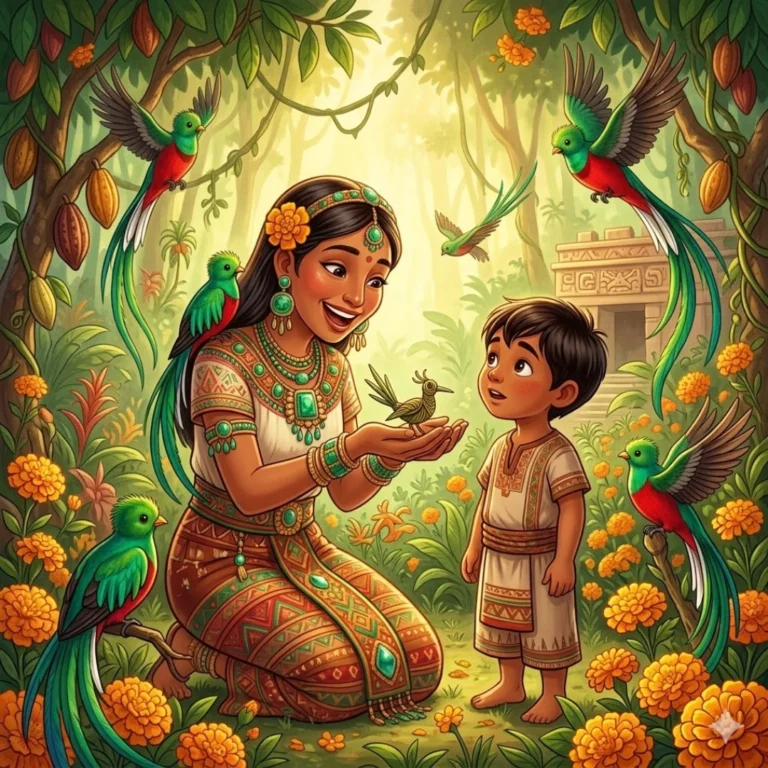
The goddess of art and flowers teaches a lonely boy that creativity is not a talent for the few—it is a gift planted in everyone.
In the great city of Tenochtitlan, there was a boy named Cualli who could not do what the other children did easily. He could not throw a spear straight. He could not run as fast. His teachers shook their heads and said he was slow.
But when Cualli sat alone, he made things.
He twisted grass into birds. He pressed flowers into flat stones to make pictures. He watched the weavers at the market for hours, memorising patterns.
One day he wandered to a garden he had never seen before—a garden full of quetzal birds, marigolds, cacao trees, and flowers he had no names for. And a woman was there, working.
She was Xochiquetzal, goddess of flowers and craft and art, though Cualli did not know this.
“What are you making?” she asked him.
He showed her a twisted grass bird. He was embarrassed. It was not a weapon or a jar or anything useful.
She held it gently. She turned it in her fingers. She made a small sound of genuine pleasure.
“Do you know what this is?” she asked.
He shook his head.
“It is a thought that lived only in your mind—made real so others can see it. That is the most powerful thing a human can do.”
She led him through her garden and showed him how the marigold’s colour had become the dye on the priests’ robes. How the pattern of a butterfly’s wing had become the temple mosaic. How the sound of the river had been caught by a potter and fixed in clay.
“Everything beautiful in your city came from someone like you,” she said. “Someone who made a thing instead of asking permission.”
Cualli walked home slowly, looking at everything differently.
He did not become a warrior. He became the man who designed the greatest market mural in the city’s history. People stood in front of it and felt, without knowing why, more alive.
That was Xochiquetzal’s gift, distributed through his hands.
Moral of the Story
Creativity is not a special talent for a chosen few. It is the act of taking what lives inside you and making it real for others. That act is sacred.
Learn These Words
- quetzal
- a brilliantly coloured bird from Central America, considered sacred by the Maya and Aztecs
- mosaic
- a picture made from small pieces of coloured tile or stone
- marigold
- a bright orange or yellow flower
- mural
- a large painting done directly on a wall
- distributed
- spread out or given to many people
Test Your Understanding
1What did Cualli make when he was alone?
2Who did Cualli meet in the mysterious garden?
3What did Xochiquetzal say Cualli’s grass bird was?
4What did Cualli become?
5What lesson does this story teach?
Frequently Asked Questions
Who is Xochiquetzal in Aztec mythology?
Xochiquetzal is the Aztec goddess of flowers, art, craft, and beauty. In this retelling, she appears in a hidden garden in Tenochtitlan and encourages a lonely boy named Cualli, teaching him that his creative gifts—making grass birds and flower pictures—are just as valuable as athletic or practical skills.
What is the moral of Xochiquetzal’s Garden?
The story’s central lesson is that creativity is not a rare talent reserved for a few special people—it is a gift planted in everyone. It encourages children to value their unique abilities, even when those abilities don’t match what others consider impressive or useful, and to see art-making as worthy and meaningful.
What age group is this story about Xochiquetzal suitable for?
This story is ideal for children roughly ages 5 to 10. Its gentle language, relatable main character, and clear moral message make it accessible for younger listeners during read-alouds, while the Aztec cultural setting and themes of self-worth give older children something deeper to discuss and reflect on.
📚 Recommended Books
Handpicked for readers like you
As an Amazon Associate, we earn from qualifying purchases. These recommendations are personalized based on this story's themes and your reading history.
Who is Cualli and why does he feel like an outsider?
Cualli is a young boy living in Tenochtitlan who struggles with the things other children do easily—throwing spears and running fast. His teachers call him slow. However, when he is alone he creates beautiful things from grass and flowers, revealing a quiet artistic talent that others overlook until the goddess Xochiquetzal notices.
How can I use this story to teach kids about Aztec culture?
The story naturally introduces Aztec elements like the city of Tenochtitlan, marigolds, cacao trees, quetzal birds, and market weavers. Parents and teachers can use these details as jumping-off points to explore Aztec daily life, the importance of art and craft in Mesoamerican society, and the rich mythology surrounding gods like Xochiquetzal.