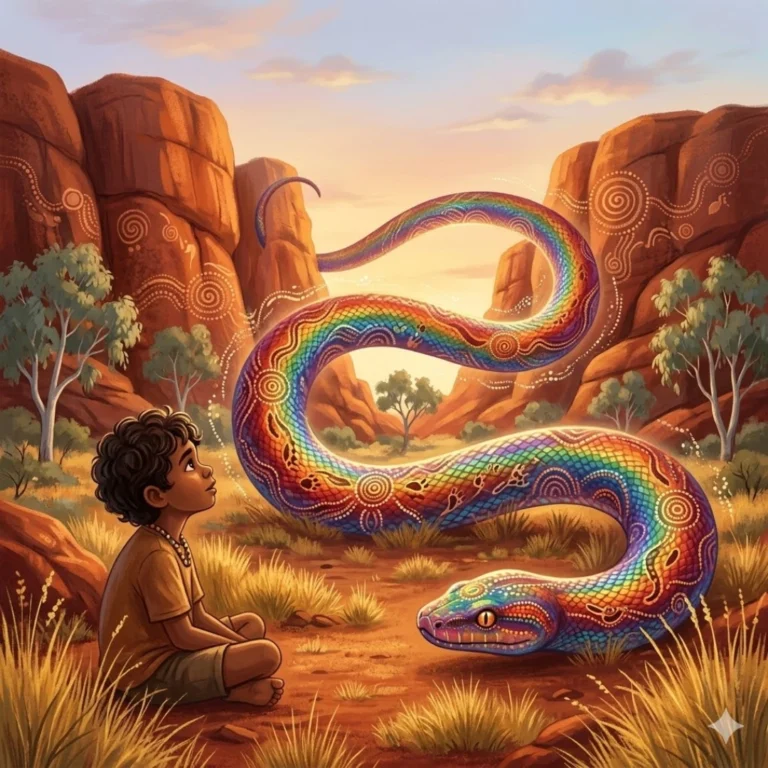
The sun was still a low, burning ember on the horizon when Yara slipped away from camp.
She was nine years old, with dust on her bare feet and a heart too impatient for the slow morning songs her grandmother always sang to the day. The red desert spread out before her like a sleeping giant — vast ochre plains stitched with silver spinifex grass, dotted with ghost gum trees whose white trunks glowed like bones in the early light. It was beautiful, Yara supposed, the way a thing you have always seen can be beautiful without really being seen at all.
She was heading for the billabong.
The billabong sat in a shallow hollow a mile from camp, fed by an underground spring that her grandmother called “the land’s own heartbeat.” Sacred water lilies floated on its surface, and in the shallows, little silver fish flicked like broken sunlight. Yara’s grandmother, Nana Birri, had told her many times: the billabong is alive. You take from it carefully. You say thank you. You never take more than you need.
But Yara had decided, this morning, to catch as many fish as she possibly could.
She was tired of being careful. She was tired of doing things slowly. At school, she learned about the world in quick flashes — screens and facts and speed. Why did everything here have to be so slow? Why did she have to whisper a thank-you to a waterhole?
She crouched at the billabong’s edge and began to splash, driving the little fish toward the shallows. She caught three, then four, more than she could ever eat. She tossed them onto the bank. She grabbed a long stick and dragged it through the lilies, tearing loose their roots, scattering the frogs that had been sleeping beneath the broad green pads.
“Shoo!” she said to a jabiru bird that watched her from the far bank with one dark eye. “Go on! This is my billabong too.”
The jabiru did not move.
Then the water changed.
It did not ripple or splash. It simply deepened in colour — from muddy brown to deep green to a blue so dark it was almost purple — and the silver fish vanished, and the lilies stilled, and the whole morning went very, very quiet.
A voice came from everywhere and nowhere at once, the way thunder comes before you know to listen for it.
“Is it yours, little one?”
Yara spun around. Standing — no, not quite standing, more like being — at the far edge of the billabong was a presence that made her breath stop entirely. It was like a serpent, enormous and ancient, its scales shimmering with every colour she had ever seen and several she had not: colours that had no names, colours that felt like music. It moved without moving. Its eyes were twin moons, patient and very old.
Yara sat down hard in the mud.
“I — I didn’t mean —” she started.
“You said this billabong is yours,” the voice said again, gentle as wind through mulga branches. “I am curious. How did it come to belong to you?”
Yara swallowed. Her grandmother had told her about the Rainbow Serpent. She had heard the stories since she was small enough to sit in Nana Birri’s lap. The Serpent had moved across the land in the great Dreamtime, when the world was still soft and unformed, carving riverbeds with its body, pushing up mountains with its coils, calling water up from the deep earth wherever it rested. The land still bore those marks. Every river, every waterhole, every valley was a memory of that ancient movement.
“I live here,” Yara said at last. “My family has always lived here.”
“Yes,” said the Serpent. “And before your family? And before them?”
Yara looked at the torn lily pads floating sadly on the surface of the water. The fish she had caught lay still on the bank. The frogs were gone. The jabiru had flown away.
“I made a mess,” she said quietly.
“You took without asking,” the Serpent said. “Do you know what asking sounds like?”
Yara thought of her grandmother’s morning songs — the low, melodic words Nana Birri murmured before she gathered anything, before she drew water, before she even lit the morning fire. Yara had always thought it was just something old people did. A habit. Like how old people talked to plants.
“It sounds like Nana Birri’s songs,” Yara said slowly.
“It sounds like remembering,” the Serpent said. “Remembering that you did not make this water. You did not make the fish. You did not make the lilies or the frogs or the bird that watches from the bank. You arrived here. You were welcomed. There is a difference between a guest and an owner.”
The colours along the Serpent’s great body shifted — a wave of deep green like spinifex after rain, then gold like afternoon light on sandstone, then the precise brilliant red of the desert floor at dusk. Yara found herself thinking that she had looked at this land every single day of her life and never truly seen any of these colours before. Not really.
“My grandmother says the land is alive,” Yara said. “I always thought that was — I thought it was just a way of talking.”
The Serpent was quiet for a moment. When it spoke again, the voice was softer, like water moving over smooth stones.
“Come. I will show you something.”
Yara did not remember standing up, but she found herself walking alongside the edge of the billabong, and the Serpent was there beside her — somehow both massive and close, the way a mountain can feel close even from a distance. The morning air tasted of dust and eucalyptus and something older, something that had no name.
“Look at the water,” the Serpent said.
Yara looked. The surface had stilled completely, and in its dark mirror she saw — the sky. The whole enormous sky, with the last stars of morning fading at its edges. And then she saw, in that reflected sky, a shape she recognised from the nights her grandmother had shown her: the dark shape of the Emu, not made of bright stars the way she had learned in school, but made of the darkness between the stars — a vast shadow-creature swimming through the light of the Milky Way.
“The sky and the land are the same story,” the Serpent said. “The Emu walks in the sky and nests in the earth. The water connects them. Every living thing is one thread in that story. When you tore the lily roots, the frogs lost their shelter. When the frogs go, the insects multiply. When the insects multiply, the birds cannot rest. When the birds cannot rest —” the Serpent paused. “Can you finish the thread?”
“Everything changes,” Yara whispered.
“Everything is connected,” the Serpent agreed. “This is not a story I invented. It is simply the way things are. Your grandmother’s songs remember this. Your ancestors walked the songlines precisely so that this remembering would never be lost. Every footstep on this land is a note in that song. You can walk it with care, or you can drag your stick through the water. But the song does not forget.”
Yara looked at the fish on the bank. Her chest felt tight with something that wasn’t quite sadness and wasn’t quite shame, but was made of both.
“Can I fix it?” she asked.
“Some things you can return,” the Serpent said. “Others you must simply do differently from now on. Both matter.”
Yara went back to the bank. She knelt in the mud and very carefully lifted each fish, still living, and slipped them back into the water. She gathered the torn lily pads and pressed their roots gently back into the silt, the way she had seen her grandmother replant desert seedlings after a storm. It was slow work. Her knees were muddy and her hands were cold from the water. But with each careful motion, she felt something loosening in her chest.
“Nana Birri will wonder where I went,” she said at last.
“Your grandmother has always known exactly where you are,” the Serpent said, and there was something warm in that ancient voice — something that might, in a human voice, have been called amusement. “She is not worried. She is waiting.”
Yara stood. The sun had climbed higher now, and the desert was coming into its full brilliant self — the red earth burning warm, the ghost gums shimmering, a wedge-tailed eagle turning slow circles in the enormous blue sky. She had looked at this country every day of her life. This morning, for the first time, she looked back at it the way it had always been looking at her.
“Thank you,” she said — and she was not sure if she was speaking to the Serpent, or to the billabong, or to the morning itself. Perhaps all three. Perhaps they were the same.
When she turned back, the Serpent was gone. The water was calm and brown and full of lilies. A single jabiru stood on the far bank, watching her with one patient dark eye.
She walked home through the spinifex, and this time she felt the land beneath her feet — not as ground to be crossed, but as something that held her up, something that had always held her up, something that asked only to be remembered in return.
Nana Birri was sitting by the morning fire, singing softly. She looked up when Yara approached, and her eyes held the particular warmth of someone who has already understood everything without being told.
“You went to the billabong,” Nana Birri said.
“Yes,” said Yara. She sat beside her grandmother. The fire crackled warmly. The desert morning stretched around them, vast and alive and ancient. “Nana, will you teach me the song? The morning one. The one you always sing.”
Her grandmother smiled — a slow, deep smile, like water rising in a spring.
“I have been waiting,” Nana Birri said, “since the day you were born.”
And she began to sing, and this time, Yara listened.
The Moral of This Story
Treat the land and all living things with respect, for we are all connected
About This Story’s Culture
This story draws on several authentic elements of Australian Aboriginal culture, including the Rainbow Serpent (known by different names across different nations, including Ngalyod and Yurlunggur), who is a widely recognised creator figure central to Dreamtime narratives across many Aboriginal traditions. The Emu in the Sky is a genuine example of Aboriginal astronomy — a dark constellation formed by the dust lanes of the Milky Way rather than by bright stars. Songlines, the practice of speaking or singing to Country before taking from it, and the concept of land as a living relative (not property) are foundational to many Aboriginal peoples’ relationships with their Country. This story has been written with deep respect for these traditions, presenting them as living wisdom rather than folklore, and deliberately avoids stereotyping or flattening the rich diversity of the hundreds of distinct Aboriginal nations across Australia.
Key Story Elements
- Rainbow Serpent (Ngalyod) as the ancient creator and wisdom presence from the Dreamtime
- Billabong as a sacred, living waterhole central to Country and ecological connection
- Songlines and morning songs as the living transmission of law and remembrance
- The dark constellation Emu in the Sky – authentic Aboriginal astronomy tradition
- Interconnectedness of all living things through a tangible cause-and-effect revelation
- Elder grandmother (Nana Birri) as the patient keeper of cultural knowledge
- Yara’s journey from impatience and taking for granted to deep respectful seeing
Frequently Asked Questions
What is The Rainbow Serpent’s Lesson about?
The Rainbow Serpent’s Lesson is an Aboriginal story for kids aged 6-12 about a young girl named Yara who sneaks away to a sacred billabong and learns an important lesson about respect and honor — for nature, elders, and the traditions that connect us to the land.
What age group is The Rainbow Serpent’s Lesson suitable for?
This story is written for children aged 6 to 12 and takes about 8 to 10 minutes to read. The themes of respect and listening to elders make it a great read-aloud choice for parents, teachers, and caregivers looking for meaningful stories rooted in Aboriginal tradition.
What does the Rainbow Serpent represent in Aboriginal culture?
In Aboriginal tradition, the Rainbow Serpent is one of the most powerful and widely known spiritual beings. It is often associated with water, creation, and the land’s life force. The serpent is deeply respected and considered a guardian of sacred places like rivers, billabongs, and waterholes.
📚 Recommended Books
Handpicked for readers like you
As an Amazon Associate, we earn from qualifying purchases. These recommendations are personalized based on this story's themes and your reading history.
What lesson does this story teach children about respect?
The story shows children that respect means listening to the wisdom of elders, honoring sacred places, and slowing down to truly see the world around you. Through Yara’s journey to the billabong, kids learn that real respect is shown through our actions, not just our words.
Is The Rainbow Serpent’s Lesson based on a real Aboriginal story?
The story draws inspiration from Aboriginal Australian oral traditions and the widespread cultural significance of the Rainbow Serpent across many Aboriginal groups. While this version is a retelling crafted for young readers, it is rooted in genuine cultural themes of respect for country, sacred water, and ancestral wisdom.