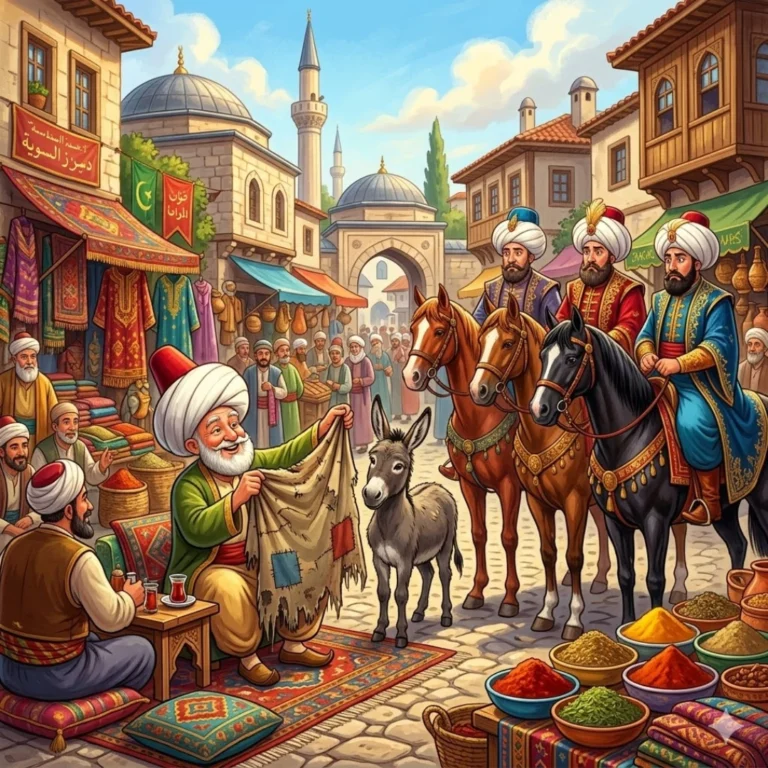
Now, the curious thing about the town of Aksehir was that it was entirely full of impossible questions, which is either a very good thing or a very bad thing, depending on whether you live there.
The market had a question hanging over every stall. The baker’s boy had a question for you before he’d give you your bread. The cats on the rooftops were almost certainly asking each other questions, though nobody had managed to overhear one yet. And at the very centre of all this questioning sat Nasreddin Hodja, on a wooden bench outside the teahouse, wearing his large turban at a slightly sideways angle, drinking tea and looking extremely pleased with things in general.
Nasreddin Hodja was not the youngest man in Aksehir, nor the tallest, nor the one with the most impressive moustache (that honour went to the blacksmith, whose moustache could have sheltered a family of sparrows). But he was, without any doubt, the wisest. And the funniest. These two things, he had discovered, were not as different as people usually supposed.
One spring morning, when the apricot trees were doing their best to make the whole world smell of honey and flowers, three very important men rode into Aksehir on three very important horses. They wore very important robes and had very important expressions – the kind of expressions that say: I have not smiled since Tuesday and do not plan to start.
“We have come,” announced the first very important man, “to ask the famous Hodja a question that no one has ever answered. We have asked it in seven cities, and the wisest men in every city have failed.”
“How delightful,” said Hodja, pouring himself more tea. “Would you like some tea while you fail to stump me? It is very good tea.”
The important men did not want tea. They had come for something far more important than tea. (A mistake, if you ask me, but nobody asked.)
The second important man stepped forward and said, in the voice of someone who has rehearsed this speech many times: “Here is the question. If you can answer it correctly, we will declare you the wisest man in the land. If you cannot, you must admit that your reputation is entirely made up.”
“Marvellous,” said Hodja. “Ask away.”
The three men leaned together and whispered for a moment. Then the third man, the most important-looking of all, cleared his throat so loudly that a dog barked two streets away, and said:
“Hodja. How many stars are there in the sky?”
The market went quiet. Even the cats on the rooftops seemed to lean in to listen.
Hodja was quiet for a long time. He appeared to be thinking very deeply. He stroked his beard. He tilted his head. He looked up at the sky, which was, at that moment, bright blue and entirely star-free, which was possibly not helpful.
Then he reached into his robe and produced a very large, very old, very thoroughly worn-out donkey blanket.
“As many,” he said serenely, “as there are hairs on this blanket.”
The important men sputtered. “That’s not – you can’t – how do we verify that?”
“Count them,” said Hodja pleasantly. “Both. Then compare. If I am wrong, I will buy you all excellent tea. If I am right, you owe me tea, and also an apology to the blanket, which I have had since I was seven years old and who does not deserve this sort of nonsense.”
The important men looked at the blanket. They looked at the sky. They looked at each other.
“That is not a real answer,” said the first man.
“It is exactly as real as the question,” said Hodja.
Another silence. The apricot blossoms drifted down like slow snow.
“Then here is a simpler question,” said the second man, who had decided to be annoyed. “How many hairs are on your donkey’s tail?”
“Ah,” said Hodja. “Now THAT is a fine question. I know precisely.” He leaned forward. “As many as there are hairs in your beard. Pull out your beard one hair at a time and count them, then pull my donkey’s tail one hair at a time and count those, and you will find the number matches exactly. And if it doesn’t, one of us will need to buy more hairs, and I think we can agree that would be very embarrassing.”
The important men stared at him.
A small child at the edge of the market – a girl called Fatma, who sold figs with her grandmother – had been listening with great attention. She laughed. It was not a polite, small laugh. It was the kind of laugh that rolls out of you before you can stop it.
The first important man said, stiffly: “These are nonsense answers.”
“Yes,” agreed Hodja cheerfully. “They are nonsense answers to nonsense questions. You asked me things that cannot be counted and cannot be answered with any meaning. So I answered them in the only way they deserve – completely correctly, and completely useless. This is called proportion.”
He refilled his tea.
“Now,” he said, “if you would like to ask me something real – why the well on the east side of town runs dry in summer, or why the miller’s son has been unhappy since February, or whether the apricot harvest will be good this year – I will answer those with all the seriousness they deserve. These are answerable questions, and answerable questions are worth answering. The other kind are only worth returning to the person who asked them.”
The third important man, who was, in truth, the least important of the three because he had been listening most carefully, sat down on a bench. “That is,” he said slowly, “actually very sensible.”
“It usually is, eventually,” said Hodja.
“But we’ve been asking that question for years. Dozens of scholars have tried to answer it and failed.”
“Well,” said Hodja, “and have any of those scholars been happy?”
A long pause.
“Not particularly,” admitted the third man.
“That is because they were trying to answer an unanswerable question instead of all the answerable ones that were waiting for them. This is the great mistake of clever people who have not yet become wise. They become very good at hard things and forget to do the easy ones first.” He looked at the man with kind, steady eyes. “What question is actually troubling you? The one beneath the silly question?”
Another pause. Longer this time.
“I…” The third man stopped. He pulled at a loose thread on his very important robe. “I don’t know if I am making the right choices. I have a great deal of power, and I don’t know if I am using it well.”
“Now THAT,” said Hodja, sitting up and setting down his tea with the expression of someone who has been waiting all morning for something interesting, “is a magnificent question. Sit down. Have some tea. This is going to take a while, and it is going to be completely worth it.”
Fatma the fig-seller leaned over and whispered to her grandmother: “Did he answer the question?”
“No,” said her grandmother. “He answered the question that mattered. That is much better.”
The apricot blossoms kept drifting down. The cats went back to their own business. And in the middle of the market of Aksehir, over several more cups of very good tea, a very important man began to become a somewhat wiser one.
Which is, when you think about it, how most wisdom actually starts.
The Moral of This Story
True wisdom means knowing which questions matter and which don’t
About This Story’s Culture
Nasreddin Hodja (also spelled Nasruddin) is one of the most beloved figures in Turkish and broader Middle Eastern/Central Asian folk tradition, appearing in thousands of stories across Turkey, Iran, Afghanistan, and the Arab world. A 13th-century historical figure from Aksehir, Turkey, he became a legendary trickster-sage whose seemingly foolish answers always contained deep wisdom. His stories have been told for 800 years across many cultures. This story draws on the authentic tradition of Hodja stories where pompous authorities are gently deflated by his practical wisdom. Aksehir hosts an annual Nasreddin Hodja festival, and his tomb there is a heritage site.
Key Story Elements
- Nasreddin Hodja – the beloved Turkish folk trickster-sage on his bench at the teahouse
- Three pompous important men seeking to embarrass the Hodja with unanswerable riddles
- The old donkey blanket used as a nonsense answer to a nonsense question
- Carroll-style whimsical logic where absurd questions get perfectly absurd answers
- The deeper question beneath the silly question – a statesman’s real crisis of conscience
- Fatma the fig-seller and her grandmother as observers representing ordinary wisdom
- The moral: distinguishing questions worth answering from questions worth returning
Frequently Asked Questions
Who is Nasreddin Hodja in this story?
Nasreddin Hodja is a famous figure from Turkish folklore known for his wit and wisdom. In this story, he’s the wisest man in the town of Aksehir — a clever, tea-drinking thinker who loves a good question and almost always has an even better answer.
What is The Hodja and the Impossible Question about?
The Hodja and the Impossible Question is a Turkish wisdom story about Nasreddin Hodja facing a question nobody is supposed to be able to answer. It explores cleverness, quick thinking, and how true wisdom often means finding unexpected solutions to problems that seem unsolvable.
What age group is this story suitable for?
This story is written for children aged 6 to 12. It takes around 8 to 10 minutes to read aloud, making it a great bedtime or classroom story. The humour and clever wordplay work well for both younger listeners and older independent readers.
📚 Recommended Books
Handpicked for readers like you
As an Amazon Associate, we earn from qualifying purchases. These recommendations are personalized based on this story's themes and your reading history.
What lesson does The Hodja and the Impossible Question teach kids?
The story teaches children that wisdom isn’t about knowing everything — it’s about thinking creatively when faced with a challenge. It encourages kids to stay calm under pressure, use humour thoughtfully, and understand that clever thinking can turn a seemingly impossible situation around.
Is Nasreddin Hodja a real historical person?
Nasreddin Hodja is believed to have been a real person who lived in 13th-century Turkey, though many details are legendary. Over centuries, he became a beloved folk hero across Turkish, Middle Eastern, and Central Asian cultures, famous for witty tales that blend humour with wisdom.