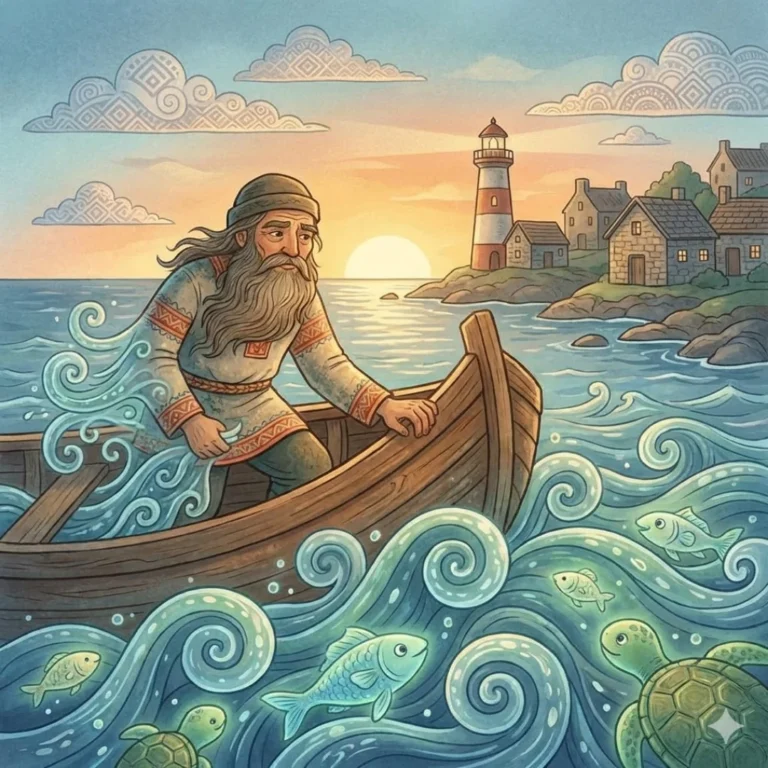
Share this engaging bedtime story with kids ages 6-12 to teach valuable life lessons.
The Fisherman Who Became the Sea
On a rocky shore where the Mediterranean waves crashed against ancient stones, there lived a simple fisherman named Glaucus. He was known throughout his village for his skill with the rod and line, always returning home with a basket full of silver fish that gleamed like treasure.
Glaucus loved his work. He loved the way the early morning mist rose from the water like ghosts dancing. He loved the smell of salt and seaweed. He loved the splash and pull of fish fighting against his line. Most of all, he loved the peace that came from sitting quietly, watching the endless blue horizon where sea met sky.
One particular morning, Glaucus rowed his small boat to a new fishing spot—a hidden cove he’d never explored before. The water was so clear here that he could see straight to the bottom, where colorful fish darted between rocks covered in waving green plants.
“What a perfect place!” Glaucus exclaimed, dropping his line.
Within minutes, fish after fish bit his hook. His basket filled quickly with flopping silver bodies, more fish than he’d ever caught in a single morning.
“This is amazing!” he laughed, pulling his boat onto the shore to rest and count his catch.
He emptied his basket onto the grass that grew right up to the water’s edge. The fish lay there, gulping and gasping, their scales catching the sunlight like tiny mirrors.
But then something strange happened.
One fish, lying on the thick grass, began to nibble at the green blades. As soon as it swallowed, the fish’s body shuddered and twitched. Then, with a mighty flip, it leaped through the air and splashed back into the sea, swimming away as if it had never been caught at all!
“What?” Glaucus rubbed his eyes. “That’s impossible!”
But another fish did the same thing. Nibble, shudder, leap, splash, swim away. Then another. And another. Within moments, half his catch had escaped back into the water.
“The grass,” Glaucus whispered, staring at the thick green carpet beneath him. “There’s something magical about this grass!”
His curiosity burned like fire in his chest. Glaucus was a simple man, but he’d always wondered about the mysteries of the world. Now here was a real mystery, right under his feet.
Slowly, carefully, he plucked a few blades of the magical grass and held them up to the sunlight. They looked ordinary—just green grass, slightly thicker than normal, with tiny drops of seawater clinging to them.
“If it gave the fish such power,” Glaucus thought, “what would it do to me?”
A wiser man might have stopped to think. A more cautious man might have run away. But Glaucus, curious and brave, placed the grass blades on his tongue and chewed.
The taste was strange—salty and sweet at once, like drinking the sea mixed with wildflower honey. It tingled on his tongue, then burned slightly, then turned cool as mountain water.
Glaucus swallowed.
For a moment, nothing happened. The waves kept crashing. The gulls kept crying overhead. The sun kept shining.
Then—
An irresistible pull seized Glaucus, as if an invisible rope tied around his chest was yanking him forward. His feet moved without his permission. He stumbled toward the water, trying to stop himself but unable to resist.
“What’s happening?” he cried out, but his voice was already changing, becoming deeper, more resonant, like the boom of waves in a cave.
He plunged into the sea.
But instead of drowning, Glaucus felt himself transform. His legs fused together, becoming a powerful tail. His skin turned rough and took on the color of the deep ocean—blue-green and gray, with patches where mussels and barnacles and seaweed began to grow. His hair grew long and wild, floating around his face like kelp in the current.
He had become a sea-god.
Glaucus didn’t need to breathe air anymore. He could dive to the deepest trenches where the water was black and cold, where strange creatures with glowing eyes floated in the darkness. He could swim faster than dolphins, ride the currents, speak to whales, and understand the language of the tides.
At first, he was amazed and delighted by his transformation.
“I can explore the entire ocean!” he thought, swimming through underwater forests of kelp and grottos of coral more beautiful than any garden on land.
But as the years passed—and then the decades, and then the centuries—Glaucus discovered something terrible: he could never go home. He could never return to his village, never see his family or friends again. He would live forever as a sea-god, wandering the coasts and islands for all eternity.
Like many sea-gods, Glaucus found he could see the future. Visions would come to him in the patterns of the waves, in the migration of fish, in the way the currents flowed. He saw storms before they came, droughts before they parched the land, and misfortunes before they struck.
Each year, compelled by his divine nature, Glaucus would rise from the depths and visit the islands and shores he had once called home. He would appear floating on the waves, his body covered with shells and seaweed, his long beard tangled with mussels, his ancient eyes sad with knowledge.
“Fishermen!” he would call out in his booming voice. “I have seen what is to come! Storms approach! Prepare your boats!”
But instead of thanking him, the fishermen were terrified. They saw only a strange sea-creature, neither fully human nor fully monster, who brought warnings of disaster.
“It’s Glaucus!” they would shout. “The cursed sea-god! He brings only bad news!”
They would pray and fast, trying to avoid the misfortunes he foretold. But they never welcomed him, never thanked him for his warnings, never remembered that he had once been one of them—just a simple fisherman who had been too curious for his own good.
And so Glaucus wandered the seas alone, forever, bitterly regretting the moment he had tasted that magical grass. He had gained power and knowledge and immortality, but he had lost everything that mattered—his home, his humanity, his peaceful life of simple joys.
Sometimes, on quiet evenings when the sea is calm, sailors report seeing a strange figure floating on the waves—a man covered in seaweed and shells, with long flowing hair and a sad, ancient face. He sings a mournful song about the dangers of curiosity, about magic that costs too much, about transformations that cannot be undone.
If you ever find yourself near a magical place, where fish leap back into the water and grass glows with strange power, remember Glaucus. Remember that some mysteries are better left alone. Remember that the life you have, simple though it may be, is often more precious than all the magic and power in the world.
For Glaucus would give anything—all his divine powers, all his immortality, all his knowledge of the future—just to be a simple fisherman again, sitting in his small boat, watching the sunrise over the peaceful sea.
Frequently Asked Questions
What is the moral lesson of The Fisherman Who Became the Sea?
What age is this story appropriate for?
How long does it take to read The Fisherman Who Became the Sea?
What culture does this story come from?
Can I use this story for teaching?
Frequently Asked Questions
What is The Fisherman Who Became the Sea story about?
The Fisherman Who Became the Sea is a bedtime story for kids ages 6-12 about Glaucus, a skilled Mediterranean fisherman who discovers a magical hidden cove. The story explores themes of contentment, transformation, and the relationship between humans and nature, teaching children valuable life lessons through an engaging mythical adventure.
What age group is The Fisherman Who Became the Sea suitable for?
This story is designed for children between 6 and 12 years old. It works wonderfully as a bedtime story, combining exciting storytelling with meaningful moral lessons that kids in this age range can easily understand and relate to.
What life lessons does this fisherman story teach kids?
The story teaches children important values like appreciating simple joys, finding peace in nature, and understanding the consequences of wanting more than you need. Through Glaucus the fisherman’s journey, kids learn about gratitude, transformation, and staying true to who you are.
📚 Recommended Books
Handpicked for readers like you
As an Amazon Associate, we earn from qualifying purchases. These recommendations are personalized based on this story's themes and your reading history.
Is this story based on Greek mythology?
Yes, the story draws inspiration from Greek mythology. Glaucus is a figure from ancient Greek myths, originally a fisherman who transformed into a sea god. This retelling brings that classic mythological tale to life in a child-friendly, accessible way set along the Mediterranean coast.
How long does it take to read this bedtime story aloud?
The Fisherman Who Became the Sea is a typical short bedtime story, designed to be read aloud in roughly 10 to 15 minutes. It’s the perfect length to keep children engaged without running too long, making it an ideal part of a nightly bedtime routine.