

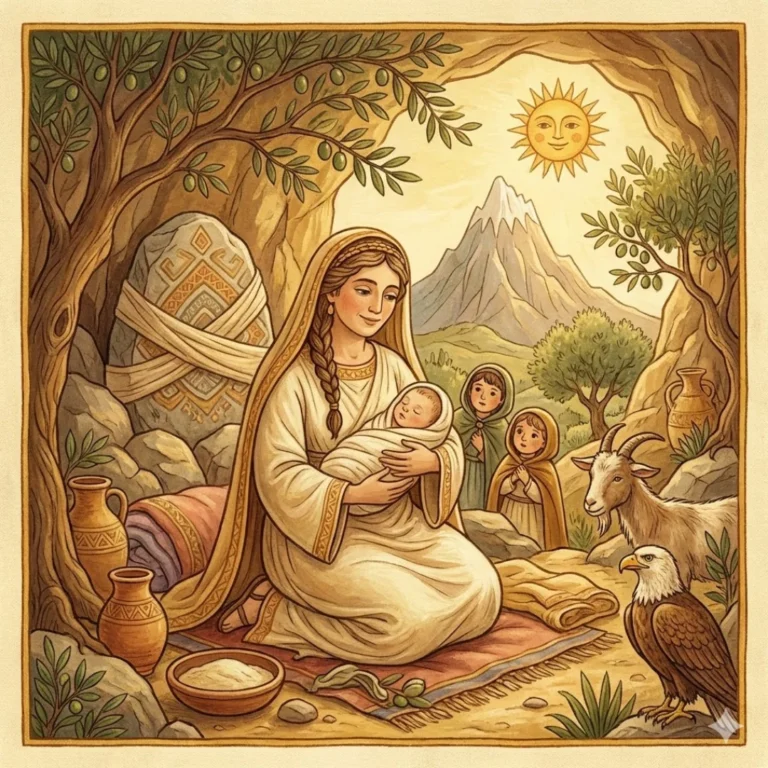
This moral story for children ages 6-12 combines entertainment with important values.
In the ancient days before the gods of Mount Olympus ruled the world, powerful beings called Titans reigned over heaven and earth. The mightiest of these Titans was Cronos, king of time itself, who sat upon a throne of stone at the peak of Mount Othrys.
Beside him sat his wife Rhea, the Great Mother. While Cronos ruled with fear and strength, Rhea’s heart overflowed with love and warmth.
But a terrible prophecy haunted Cronos. An oracle had told him that one day, one of his own children would overthrow him, just as he had overthrown his own father.
“I will not let it happen,” Cronos muttered, his eyes dark with worry.
When Rhea gave birth to their first child, a beautiful daughter named Hestia, she held the baby close, feeling joy unlike anything she’d ever known. The infant’s tiny fingers curled around her mother’s thumb.
“She’s perfect,” Rhea whispered.
But Cronos strode into the room, his face grim. “Give her to me.”
“What? No!” Rhea clutched her baby tighter.
“The prophecy, wife. It must not come true.”
Before Rhea could stop him, Cronos took the baby and—in one terrible moment—swallowed her whole.
Rhea screamed in anguish, falling to her knees. But Hestia was gone, alive but trapped inside her father’s body.
One by one, Rhea gave birth to more children. Beautiful Demeter, proud Hera, mighty Hades, powerful Poseidon. Each time, Rhea’s heart filled with love. Each time, she begged Cronos to spare them. And each time, Cronos swallowed the child.
After losing five children, Rhea could barely breathe for the grief that crushed her heart. At night, she dreamed of her children crying for her from the darkness.
Then she realized she was pregnant again.
“No,” Rhea whispered, placing her hands on her belly. “Not this one. This child I will save. I swear it.”
In the dead of night, Rhea fled the palace and traveled far to the south, to where her mother Gaia, the ancient Earth herself, dwelt.
“Mother,” Rhea sobbed. “Help me save this child. I cannot lose another.”
Gaia held her daughter close, feeling the baby move in Rhea’s womb. “This child is special. This is the one from the prophecy. He will be strong and just, and he will free his brothers and sisters. But first, we must keep him safe.”
“Tell me what to do,” Rhea said, her voice filled with desperate determination.
Together, they made a plan.
When the time came for the baby to be born, Gaia took Rhea to the island of Crete, to a hidden cave deep in the mountains. Moonlight streamed through the cave entrance, and the sound of waves echoed through the stone chambers.
There, in that secret place, Rhea gave birth to a boy. His cry was so powerful it sounded like thunder.
“Zeus,” she whispered, naming him. “You are Zeus, and you will be great.”
But she couldn’t keep him with her. Crying softly, she gave the baby to kind nymphs who lived in the cave. “Protect him. Raise him well. Keep him hidden until he’s strong enough to fulfill his destiny.”
The nymphs promised, and Rhea watched them carry her precious son deeper into the cave.
Then came the hardest part of the plan.
Gaia had brought a special stone—smooth and grey, about the size of a newborn baby. Rhea wrapped it carefully in soft white swaddling clothes, just as she would have wrapped Zeus. Her hands trembled as she worked.
“For my children,” she whispered to herself. “Be brave, Rhea.”
She returned to Mount Othrys, the stone bundle held carefully in her arms. Cronos met her at the palace entrance, his eyes immediately drawn to the bundle.
“Another child?” he asked coldly.
Rhea’s voice shook. “Yes. Another son. Here—take him quickly. I cannot bear to watch again.” She thrust the bundle toward him, turning her face away.
Cronos took the bundle. For one terrible moment, Rhea feared he would unwrap it and discover the deception. Her heart pounded.
But Cronos was too confident. Without even looking, he swallowed the bundle whole.
The stone went down. Cronos gasped, clutching his stomach. “That one felt… different. Heavier.”
“Perhaps because he would have grown to be the strongest,” Rhea said quietly.
She walked away before Cronos could see the spark of hope hidden in her eyes.
Years passed. In his cave on Crete, Zeus grew strong and wise. The nymphs fed him honey and goat’s milk. Young warriors called the Curetes clashed their shields and spears, making noise to hide Zeus’s cries. He learned to run through the mountains, to swim in the sea, to harness the power of lightning that crackled at his fingertips.
Meanwhile, Rhea waited patiently. She watched Cronos carefully, noting how his fear made him cruel. She kept her secret close to her heart like a precious gem.
When Zeus was finally grown into a strong young god, he came to his mother in disguise. Rhea’s eyes filled with tears of joy when she recognized him.
“My son,” she whispered, embracing him. “You’re ready.”
“Thanks to your courage, Mother,” Zeus said. “Now it’s time to free my brothers and sisters.”
Together, they prepared a special potion. At the feast that night, Rhea convinced Cronos to drink it. The potion worked immediately, making Cronos terribly ill. He vomited up everything he’d swallowed over the years.
First came the stone, which would later be placed at Delphi as a sacred marker. Then, one by one, came the children—Poseidon, Hades, Hera, Demeter, and Hestia, fully grown and grateful to be free.
“Mother?” Hestia whispered, seeing Rhea’s face. Though she had been swallowed as an infant, somehow she knew this woman who wept with joy.
“My children,” Rhea cried, gathering them all close. “You’re free. You’re finally free.”
Cronos stared in horror, realizing too late that the prophecy had come true. Zeus stepped forward, lightning crackling around his hands.
“Father,” Zeus said firmly, “your reign of fear is over. We will build a new world—one ruled by justice, not tyranny.”
The battle that followed was fierce, but Zeus and his siblings fought with the strength of those who had been wronged and the courage inherited from their mother. In the end, the Titans were defeated, and the Olympian gods took their place as rulers of the cosmos.
Before Zeus claimed his throne on Mount Olympus, he knelt before his mother. His siblings joined him, all six of them bowing to Rhea.
“We owe everything to you,” Zeus said, his voice thick with emotion. “Your love saved us. Your cleverness freed us. You defied fate itself.”
Rhea touched each of her children’s faces, hardly able to believe they were truly here, truly safe. “A mother’s love knows no bounds,” she said softly. “I would have crossed the earth, moved mountains, and changed the stars themselves to save you. That’s what mothers do.”
From that day forward, Rhea was honored as the Great Mother, protector of all children. Her story was told for thousands of years, teaching everyone who heard it that love is stronger than fear, that cleverness can overcome brute force, and that even the most powerful tyrant can be defeated by a mother’s determined heart.
And on the island of Crete, in that hidden cave where Zeus was born, people would visit for centuries afterward, leaving offerings of flowers and honey, grateful for the mother who dared to trick a king and change the world.
Frequently Asked Questions
What is the moral lesson of Rhea: The Mother Who Defied Fate?
What age is this story appropriate for?
How long does it take to read Rhea: The Mother Who Defied Fate?
What culture does this story come from?
Can I use this story for teaching?
Frequently Asked Questions
What is the story of Rhea the Mother Who Defied Fate about?
Rhea: The Mother Who Defied Fate is a children’s moral story retelling the Greek myth of Rhea, a Titan goddess who bravely outwits her husband Cronos to protect her children. It explores themes of love, courage, and a mother’s determination to defy a terrible prophecy.
What age group is this Rhea myth story suitable for?
This story is written for children aged 6 to 12. It combines entertaining storytelling with important values, making it a great read-aloud for younger kids and an independent read for older ones.
Who were the Titans in Greek mythology?
The Titans were powerful beings who ruled heaven and earth before the gods of Mount Olympus took over. Cronos was their mightiest king, ruling from Mount Othrys, and Rhea was his wife, known as the Great Mother for her loving and nurturing nature.
📚 Recommended Books
Handpicked for readers like you
As an Amazon Associate, we earn from qualifying purchases. These recommendations are personalized based on this story's themes and your reading history.
What moral lesson does this story teach children?
The story teaches children that love and courage can overcome fear and power. Rhea’s willingness to stand up against her husband to protect her children shows that doing what is right, even when it’s difficult, can change the course of fate.
Why did Cronos fear his own children in Greek mythology?
Cronos was haunted by a prophecy that one of his own children would overthrow him, just as he had overthrown his father. This fear drove him to desperate actions, setting up the central conflict of the story between his need for control and Rhea’s fierce maternal love.
