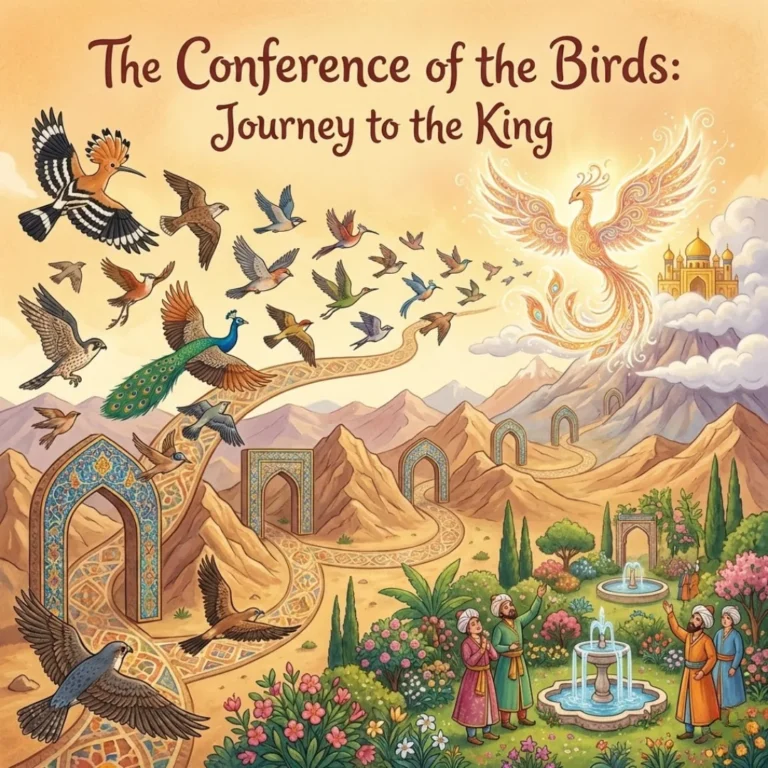
“We have no leader,” said the wise hoopoe, her crown of feathers catching the morning light. “Every other creature has a king, but we birds fly without direction.”
“I heard a legend,” whispered a dove. “They say there is a great king of all birds—the Simorgh—who lives beyond the mountains.”
The name rippled through the crowd like wind through grass. The Simorgh! The legendary king whose wisdom/” title=”More stories about wisdom”>wisdom could answer any question, whose presence could heal any wound.
“Then we must find this Simorgh!” declared a young falcon. “We must journey to our king!”
Thousands of birds lifted their voices in agreement. But the hoopoe raised one wing for silence.
“The journey will not be easy,” she warned. “We must cross seven valleys to reach the Simorgh. Many who start will not finish. Each valley will test you in ways you cannot imagine.”
The nightingale fluttered her wings. “What could be harder than what we already face? At least this journey has purpose.”
And so, when dawn broke the next morning, thousands of birds took flight together. The sky darkened with their wings. The air filled with their calls. They flew toward the distant mountains, toward their destiny, toward the king they had never seen.
The first valley appeared below them—the Valley of the Quest. Here, each bird had to truly decide: Why am I seeking the Simorgh?
“I want power,” thought the eagle, but as he flew deeper into the valley, his wings grew heavy. The desire for power weighed him down until he could not continue. He turned back, along with hundreds of others who sought the Simorgh for selfish reasons.
The hoopoe called out, “Only those who seek with pure hearts can pass through. Ask yourself: What do you truly need?”
Thousands became hundreds.
The second valley rose before them—the Valley of Love. Here, the heart became wild and foolish. Birds found themselves distracted by everything beautiful.
“Look at those flowers!” cried a parrot, diving toward a garden. “I must stay here forever!”
The nightingale saw a rose and forgot why she was flying. “My love, my rose,” she sang, circling lower and lower.
“Love is good,” the hoopoe called, “but love without wisdom is a cage. We must love the journey, not just the beautiful moments.”
Only those who understood flew onward. Hundreds became dozens.
The third valley stretched endlessly—the Valley of Understanding. Here, every bird saw the world differently. What looked like water to one appeared as fire to another. What seemed up was down. Nothing made sense.
“I’m going in circles!” shrieked a crow. “Nothing is real!”
Many birds flew in confusion until they were too exhausted to continue. But the young falcon realized something. “Maybe there are many ways to see the truth. Maybe my path doesn’t have to be exactly like yours.”
Those who could accept many truths flew on. Dozens became a handful.
The fourth valley appeared—the Valley of Detachment. Here, each bird had to let go of everything they thought they needed.
“But I love my beautiful feathers,” wept a peacock.
“But I need my sharp talons,” said an owl.
The hoopoe’s voice was gentle but firm. “The Simorgh doesn’t care about your feathers or talons. Those things are not who you are. They are only what you wear.”
One by one, birds learned to release their attachments. A handful became very few.
The fifth valley rose steeply—the Valley of Unity. Here, all the remaining birds began to see something strange. The falcon looked at the hoopoe and saw himself. The dove looked at the sparrow and recognized her own heart.
“We’re not so different,” the falcon said slowly. “Your struggles are my struggles. Your journey is my journey.”
“Yes,” said the hoopoe. “We are all one flock. Separate birds, but one shared spirit.”
The sixth valley challenged them most—the Valley of Astonishment and Bewilderment. Here, nothing could be explained. Beauty and terror walked together. Joy and sorrow sang the same song.
“I don’t understand,” said a small sparrow, her voice shaking. “Everything is confusing.”
“That’s because understanding is not enough,” replied the hoopoe. “Sometimes we must simply experience without needing to know why.”
Those who could embrace the mystery flew forward.
Finally, only thirty birds reached the seventh valley—the Valley of Poverty and Nothingness. Here, they had to release even themselves. Their names didn’t matter. Their accomplishments meant nothing. They were simply thirty birds, exhausted and stripped bare, flying toward a king they’d never met.
The mountain peak appeared through the clouds.
“There,” whispered the hoopoe. “The Simorgh’s palace.”
The thirty birds landed before a great door made of light. They tucked in their wings, humbled and small.
“Great Simorgh,” they called. “We have traveled through seven valleys to find you. We have lost everything to be here. Please, appear before us. We need our king.”
The door opened.
Light poured out, warm and welcoming. The thirty birds stepped through—and gasped.
Before them stood a mirror, vast as the sky. In it, they saw thirty birds looking back. But these birds were radiant. They glowed with inner light. They were beautiful in ways that had nothing to do with feathers or wings.
The hoopoe began to laugh—a sound of pure joy and recognition.
“Don’t you see?” she cried. “Look at the name! Si-morgh. In Persian, it means ‘thirty birds.’ We came looking for a king outside ourselves, but the king was always within us. We are the Simorgh!”
The young falcon stared at his reflection in wonder. “All this time…”
“The journey made us worthy,” said the sparrow. “We had to cross seven valleys to discover what was already inside us.”
The thirty birds understood then. Every struggle had polished them like rough stones in a stream. Every valley had removed something false until only their true selves remained. The divine king they’d sought wasn’t in a distant palace. It was in their own hearts, waiting to be discovered.
They flew back down the mountain, no longer seeking. They had found what they needed. Not a king to rule them, but the knowledge that each carried royalty within.
And though many had turned back on the journey, those thirty birds knew the truth: The Simorgh isn’t a place you reach. It’s what you become along the way.
Every person carries this same light inside them. Sometimes it takes a long journey through difficult valleys to remember it’s there. But it’s always there, waiting—patient and eternal, like a king who was never lost, only forgotten.
Moral of the Story
The divine wisdom we seek exists within ourselves, discovered through the journey of self-transformation
Frequently Asked Questions
What is the moral lesson of The Conference of the Birds: Journey to the King?
What age is this story appropriate for?
How long does it take to read The Conference of the Birds: Journey to the King?
What culture does this story come from?
Can I use this story for teaching?
Frequently Asked Questions
What is The Conference of the Birds about?
The Conference of the Birds is a classic allegorical story about birds from around the world who gather and decide to journey to find their legendary king, the Simorgh. Led by the wise hoopoe, they must cross seven difficult valleys to reach him. The tale explores themes of leadership, courage, and self-discovery.
Who is the Simorgh in The Conference of the Birds?
The Simorgh is the legendary king of all birds in the story. He is said to live beyond the mountains and possess extraordinary wisdom that can answer any question and heal any wound. The birds’ quest to find the Simorgh drives the entire journey and serves as the story’s central adventure.
What is the Conference of the Birds journey about for kids?
The Conference of the Birds journey is about birds discovering that great things require courage and perseverance. The birds must cross seven challenging valleys, each testing them in different ways. It’s a kid-friendly adventure that teaches children about facing fears, working together, and not giving up when things get hard.
📚 Recommended Books
Handpicked for readers like you
As an Amazon Associate, we earn from qualifying purchases. These recommendations are personalized based on this story's themes and your reading history.
What role does the hoopoe play in the story?
The hoopoe is the wise guide and leader of the birds throughout the journey. She first identifies that the birds need a king, shares the legend of the Simorgh, and warns everyone that the quest will be difficult. Her wisdom and calm leadership help keep the other birds focused and motivated.
What lessons can children learn from The Conference of the Birds?
Children can learn several important lessons, including the value of strong leadership, the courage to pursue a difficult goal, and the importance of working together. The story also teaches that meaningful journeys require sacrifice and persistence, and that some rewards only come to those willing to face real challenges along the way.