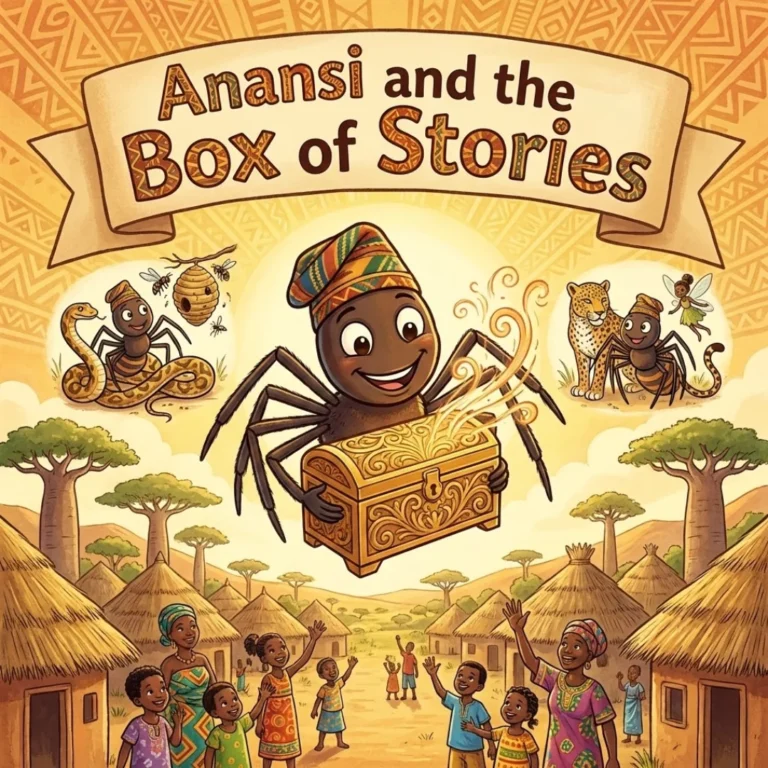
Now, Nyame kept this box close beside him in the sky, and whenever people wanted a story, they had to ask very nicely, and even then, he might say no.
Down on Earth lived Anansi the spider. Anansi wasn’t very big, and he wasn’t very strong, but oh, was he clever! His eight legs were always going in different directions, and his mind went even faster than that.
One evening, Anansi sat in his web watching the sunset. “You know what,” he said to himself (for Anansi often had the best conversations with himself), “it’s not fair that Nyame keeps all the stories. Stories should belong to everyone!”
So Anansi climbed up his strongest thread, all the way up to the sky. It took him three whole days, and by the time he reached Nyame’s palace, his legs were terribly tired.
Nyame sat on his throne, big as a mountain, bright as the sun. “Little spider,” he rumbled, “why have you come?”
Anansi bowed as low as a spider can bow. “Great Nyame, I wish to buy your box of stories.”
Nyame laughed, and his laugh shook the clouds. “Many have tried to buy my stories, Anansi. Warriors. Kings. Wise men. All failed. What could a tiny spider possibly offer me?”
“Name your price,” Anansi said, standing as tall as his little spider body could stand. “Whatever it is, I’ll pay it.”
Nyame smiled. He liked Anansi’s courage. “Very well. Bring me four things, and the stories are yours. First, bring me Onini the python who can swallow a goat whole. Second, bring me Osebo the leopard with teeth like knives. Third, bring me the Mmoboro hornets whose stings are like fire. And fourth,” Nyame paused, “bring me Mmoatia the fairy who no one can see.”
“Is that all?” Anansi asked cheerfully, though inside he was thinking this was quite impossible.
“That is all,” Nyame agreed.
Anansi climbed back down to Earth, his mind spinning faster than his web. How could a little spider catch such dangerous things?
First, he went to find Onini the python. The great snake lay coiled by the river, longer than ten men laid end to end.
“Good morning, Onini!” Anansi called out.
“Go away, spider,” Onini hissed. “I’m trying to sleep.”
“I just came to settle an argument,” Anansi said. “My wife says you’re longer than this bamboo pole I’m carrying. I said you’re shorter. Which of us is right?”
Onini’s eyes opened. “Shorter? I am certainly NOT shorter than a bamboo pole!”
“Prove it,” Anansi suggested.
Onini, proud as pythons are, stretched himself next to the pole. “See? I’m much longer!”
“Hmm,” Anansi said, pretending to look closely. “You keep scrunching up at the ends. Let me tie you to the pole so we can measure properly.”
Onini agreed, and Anansi tied him tight with spider silk—head, middle, and tail. “You’re absolutely right,” Anansi said. “You’re much longer! I’m taking you to Nyame now to prove it.”
Onini thrashed and hissed, but he was stuck tight.
Next, Anansi found Osebo the leopard. He dug a deep pit on the leopard’s favorite path and covered it with branches and leaves. When night fell, Osebo came prowling along and—CRASH—fell right in.
In the morning, Anansi peered into the pit. “Oh my, Osebo! Are you hurt?”
“Get me out of here, spider!” Osebo roared.
“Of course! Let me fetch a strong branch.” Anansi bent a young tree down into the pit. “Grab hold!”
When Osebo grabbed the branch with all four paws, Anansi quickly tied them together with spider silk. Then he pulled the leopard out and carried him off to the sky.
Two down, two to go!
The Mmoboro hornets lived in a nest high in a tree. Anansi filled a gourd with water and poured some over the hornets’ nest and some over himself. Then he covered his head with a banana leaf.
“It’s raining! It’s raining!” Anansi called to the hornets. “You’d better come into my gourd to stay dry!”
The hornets, who weren’t very clever, flew into the gourd one by one. As soon as the last hornet was inside, Anansi plugged the gourd with a cork. Their angry buzzing sounded like a tiny thunderstorm trapped in a bottle.
Three down, one to go!
Now, catching Mmoatia the fairy was the hardest task of all. No one could see her, so how could anyone catch her? Anansi thought and thought. Finally, he carved a wooden doll and covered it with sticky gum from a tree. He put a bowl of yam paste in front of the doll and hid nearby.
Mmoatia loved yam paste. She appeared out of nowhere, invisible but real, and took some paste. “Thank you!” she said to the doll.
The doll said nothing.
“I said thank you!” Mmoatia repeated, feeling cross. “Don’t you have any manners?”
Still the doll said nothing.
“How rude!” Mmoatia slapped the doll—and her hand stuck fast in the gum. She hit it with her other hand, and that stuck too. She kicked it with both feet, and those stuck as well. Soon she was completely trapped, visible now in her anger, stuck tight to the gum.
Anansi jumped out of hiding and wrapped her carefully in soft leaves so she wouldn’t be hurt. “I’m very sorry,” he said politely, “but Nyame has requested your presence.”
With all four prizes, Anansi climbed back up to the sky. His legs were even more tired than before, but his heart was light.
Nyame stared in amazement. “You actually did it. A python who could swallow you whole. A leopard who could tear you to pieces. Hornets who could sting you to death. A fairy no one can see. You caught them all?”
“With respect, great Nyame, not with strength. With thinking.”
Nyame nodded slowly. “You have paid the price, little spider. From this day forward, these stories are yours. They will no longer be called Nyame’s stories. They will be called Anansi stories.”
He handed the golden box to Anansi, who carefully carried it down to Earth. When he opened it, all the stories flew out like birds—thousands and thousands of them, spreading across the world. Stories of bravery and kindness, stories of foolishness and wisdom, funny stories and sad stories, old stories and new stories yet to be told.
And that, my dear friends, is why we tell stories today. Because a small spider named Anansi believed that stories belong to everyone, and he was clever enough to prove it.
So whenever you hear a story, remember: it might be big, it might be small, but it’s yours to share. Just like Anansi shared his box of stories with the whole wide world.
Moral of the Story
Wisdom and cleverness can accomplish what strength cannot. Stories belong to everyone and should be shared.
Frequently Asked Questions
What is the moral lesson of Anansi and the Box of Stories?
What age is this story appropriate for?
How long does it take to read Anansi and the Box of Stories?
What culture does this story come from?
Can I use this story for teaching?
Frequently Asked Questions
What is the story of Anansi and the Box of Stories about?
Anansi and the Box of Stories is a traditional West African folktale about Anansi the clever spider who travels to the sky to win all the world’s stories from Nyame, the sky god. It teaches children that wisdom and cleverness can achieve what strength and size cannot, and that stories belong to everyone.
Who is Anansi the spider?
Anansi is a beloved trickster spider from West African and Caribbean folklore, especially from the Akan people of Ghana. He is small and not physically strong, but he is incredibly clever and witty. Anansi uses his intelligence to outsmart gods, animals, and humans, making him one of the most popular characters in world mythology.
What is the Box of Stories in Anansi’s tale?
The Box of Stories is a golden, beautifully carved box belonging to Nyame, the sky god. It contains every story ever told in the world. Nyame keeps it close to him in the sky, only sharing stories on rare occasions. Anansi sets out to win this box so that stories can be freely shared with all people on Earth.
📚 Recommended Books
Handpicked for readers like you
As an Amazon Associate, we earn from qualifying purchases. These recommendations are personalized based on this story's themes and your reading history.
Is Anansi and the Box of Stories suitable for young children?
Yes, this story is perfect for young children. It uses simple, conversational language and a fun, adventurous plot that keeps kids engaged. It also carries gentle moral lessons about fairness, cleverness, and the value of storytelling, making it both entertaining and educational for early readers and bedtime listening.
What moral lesson does the Anansi story teach kids?
The key lesson in Anansi and the Box of Stories is that intelligence and determination matter more than size or strength. It also encourages children to believe that knowledge and stories should be shared with everyone, not kept by a few. Anansi’s bravery in challenging a god shows that even the smallest person can make a big difference.