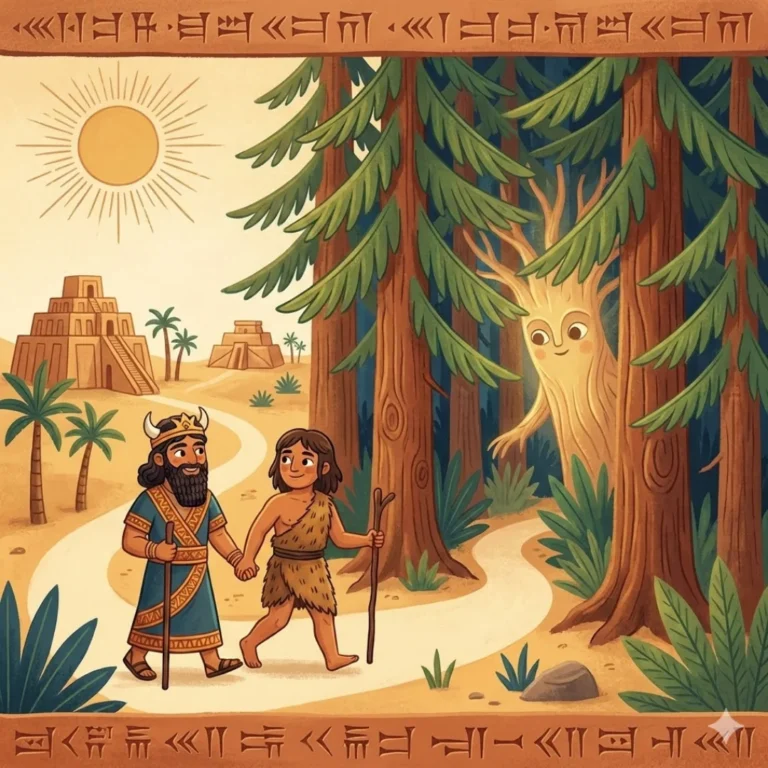
But strength alone does not make a king.
Gilgamesh sat on his throne of carved cedar wood, his arms crossed over his broad chest, staring out at his kingdom. The palace walls were tall and strong. The streets below buzzed with merchants and children and the bleating of goats. But the young king felt restless, like a caged lion pacing back and forth, back and forth.
“I need to do something great,” Gilgamesh announced to the empty throne room. His voice echoed off the stone walls. “Something people will remember forever. Something that will prove I am the greatest king who ever lived.”
But the throne room was silent. And being the strongest does not mean you are the wisest.
In those days, there lived in Uruk a wild man named Enkidu. He had once run with the gazelles and drunk from streams like a wolf. He had wrestled lions with his bare hands and slept under the stars. But the gods had sent him to the city to be a friend to Gilgamesh, to teach the proud king about friendship and kindness and things more important than fame.
Enkidu found Gilgamesh that morning, standing at the city gates, gazing at the distant mountains. The wild man’s footsteps were quiet as a cat’s, but Gilgamesh heard him coming.
“My friend,” said Gilgamesh, turning with a gleaming smile, “I have decided what we must do! We will journey to the Cedar Forest and cut down the sacred trees. We will bring back timber such as the world has never seen. Everyone will know the name of Gilgamesh!”
Enkidu’s face went pale as morning mist. His rough, calloused hands clenched into fists. “No, my brother. You must not. The Cedar Forest is protected by Humbaba the Terrible—Humbaba the Guardian, Humbaba whose breath is fire and whose roar is like a raging flood. The gods placed him there to guard the sacred cedars. No one may cut them down.”
But Gilgamesh laughed, throwing back his head. “I am afraid of nothing! What is this Humbaba to me? I am Gilgamesh the King! Come, my friend, let us prove our courage together!”
And so they prepared for the journey—the proud king and the wild man who had become his friend. They gathered weapons of bronze that shone like small suns in the morning light. They packed food and water in leather bags. They said prayers to Shamash, the sun god, asking for protection.
Gilgamesh’s mother, the wise goddess Ninsun, came to see them before they left. She wore robes as white as clouds, and her eyes held the sadness of mothers everywhere who watch their children go into danger.
“My son,” she said softly, placing her hand on Gilgamesh’s arm, “why do you seek this glory? You are already a great king. Why risk your life and the life of your friend?”
“Because I must, Mother,” Gilgamesh replied, though his voice was gentler now. “Because I must know if I am truly brave. Because my name must live forever.”
Ninsun sighed, a sound like wind through reeds. “Then go. But remember—true greatness is not measured in trees cut down or monsters slain. True greatness lives in how we treat those we love.”
But Gilgamesh did not understand. Not yet.
For seven days and seven nights, Gilgamesh and Enkidu journeyed across the burning desert and through the rocky hills. The sun beat down on them like a hammer on an anvil. Their lips cracked from thirst. Sand got into their eyes and between their teeth. But they did not turn back, did not turn back, did not turn back.
On the morning of the eighth day, they saw it—the Cedar Forest rising before them like a wall of green against the blue sky. The trees were ancient and massive, their trunks as wide as houses, their branches reaching up to touch the clouds. The air smelled of pine and earth and something wild and sacred.
“It’s beautiful,” Enkidu whispered, his voice full of wonder.
“It’s ours for the taking,” Gilgamesh declared, gripping his axe.
But as they entered the forest, the light changed. The shadows grew deeper and darker. The air grew cold despite the desert heat outside. And then they heard it—a sound like thunder rolling across mountains, like earthquakes shaking the foundations of the world.
Humbaba was coming.
The ground trembled beneath their feet. Birds exploded from the trees in clouds of panic. Small animals fled in every direction. And then he appeared—Humbaba the Guardian.
He was enormous, taller than three men standing on each other’s shoulders. His face was like twisted wood and ancient stone, with eyes that glowed like coals in a fire. His voice, when he spoke, made the very trees shake.
“WHO DARES ENTER MY FOREST?” The words crashed over them like waves.
Gilgamesh stepped forward, his chin raised high. “I am Gilgamesh, King of Uruk! I have come to take the sacred cedars!”
“Fool of a king! Fool of a man!” roared Humbaba. “I was set here by the gods themselves! Turn back now, or I will crush you like insects beneath my feet!”
Then the battle began—the battle fierce, the battle long, the battle that shook the mountains and made the rivers run backwards. Gilgamesh swung his mighty axe. Enkidu fought at his side, dodging and striking, striking and dodging. Humbaba breathed fire that scorched the earth. He roared winds that bent the great cedars like grass.
The fight raged for hours. Gilgamesh and Enkidu were bruised and bleeding, their arms growing weak, their breath coming in ragged gasps. But they fought as one—the king and the wild man, the proud warrior and the loyal friend, fighting side by side, back to back.
Finally, Enkidu struck a clever blow that knocked Humbaba off balance. The guardian fell to one knee, breathing heavily.
“Please,” Humbaba gasped, his terrible voice now quiet. “Spare me. I was only doing what the gods commanded. Let me live, and I will serve you. I will cut the cedars for you myself. I will be your servant forever.”
Gilgamesh lowered his axe, his chest heaving. He looked at Enkidu, and in his friend’s eyes he saw something—mercy, perhaps, or wisdom. For a moment, the king hesitated.
But then pride filled his heart again. “No,” Gilgamesh said coldly. “Dead guardians make better stories than living servants.” And he struck the final blow.
Humbaba fell, fell like an ancient tree crashing to the forest floor. As he died, his eyes found Gilgamesh’s face. “You have won your fame, King of Uruk,” the guardian whispered. “But fame comes with a price. You have killed the gods’ guardian. There will be consequences. There are always consequences.”
Gilgamesh and Enkidu cut down the sacred cedars. They built a great raft and floated the timber down the river to Uruk. The people cheered. They sang songs of Gilgamesh the Mighty, Gilgamesh the Brave, Gilgamesh who had defeated Humbaba.
But that night, as they celebrated in the palace, Enkidu could not smile. He sat quietly in the corner, his face troubled.
“What’s wrong, my friend?” asked Gilgamesh. “We have won! We are heroes!”
“Have we?” Enkidu replied softly. “Humbaba begged for mercy, and we showed him none. We killed the guardian the gods had placed there. We did this not because it needed to be done, but because you wanted fame. Is that truly heroic?”
For the first time, doubt crept into Gilgamesh’s heart. He looked at his friend—his loyal, brave friend who had followed him into danger, who had fought beside him, who had helped him win his great victory. And suddenly the victory felt hollow, like a drum with nothing inside.
“I… I wanted people to remember me,” Gilgamesh said quietly.
“They will remember you, my friend,” Enkidu said, placing a hand on the king’s shoulder. “But not because you cut down trees or defeated guardians. They will remember you because of how you treat your people. They will remember you because of the friends you keep and the kindness you show. Fame fades like morning dew. But friendship—true friendship—that lasts forever.”
And in that moment, Gilgamesh understood. He was the strongest king in the world, yes. The bravest, perhaps. But his greatest treasure was not his strength or his courage. It was not his fame or his great victory.
It was Enkidu. It was friendship. It was the bond between two souls who had faced danger together, who had fought side by side, who had learned to value each other more than glory.
From that day forward, Gilgamesh ruled Uruk with greater wisdom. He learned that being a king meant more than being strong. It meant being kind. It meant listening to friends. It meant understanding that some things—like friendship, like loyalty, like love—are worth more than all the fame in the world.
And when people told the story of Gilgamesh, they did not just speak of his strength or his victories. They spoke of his friendship with Enkidu, the bond that changed a proud king into a wise one, the love that taught him what truly matters.
For friendship is the greatest treasure, and loyalty the finest gold. And that, dear children, is a truth that lasts forever.
Moral of the Story
The bonds of friendship give meaning to our brief time on earth. True greatness is not measured in victories or fame, but in how we treat those we love and the friendships we cherish.
Frequently Asked Questions
What is the moral lesson of Gilgamesh and the Cedar Forest?
What age is this story appropriate for?
How long does it take to read Gilgamesh and the Cedar Forest?
What culture does this story come from?
Can I use this story for teaching?
Frequently Asked Questions
What is the story of Gilgamesh and the Cedar Forest about?
Gilgamesh and the Cedar Forest tells the tale of Gilgamesh, the mighty king of Uruk, who seeks glory and lasting fame by journeying to a legendary Cedar Forest. Along the way, he teams up with his friend Enkidu and faces powerful challenges that test not just his strength, but his wisdom and character.
Who is Gilgamesh and why is he so famous?
Gilgamesh is an ancient legendary king from Mesopotamia, the land between the Tigris and Euphrates rivers. He is famous for being two-thirds god and one-third man, possessing incredible strength and speed. His story is one of the world’s oldest written epics, making him a hugely important figure in world mythology and literature.
Is the Gilgamesh Cedar Forest story suitable for kids?
Yes, this retelling of the Gilgamesh Cedar Forest story is written in simple, engaging language designed for young readers. It brings the ancient epic to life in a fun, accessible way while gently exploring themes like friendship, ambition, bravery, and the difference between true greatness and simply being the strongest.
📚 Recommended Books
Handpicked for readers like you
As an Amazon Associate, we earn from qualifying purchases. These recommendations are personalized based on this story's themes and your reading history.
Who is Enkidu in the story of Gilgamesh?
Enkidu is a wild man sent by the gods to Uruk who becomes Gilgamesh’s closest companion. He once ran with animals and wrestled lions bare-handed. His friendship with Gilgamesh is central to the epic, as the two balance each other — Enkidu grounding the restless king and helping him grow beyond mere strength.
What lesson does Gilgamesh and the Cedar Forest teach?
The story teaches that true greatness comes from more than physical strength or power. Gilgamesh starts out restless and glory-hungry, but his journey teaches him that wisdom, friendship, and how you treat others matter far more than fame. It’s a timeless lesson that has resonated with readers for thousands of years.