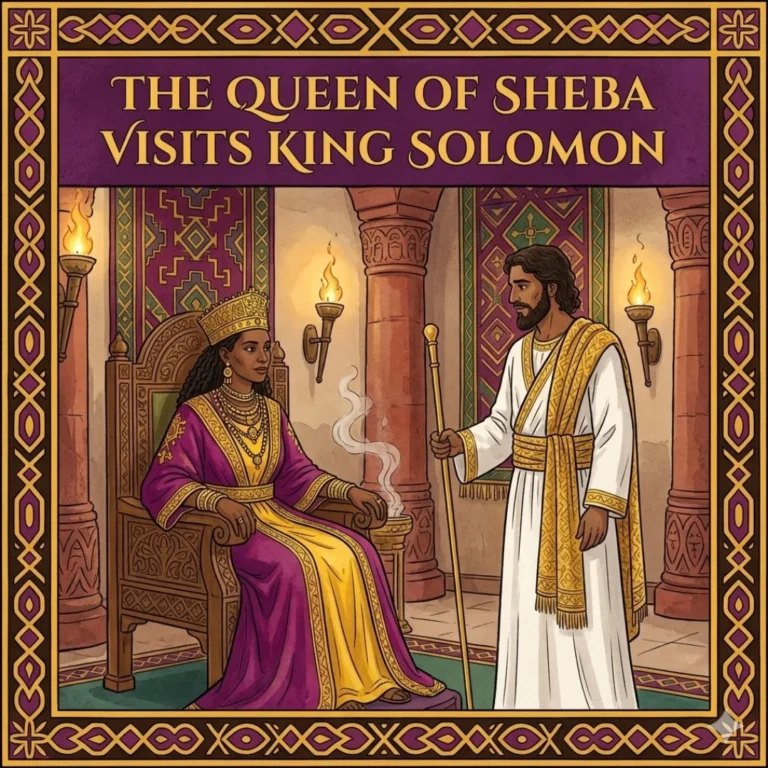
Long ago, in the magnificent kingdom of Ethiopia, there lived a queen whose fame had spread across the ancient world. Her name was Makeda, though most knew her as the Queen of Sheba, and she was renowned not only for her beauty and wealth but for her curious mind and love of learning.
One day, as she sat in her golden throne room surrounded by her advisors, a merchant arrived from the distant land of Israel with tales of King Solomon. “Your Majesty,” the merchant said, bowing low, “in Jerusalem there rules a king whose wisdom surpasses all others. They say he can answer any question and solve any riddle.”
The Queen raised one elegant eyebrow. “Any riddle?” she asked. “We shall see about that.”
Now, dear children, you must understand that Queen Makeda was a very intelligent woman, but she also had a problem that many clever people share: she was quite proud of her intelligence. She decided right then and there to journey to Jerusalem and test this King Solomon herself. If she could stump him with her puzzles, she would prove herself the wiser of the two.
For weeks, she prepared for her journey. She gathered the finest gifts: spices that filled entire rooms with their fragrance, gold that would take a hundred men to carry, and precious jewels that sparkled like captured stars. But most importantly, she prepared her most difficult riddles and puzzles.
“I shall ask him questions that have no answers,” she told her chief advisor, smiling confidently. “Then everyone will know that I am the wisest ruler in all the world.”
When Queen Makeda finally arrived in Jerusalem after her long journey, she was impressed despite herself. King Solomon’s palace was indeed magnificent, though perhaps not quite as grand as her own. The King himself was younger than she expected, with kind eyes that seemed to see more than most people’s eyes could see.
“Welcome, great Queen,” Solomon said warmly. “I have heard of your journey. They say you come with questions.”
“Indeed I do,” the Queen replied. “If you truly are as wise as people claim, you should be able to answer them all.”
She began with what she thought were impossible riddles. “What has no weight but can move mountains?” she asked.
“Words,” Solomon answered calmly. “Words can inspire people to move mountains of stone, or mountains of injustice.”
The Queen frowned slightly but continued. “What is it that you can give away completely yet still keep?”
“Knowledge,” Solomon replied. “When I teach you something, you gain it, but I do not lose it.”
Question after question, riddle after riddle, King Solomon answered them all. The Queen felt her cheeks growing warm with embarrassment. Her pride, which had been so tall and mighty, began to shrink like a flower without water.
Finally, she asked her most difficult question. “Very well, wise King. Tell me this: How can a person know if they are truly wise?”
Solomon was quiet for a long moment. The Queen leaned forward, certain she had finally stumped him. But when he spoke, his words surprised her more than any clever answer could have.
“That, great Queen,” he said with a gentle smile, “is a question I cannot fully answer. For the moment I claim to know all about wisdom, I prove I am a fool. A truly wise person knows how much they do not know.”
The Queen sat back, astonished. Here was the great King Solomon, admitting he did not know something! Instead of feeling victorious, she felt… curious.
“You could have invented an answer,” she said. “Why didn’t you?”
“Because, Your Majesty, the truth is more valuable than appearing clever,” Solomon replied. “I have learned many things in my life, but each day I discover how much more there is to learn. My wisdom comes not from knowing everything, but from knowing that I never will.”
In that moment, something changed in Queen Makeda’s heart. She realized that she had come to Jerusalem with the wrong goal. She had wanted to prove she was wiser than Solomon, but wisdom was not a competition to be won. It was a journey without end, and the wisest travelers were those who admitted they hadn’t reached the destination.
“King Solomon,” she said, and her voice was different now—softer, more humble, “I came here to test you, but you have taught me instead. I thought wisdom meant having all the answers, but you have shown me that sometimes wisdom means admitting you don’t.”
Solomon smiled. “And you have just demonstrated great wisdom yourself, for it takes a wise person to learn, and an even wiser one to change their mind.”
The Queen stayed in Jerusalem for many days, and she and Solomon shared their knowledge with each other. She taught him about the plants and animals of Ethiopia, about the stars as they appeared in her homeland, about the history of her people. He shared with her his understanding of justice, of building, of the patterns he saw in nature.
When she finally returned home, Queen Makeda was changed. She still asked questions and loved to learn, but she no longer needed to be the smartest person in every room. Instead, she sought out wise people throughout her kingdom—farmers who understood the earth, healers who knew the properties of plants, grandmothers who remembered the old stories.
“Teach me,” she would say to them, and they would share their knowledge gladly.
Her kingdom flourished as never before, because a queen who admits she doesn’t know everything is a queen who can learn from everyone. And the story of her journey to Jerusalem, and the wisdom she learned there, was told for generations—a reminder that the wisest people are not those who pretend to know everything, but those who are brave enough to say, “I don’t know, but I would like to learn.”
And so, dear children, remember: if you want to be truly wise like Queen Makeda and King Solomon, never be afraid to say those three magical words: “I don’t know.” For those words are not a sign of foolishness—they are the beginning of wisdom.
Moral: The wisest person is not one who knows everything, but one who knows the limits of their knowledge
Frequently Asked Questions
What is the moral lesson of The Queen of Sheba’s Wisdom Test?
What age is this story appropriate for?
How long does it take to read The Queen of Sheba’s Wisdom Test?
What culture does this story come from?
Can I use this story for teaching?
Frequently Asked Questions
What is the story of the Queen of Sheba’s wisdom test?
The Queen of Sheba’s wisdom test is a story about Queen Makeda of Ethiopia, who travels to Jerusalem to challenge King Solomon with riddles after hearing of his legendary wisdom. It explores themes of pride, intelligence, and humility as two great minds go head to head in a battle of wits.
Who was the Queen of Sheba in real life?
The Queen of Sheba is believed to be Queen Makeda, a ruler of ancient Ethiopia or possibly Arabia. She appears in historical and religious texts including the Bible, the Quran, and Ethiopian tradition. She was celebrated for her wealth, beauty, and remarkable intelligence.
What lesson does the Queen of Sheba wisdom story teach children?
The Queen of Sheba wisdom story teaches children that true wisdom includes humility. Being clever is a gift, but pride in your own intelligence can become a weakness. The story gently shows that even the smartest people can learn something new when they stay open-minded.
📚 Recommended Books
Handpicked for readers like you
As an Amazon Associate, we earn from qualifying purchases. These recommendations are personalized based on this story's themes and your reading history.
Why did the Queen of Sheba travel to visit King Solomon?
The Queen of Sheba decided to visit King Solomon after a merchant told her that Solomon could answer any question and solve any riddle. Proud of her own intelligence, she wanted to test him herself by bringing her most challenging puzzles to see if she could outsmart him.
Is the Queen of Sheba story suitable for kids?
Yes, the Queen of Sheba story is a great read for children. It is written in engaging, child-friendly language and draws on a fascinating historical legend. It delivers a meaningful moral about wisdom and humility in a way that is fun, accessible, and easy for young readers to understand.