

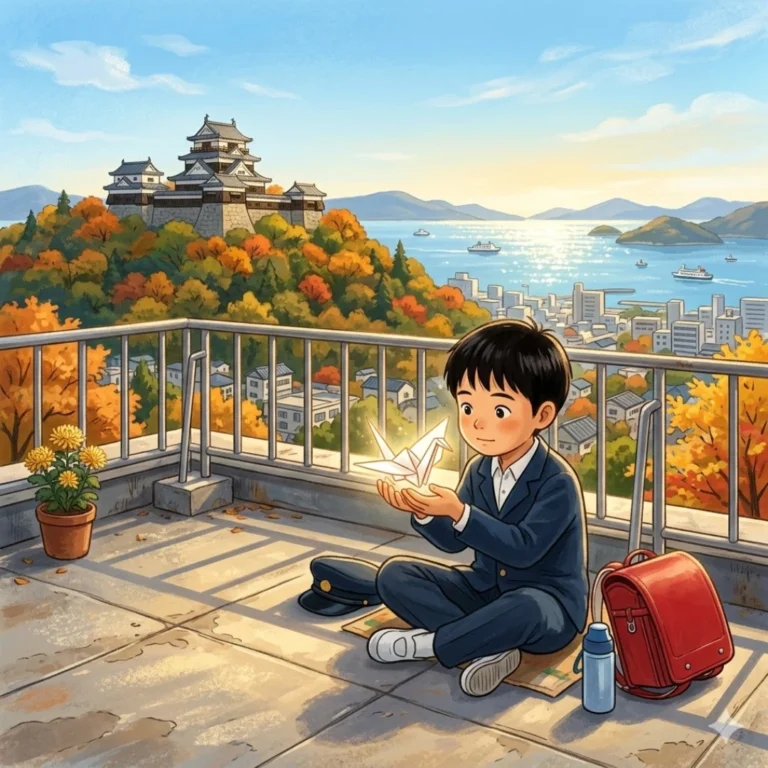
In the city of Matsuyama, where the castle sits on the hill like a white heron and the Seto Inland Sea lies beyond the town in shifting silver, there was a boy called Kenji who could fold paper cranes that almost breathed.
This was not hyperbole. When Kenji finished a crane – white or red or the pale gold of autumn ginkgo leaves – it held something that other people’s cranes didn’t hold: a quality of potential, of being on the edge of motion. His teacher said it was because he breathed carefully when he folded, and his grandmother said it was because he paid attention, which she said was the same thing in different words.
He was ten years old, and he had a problem that was about to become a larger problem.
The problem was this: he had entered the school’s origami contest, and he had won second place, and the first place had gone to Haruto, and Haruto had cheated.
Not dramatically cheated. Haruto had copied his winning crane design directly from a master origami artist’s published pattern without crediting it, which the contest rules prohibited clearly. The design was beautiful. The execution was good. The attribution was missing. This was not Haruto’s original work.
Kenji knew this because he had the same book at home and had studied the same master’s work.
Haruto was his friend. Had been his friend since they were six. They ate lunch together every day and walked home together on Tuesdays and Thursdays and Haruto had been the one who had sat with Kenji for three days straight when his grandfather was sick last winter.
Kenji held this knowledge for a week, turning it over the way you turn a stone in a stream, seeing what’s underneath.
The cranes he folded that week came out wrong. Not technically wrong – the folds were crisp, the proportions correct – but wrong in the way that his grandmother would notice, the way that made them sit still rather than on the edge of motion.
“What is this?” his grandmother asked, holding a recent crane up to the window light.
“A crane,” said Kenji.
“It is the shape of a crane.” She set it down. “Where did the breathing go?”
He told her. The whole of it.
His grandmother – Obāchan, who had lived eighty-one years and outlasted three political regimes and one major earthquake and the deaths of people she loved and had emerged from all of it still curious and still kind – listened without interrupting, which she was very good at.
When he finished, she was quiet for a moment, looking at the still crane on the table.
“You feel responsible,” she said. Not a question.
“I don’t know what to do. He’s my friend.”
“Yes. These two things are true at the same time.” She folded her hands. “What do the cranes say?”
“The cranes?”
“You breathe into them. They hold something. When they hold nothing, it is because something is in the way.” She looked at him steadily. “What is in the way?”
Kenji thought about the week of flat cranes. He thought about what he was holding in his chest that shouldn’t be there. He thought about Haruto.
“I need to tell him what I know,” he said. “Not the teacher. Haruto first.”
“That seems right,” said Obāchan.
“He’ll be angry.”
“He might be. Being told a true thing sometimes feels like being pushed.” She picked up the flat crane. “But a pushed person can find their footing again. A person who is told only what they want to hear is walking on ground that isn’t there.”
Kenji found Haruto the next morning before school, at the corner where they met on Tuesdays.
He told him directly, without preamble, which was not his natural style but seemed necessary.
Haruto’s face went through several things very quickly. Shock. Then something that looked like the beginning of anger. Then – Kenji watched this happen – something more complicated. A kind of sinking.
“You knew the whole time,” Haruto said.
“A week.”
“And you didn’t -” He stopped. He looked at the road. “Why are you telling me and not the teacher?”
“Because you’re my friend. And because friends tell each other true things.” He paused. “What you do with it now is yours to decide.”
Haruto didn’t speak for a long moment. Then: “It was a stupid thing to do. I panicked. I thought my own design wasn’t good enough and the contest was the next day and I – I panicked.”
“Your own designs are good,” said Kenji.
“You didn’t see what I was going to submit.”
“I’ve seen what you make when you’re not panicking.”
Another silence. A crow landed on the power line above them and regarded them with professional crow interest.
Haruto went to the teacher himself. That afternoon. He returned the first-place ribbon and explained, concisely and without making excuses, what had happened. The teacher listened, reassigned the ribbon to second place (which became first), and gave Haruto an additional assignment: a presentation on the origami master whose work he had copied, which turned out to be genuinely interesting.
Haruto was embarrassed for two weeks. During those two weeks, Kenji ate lunch with him every day, which Haruto later said was either the most comforting or the most annoying thing, he couldn’t tell which.
The crane Kenji folded that evening came out right. He could feel it in the paper – that quality of being about to lift, about to go.
He set it on the windowsill where the afternoon light came through, and it sat in the light and almost breathed, the way his good cranes did, and he thought about how strange it was that honesty could be felt in folded paper, that the things held inside came out in the hands.
Outside, the Seto Sea lay silver under the autumn sky, and the herons flew low over the water, and the light was honest and clear, the way light is when you have stopped carrying what belongs to someone else.
The Moral of This Story
An honest word costs nothing and buys everything that matters
About This Story’s Culture
Origami (paper folding) is a central Japanese art form with deep cultural significance. The paper crane (orizuru) is the most iconic origami form in Japan, associated with longevity and good fortune through the legend that folding 1,000 cranes grants a wish. The story is set in Matsuyama, the capital of Ehime Prefecture on Shikoku island, known for its hilltop castle and proximity to the Seto Inland Sea. Miyazawa Kenji (the author persona) was a real early 20th-century Japanese poet and author known for his nature-spirit stories, including Night on the Galactic Railroad. The name Obāchan is the authentic informal Japanese word for grandmother. The cultural value of meiwaku (causing trouble to others) and the difficulty of honest confrontation in Japanese social culture are authentically represented.
Key Story Elements
- Kenji – a ten-year-old paper-folder whose cranes ‘almost breathe’ when he’s at peace
- Haruto’s plagiarism – a panic-driven mistake, not malice, complicating the moral choice
- Obāchan’s wisdom: flat cranes as an indicator that something is blocking the breathing
- Miyazawa’s nature-spirit style: the crane as a vessel for inner honesty, light as clarity
- Kenji going to Haruto first – friend before authority, honesty as an act of love
- Haruto’s self-reporting to the teacher – honesty enabled by being first given a safe space to hear it
- The crow on the power line watching with professional interest – Miyazawa’s animal observers
Frequently Asked Questions
What is The Paper Crane’s Secret story about?
The Paper Crane’s Secret is a Japanese-inspired children’s story about a ten-year-old boy named Kenji who discovers his classmate cheated in a school origami contest. The story explores themes of honesty and doing the right thing, even when it feels difficult. It’s written for kids aged 6 to 12 and takes about 8 to 10 minutes to read.
What is the moral lesson of The Paper Crane’s Secret?
The main moral lesson of The Paper Crane’s Secret is honesty. The story guides young readers through what it feels like to witness unfairness and have to decide whether to speak up. It gently encourages children to value truth and integrity, even when staying silent might seem easier.
Is The Paper Crane’s Secret based on Japanese tradition?
Yes, the story is rooted in Japanese tradition and is set in the real city of Matsuyama, Japan. It draws on the cultural significance of origami and paper cranes in Japanese culture, making it a great way for children to enjoy a values-based story while also learning about Japanese heritage.
📚 Recommended Books
Handpicked for readers like you
As an Amazon Associate, we earn from qualifying purchases. These recommendations are personalized based on this story's themes and your reading history.
What age group is this paper crane story suitable for?
The Paper Crane’s Secret is recommended for children aged 6 to 12. The language is rich but accessible, and the emotional themes around fairness, honesty, and doing what’s right are perfectly matched to this age group’s growing moral understanding.
How long does it take to read The Paper Crane’s Secret?
The Paper Crane’s Secret takes approximately 8 to 10 minutes to read, making it a great choice for a bedtime story or a short classroom reading session. It’s long enough to develop a meaningful story but short enough to hold a child’s attention from start to finish.
