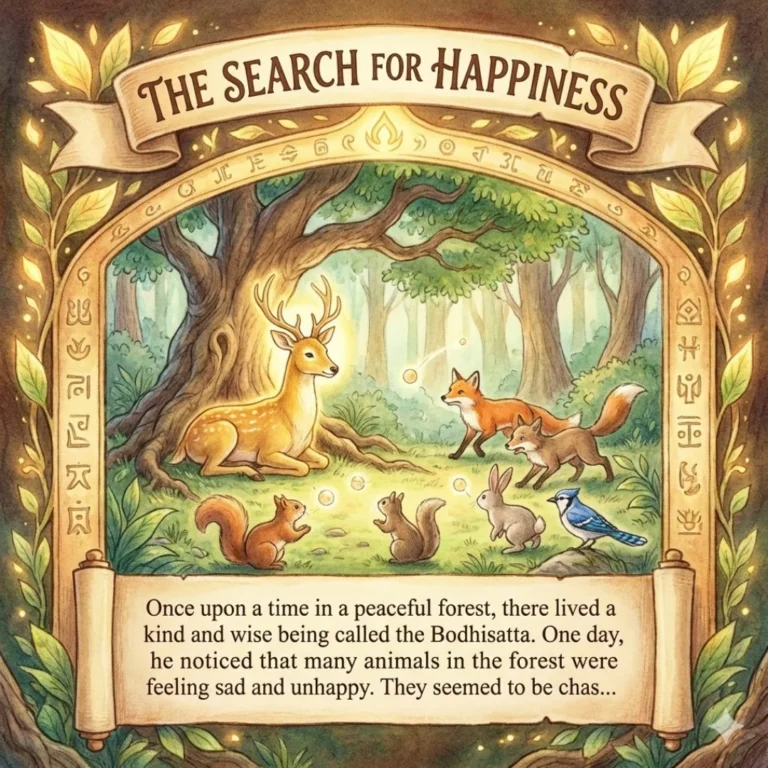
This bedtime story for kids, ‘The Search for Happiness’, teaches children ages 6-12 about important moral values.
In a time before the Buddha’s final enlightenment, when he was still journeying through countless lifetimes perfecting the qualities needed for Buddhahood, the Bodhisattva was born into the animal realm as a noble golden deer with wisdom/” title=”More stories about wisdom”>wisdom that surpassed many humans.
This golden deer lived in a vast forest that stretched across ancient India, a forest teeming with life – monkeys chattering in the canopy, peacocks displaying their magnificent tails, elephants rumbling through clearings, and countless other creatures making their homes among the trees. The forest should have been a paradise, yet the Bodhisattva noticed something troubling: despite the abundance of food and water, the animals were not at peace. They fought constantly, hoarding resources, attacking each other, living in perpetual fear and anxiety.
One day, the Bodhisattva climbed to a high clearing on a hillside where an ancient banyan tree spread its vast canopy. From this vantage point, he could observe the entire forest ecosystem. What he witnessed filled his great heart with compassion.
A family of monkeys fought viciously over a mango tree, though there were mangoes enough for all. A group of wild boars trampled smaller creatures in their rush to reach a watering hole. Birds built nests, only to have them destroyed by rivals. Deer herds split into factions, suspicious of each other. Everywhere he looked, the Bodhisattva saw beings creating their own suffering through greed, hatred, and ignorance.
The golden deer settled into meditation beneath the banyan tree, his mind becoming still and clear as a mountain lake. In this clarity, he began to perceive the invisible chains that bound all these creatures in suffering – a complex web of cause and effect that perpetuated misery generation after generation.
“How strange,” the Bodhisattva reflected with infinite compassion. “These beings seek happiness, yet their very actions ensure they remain trapped in suffering. They cannot see the chains they forge themselves.”
Just then, a council of animals gathered at the base of the hill – the leaders of different species, brought together by drought and depleting resources. The tiger spoke first, growling: “We must drive out the weaker animals. Only the strong deserve the forest’s bounty.”
A cunning jackal added, “We should hoard all food we find. Who knows when we’ll eat again? Every creature for itself!”
An old elephant, worn by years, sighed deeply. “I remember when this forest knew peace. But now I see only conflict. Perhaps this is simply the way things must be.”
The Bodhisattva descended from his meditation spot, his golden coat shimmering in the filtered sunlight. The animals fell silent, awed by his presence. Even the aggressive tiger felt an unusual calm in the deer’s presence.
“Noble creatures,” the Bodhisattva began, his voice carrying the weight of wisdom accumulated over countless lifetimes, “I have been observing our forest, and I wish to share what I have understood. May I speak?”
The animals, struck by something in his manner – a quality of peace they themselves sought but could not grasp – nodded for him to continue.
“You are all suffering,” he said gently. “Even those among you who seem successful, who have the most territory or the most food, suffer from fear of losing what you have. Those who have little suffer from wanting more. Those who have been hurt suffer from anger and desire for revenge. And so the wheel turns endlessly, suffering creating more suffering. But have you ever asked yourselves why this is? Why, in a forest of plenty, do we find only scarcity? Why, when we all seek happiness, do we find only pain?”
A young monkey spoke up, “That’s just how life is! We suffer because the world is cruel.”
The Bodhisattva shook his head kindly. “No, dear friend. We suffer because we do not understand the true nature of our suffering. Let me explain what I have seen.”
He gestured for all to sit, and even the fierce predators found themselves settling down, drawn by something in the golden deer’s presence – a promise of understanding they had long sought.
“All suffering,” the Bodhisattva began, “arises from a chain of causes, like links connected one to another. The first link is ignorance – not understanding the true nature of reality. Because we are ignorant, we form mental patterns and habits (the second link) that shape how we see the world.
“These mental formations create our consciousness (the third link) – the way we experience and interpret everything around us. This consciousness gives rise to our mind and body (the fourth link), which develop the six sense doors (the fifth link) – eyes, ears, nose, tongue, body, and mind – through which we contact the world.
“Through these six senses, we experience contact with objects (the sixth link). This contact produces feelings (the seventh link) – pleasant, unpleasant, or neutral sensations. And here is where the crucial moment occurs: we experience these feelings with craving (the eighth link) – we desperately want pleasant feelings to continue and unpleasant feelings to stop.
“This craving leads to clinging (the ninth link) – grasping at what we want, pushing away what we don’t want, holding tightly to our views and sense of self. This clinging creates the conditions for becoming (the tenth link) – the perpetuation of our patterns and the creation of new karma that binds us to future suffering.
“This becoming leads to birth (the eleventh link) – not just physical birth, but the continuous birth of new states, new problems, new conflicts. And wherever there is birth, there must inevitably be aging and death (the twelfth link) – the end of what we’ve clung to, bringing sorrow, pain, and despair.”
The animals listened in growing wonder. The Bodhisattva was describing the very patterns they lived every day, yet had never clearly seen.
A wise old owl hooted thoughtfully, “But Golden Deer, if we are all trapped in this chain, is there no escape? Are we condemned to suffer forever?”
The Bodhisattva’s eyes shone with compassion and certainty. “This is the wonderful news I bring! Just as suffering arises from causes, suffering can cease when those causes are removed. The chain can be broken!”
“When ignorance is removed through wisdom – through truly understanding the nature of reality – the mental formations based on ignorance cease. When mental formations cease, consciousness is no longer distorted. When consciousness is pure, mind and body function properly. When mind and body are in harmony, the sense doors operate without generating craving. When there is no craving, there is no clinging. When there is no clinging, there is no becoming. When there is no becoming, there is no birth. When there is no birth, there is no aging and death. And thus, suffering ceases!”
A young deer asked, “But how do we remove ignorance? How do we gain this wisdom?”
The Bodhisattva smiled warmly. “By looking clearly at reality as it truly is. Notice that everything changes constantly – nothing is permanent. The mango you fought over yesterday is already rotting. The territory you defend so fiercely will belong to another in a few seasons. Even your own bodies are constantly changing, constantly aging.
“Notice also that everything is interconnected. The fruit depends on the tree, the tree on the soil, the soil on the rain, the rain on the wind, the wind on the sun. Nothing exists independently. You, dear creatures, depend on each other far more than you realize. When the strong eliminate the weak, they eliminate part of the web that sustains them.
“And notice that what you think of as ‘yourself’ – this solid, unchanging self you defend so vigorously – is actually just a collection of ever-changing processes: sensations, thoughts, emotions, all arising and passing like waves on the ocean.”
An aggressive tiger, who had been listening skeptically, growled, “So what do you suggest we do? Just give up? Let others take what is ours?”
“Not at all,” the Bodhisattva replied. “I suggest something far more revolutionary: cooperation, generosity, and loving-kindness. When you hoard food, you create scarcity. When you share food, you create abundance – not just of resources, but of trust, friendship, and mutual support.
“When you attack others out of fear, you create enemies and perpetuate the cycle of violence. When you extend compassion even to those who have harmed you, you break that cycle. You free yourself from the chain of cause and effect that binds you to suffering.
“This is not weakness – this is wisdom. This is not foolishness – this is understanding cause and effect more deeply than those who rely on force and cunning.”
To demonstrate his teaching, the Bodhisattva made a proposal: “Let us try an experiment. For the next full moon cycle, let us share resources rather than hoard them. Let us protect all creatures in the forest, not just our own species. Let us meet conflicts with understanding rather than aggression. And then let us see: Does suffering increase or decrease?”
Moved by his wisdom and the undeniable logic of his explanation, the animals agreed. The tiger and the deer who would normally be enemies agreed to a truce. The monkeys shared their mango trees. The elephants used their strength to help smaller animals reach water safely. The birds warned all creatures of danger, not just their own kind.
Something miraculous began to happen. As the Bodhisattva had predicted, when greed decreased, abundance appeared. When fear decreased, peace emerged. When hatred decreased, friendship grew. The animals began to experience a happiness they had never known – not the temporary pleasure of satisfying a desire, but a deeper contentment that came from living in harmony with reality rather than fighting against it.
A young rabbit, who had lived her entire life in fear, approached the Bodhisattva with tears in her eyes. “Golden Deer, for the first time in my life, I feel safe. I can eat without constantly watching for predators. I can sleep without nightmares. How is this possible?”
The Bodhisattva touched his nose gently to hers. “It is possible because you and your fellow creatures have begun to understand the truth of interdependence. You have begun to see that your happiness is connected to the happiness of all beings. You have begun to break the chains of ignorance, craving, and hatred that create suffering.
“Remember this always: True happiness does not come from taking from others, but from giving to others. It does not come from satisfying every desire, but from understanding that permanent satisfaction through external things is impossible. It comes from wisdom, from ethics, from compassion, from living in harmony with the way things truly are.”
The Bodhisattva continued to dwell in that forest for many years, teaching any creature who came to him. He explained the Four Noble Truths – that suffering exists, that it has a cause, that it can end, and that there is a path to end it. He taught about loving-kindness that extends to all beings without exception, compassion that wishes for the end of all suffering, joy in others’ happiness, and equanimity in the face of life’s ups and downs.
Eventually, the golden deer’s physical form grew old and died, as all forms must. But the wisdom he had shared continued to transform the forest. The animals remembered his teachings and passed them to their offspring. The forest became known across the land as a place of unusual harmony – a place where predator and prey had learned to coexist with wisdom and compassion.
And the Bodhisattva? His journey through countless lives continued, accumulating the merit and wisdom that would, in his final birth as Prince Siddhartha, lead to complete enlightenment under the Bodhi tree. But in each life, whether as animal, human, or divine being, his purpose remained constant: to understand suffering deeply and to teach the path to liberation to all who would listen.
For the Bodhisattva knew what he would later teach as the Buddha: that all beings, without exception, have the potential for awakening. All beings seek happiness and wish to avoid suffering. And all beings are caught in the same chains of ignorance, craving, and aversion – chains that can be broken through wisdom, ethics, and compassionate awareness.
The story spread beyond that forest, told and retold as one of the Jataka tales – stories of the Buddha’s previous lives. And its message continues to resonate: that true liberation comes not from fulfilling every desire or defeating every enemy, but from understanding the very nature of suffering and choosing, with wisdom and compassion, to break the chains that bind all beings to the wheel of suffering.
Moral Lessons
- True happiness and liberation from suffering come from understanding the causes of suffering – particularly craving, ignorance, and hatred – and from cultivating their opposites: wisdom, generosity, and loving-kindness toward all beings. We create our own suffering through our minds, and we can end it through transforming our minds.
Test Your Understanding
1. What is a Bodhisattva?
Frequently Asked Questions
What is the moral lesson of The Search for Happiness?
What age is this story appropriate for?
How long does it take to read The Search for Happiness?
What culture does this story come from?
Can I use this story for teaching?
Frequently Asked Questions
Is The Search for Happiness a good bedtime story for kids?
Yes, this is specifically designed as a bedtime story for kids ages 6-12. It teaches valuable moral lessons about finding true happiness through wisdom and compassion, making it perfect for bedtime reading that both entertains and educates children.
What age group is this moral story for children appropriate for?
This moral story for children is ideal for ages 6-12. The content is age-appropriate with gentle themes about animals in a forest, avoiding scary elements while still delivering meaningful lessons about happiness and inner peace.
What is the main lesson kids learn from this story?
Children learn that true happiness doesn’t come from having more things or fighting with others. The story teaches that real contentment comes from wisdom, kindness, and understanding – values that help create peace in our hearts and communities.
📚 Recommended Books
Handpicked for readers like you
As an Amazon Associate, we earn from qualifying purchases. These recommendations are personalized based on this story's themes and your reading history.
Who are the main characters in The Search for Happiness?
The main character is the Bodhisattva, who appears as a wise golden deer living in an ancient Indian forest. The story also features various forest animals like monkeys, peacocks, and elephants who are struggling to find happiness.
What makes this different from other animal stories for kids?
This story combines engaging animal characters with deep Buddhist wisdom in a way children can understand. It’s not just about talking animals – it explores profound questions about what really makes us happy while remaining gentle and appropriate for young readers.