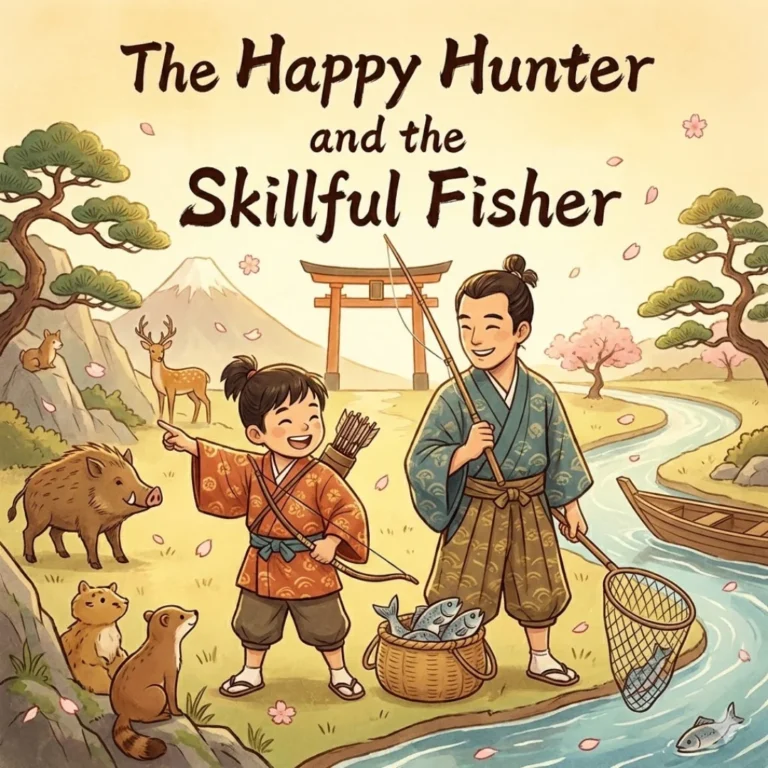
This bedtime story for kids, ‘The Happy Hunter and the Skillful Fisher’, teaches children ages 6-12 about important moral values.
Long ago in the divine age of Japan, when gods still walked among mortals, there lived two brothers who were grandsons of the sun goddess Amaterasu herself. These were no ordinary men, for divine blood flowed in their veins.
The elder brother was named Hoderi, which means “Fire-Shine.” He was blessed with Umisachi—Sea Luck—and spent his days fishing in the ocean. Whatever waters he cast his hook into, fish would come eagerly to be caught. His fishing hook was his most precious possession, for with it, he never failed to bring home a bountiful catch.
The younger brother was named Hoori, which means “Fire-Fade.” He was blessed with Yamasachi—Mountain Luck—and spent his days hunting in the forests and mountains. Whatever prey he sought, his arrows would find their mark. With his bow, he provided his family with game from the hills.
The brothers lived in peace, each content with his own calling. But one day, Hoori grew curious about his brother’s life upon the sea.
“Elder brother,” Hoori said, “let us exchange our tools for one day. I would like to try fishing in the sea, and perhaps you might enjoy hunting in the mountains.”
Hoderi was reluctant. “Our tools are precious to us, younger brother. Your bow was given to you by the gods for hunting. My fishing hook has never failed me. It would not be wise to exchange them.”
But Hoori persisted, asking again and again, until finally Hoderi agreed. “Very well,” he said. “But take great care with my fishing hook. It has been in our family for generations and brings me all my luck.”
“I will guard it as carefully as my own life,” Hoori promised.
And so they exchanged their tools. Hoderi took his younger brother’s bow and arrows and headed into the mountains. Hoori took the precious fishing hook and went down to the sea.
But the exchange was a disaster. Hoderi, who had Sea Luck, could not catch even one animal on land. The beasts sensed he did not belong in their domain and fled before him. He returned home exhausted and empty-handed.
Hoori fared even worse. Despite his Mountain Luck, he had no skill with the sea. He cast the line again and again, but the fish would not bite. Frustrated and ashamed, he pulled the line too hard—and the ancient fishing hook slipped off and sank into the depths of the ocean.
Hoori dove into the water, searching desperately, but the hook had vanished into the vastness of the sea. When the sun began to set, he returned to shore, his heart heavy with dread.
That evening, the brothers met again. Hoderi immediately asked for his precious fishing hook back.
“Elder brother,” Hoori said, his voice trembling, “I have suffered a terrible misfortune. Your fishing hook—it has been lost in the sea. I searched and searched, but I could not find it.”
Hoderi’s face grew dark with anger. “You lost my ancestral hook? The one I warned you to guard carefully? You foolish boy! Return it to me at once!”
“I will make you a new one,” Hoori offered desperately. He took his sword and broke it into pieces, forging five hundred new hooks. “Please, take these in place of the one I lost.”
But Hoderi pushed them away. “I do not want these new hooks. I want my own hook back—the one that has brought me luck since before you were born!”
Hoori forged a thousand more hooks, but still Hoderi refused them all. “I want my original hook and no other!”
Heartbroken and ashamed, Hoori walked along the beach, weeping. He did not know what to do. How could he possibly find one small hook in the vast ocean?
As he sat by the shore, an old man appeared before him. This was Shiotsuchi-no-Oji, the Old Man of the Tides, a sea kami who had taken pity on the young prince.
“Why do you weep, grandson of the sun goddess?” the old man asked.
Hoori told him the whole story—the exchange, the loss of the hook, his brother’s anger, and his own despair.
“I know where your brother’s hook might be,” said the Old Man of the Tides. “Come with me.” He built a small boat woven so tightly that water could not enter it. “Get in this boat, and it will take you to the palace of Ryujin, the Dragon King who rules the sea. There you may find what you seek.”
The boat carried Hoori down through the waters, deeper and deeper, until he reached a magnificent palace made of coral and pearl. This was the undersea realm of the Dragon King. At the palace gate stood a cassia tree with spreading branches, and Hoori climbed into it to wait.
Soon, a beautiful maiden came out to draw water from the well. This was Toyotama-hime, the Luminous Pearl Princess, daughter of the Dragon King. She looked into the well and saw the reflection of a handsome young man in the tree above. Looking up, their eyes met, and in that instant, both felt their hearts catch.
Toyotama-hime hurried back to her father. “Father! There is a noble man sitting in our cassia tree, more handsome than any I have ever seen!”
The Dragon King came out to greet Hoori. When he learned that his visitor was the grandson of Amaterasu, the sun goddess, he received him with great honor. “You are most welcome in my realm,” Ryujin said.
The Dragon King offered Hoori his daughter’s hand in marriage, and Hoori, who had fallen in love with Toyotama-hime at first sight, accepted joyfully. They celebrated their wedding in the palace under the sea, and Hoori lived there in happiness, forgetting for a time the trouble that had brought him there.
Three years passed like three days in that enchanted realm. But one day, Hoori sighed deeply, remembering his brother’s anger and the lost fishing hook.
Toyotama-hime heard him sigh. “My husband, why do you sigh? In all our time together, I have never heard you make such a sad sound.”
Hoori told her about the lost hook and his brother’s refusal to accept any substitute. “I cannot return to the land above until I find it,” he said.
Toyotama-hime went to her father, and the Dragon King summoned all the fish of the sea. “Does anyone know of a fishing hook that was lost three years ago?”
The fish looked at each other until one said, “The tai fish has been complaining lately about something stuck in his throat. Perhaps that is what you seek?”
They brought the tai fish forward and looked in its mouth—and there was the hook! The Dragon King gave it to Hoori, and he also gave him two precious jewels: the Tide-Flowing Jewel and the Tide-Ebbing Jewel.
“These jewels control the tides,” the Dragon King explained. “If your brother treats you badly when you return, use the Tide-Flowing Jewel to bring the waters up and cause him distress. When he begs for mercy, use the Tide-Ebbing Jewel to make the waters recede. In this way, you will make him respect you.”
Hoori thanked the Dragon King and said farewell to his beloved wife, who was now pregnant with his child. “I will return to you,” he promised. Then he rode upon the back of a great crocodile that carried him back to the land above.
When Hoori returned to his brother’s house, he offered the hook with both hands. “Elder brother, I have found your hook. Please forgive the delay.”
But Hoderi, who had grown bitter during the three years of his brother’s absence, sneered at him. “Three years to find one hook? You are useless! You should never have returned!”
Then Hoori remembered the Dragon King’s gift. As his brother continued to mock him, Hoori held up the Tide-Flowing Jewel. Immediately, the sea began to rise. Water rushed inland, flooding Hoderi’s house and fields.
“Stop! Stop!” Hoderi cried, struggling in the rising waters. “I beg you, younger brother! Show mercy!”
Only then did Hoori use the Tide-Ebbing Jewel, and the waters receded. From that day forward, Hoderi served his younger brother and never again treated him with disrespect.
Hoori became a great leader of his people, and he never forgot his wife in the sea palace. When their child was due to be born, Toyotama-hime came onto land to give birth, making Hoori promise not to look at her while she delivered the child.
But Hoori’s curiosity overcame him, and he peeked—only to see that Toyotama-hime had transformed into a great dragon during childbirth. Ashamed that he had seen her true form, she left their child with him and returned to the sea, never to come back to land again.
The child they had together grew up to be a great warrior. His son, in turn, became the first Emperor of Japan, Jimmu. And so the imperial line of Japan traces its ancestry back through Hoori to the Dragon King of the sea and upward to Amaterasu, the sun goddess herself—a bloodline that connects heaven, earth, and sea.
The story of the two brothers reminds us that each person has their own path and their own gifts. To stray from your true calling brings misfortune. But it also teaches that mistakes can lead to unexpected blessings, for if Hoori had not lost the hook, he would never have journeyed to the sea palace, never have met his beloved wife, and never have fathered the line of emperors.
Moral Lessons
- Each person has their own unique gifts and calling. Straying from your path may lead to hardship, but sometimes our mistakes lead us to our destiny. Respect what others value, and take responsibility when you fail in your promises.
Test Your Understanding
1. What was Orpheus famous for?
Frequently Asked Questions
What is the moral lesson of The Happy Hunter and the Skillful Fisher?
What age is this story appropriate for?
How long does it take to read The Happy Hunter and the Skillful Fisher?
What culture does this story come from?
Can I use this story for teaching?
Frequently Asked Questions
What is ‘The Happy Hunter and the Skillful Fisher’ bedtime story about?
This Japanese moral story follows two divine brothers – Hoderi (the fisher) and Hoori (the hunter) – who are grandsons of sun goddess Amaterasu. When they exchange their tools out of curiosity, it leads to important lessons about respecting others’ gifts and responsibilities.
Is this story appropriate for children ages 6-12?
Yes, this bedtime story is specifically designed for kids ages 6-12. It features mythological elements that spark imagination while teaching valuable moral lessons about family, respect, and understanding different talents in an age-appropriate way.
What moral values does this Japanese story teach kids?
The story teaches children about appreciating different talents, respecting others’ skills, and understanding that everyone has unique gifts. It also emphasizes the importance of family relationships and being content with your own abilities rather than envying others.
📚 Recommended Books
Handpicked for readers like you
As an Amazon Associate, we earn from qualifying purchases. These recommendations are personalized based on this story's themes and your reading history.
Are Hoderi and Hoori real characters from Japanese mythology?
Yes, they are authentic figures from Japanese Shinto mythology. Hoderi and Hoori appear in ancient texts as divine beings with special powers – one blessed with sea luck for fishing, the other with mountain luck for hunting.
What happens when the brothers switch their fishing and hunting tools?
When curious Hoori asks to exchange tools with his brother Hoderi, it sets off a chain of events that teaches both brothers valuable lessons about their unique talents and the importance of staying true to their own gifts.